Yinson Brand Guidelines
A Johor Bahru transport agency that went offshore.
Aa
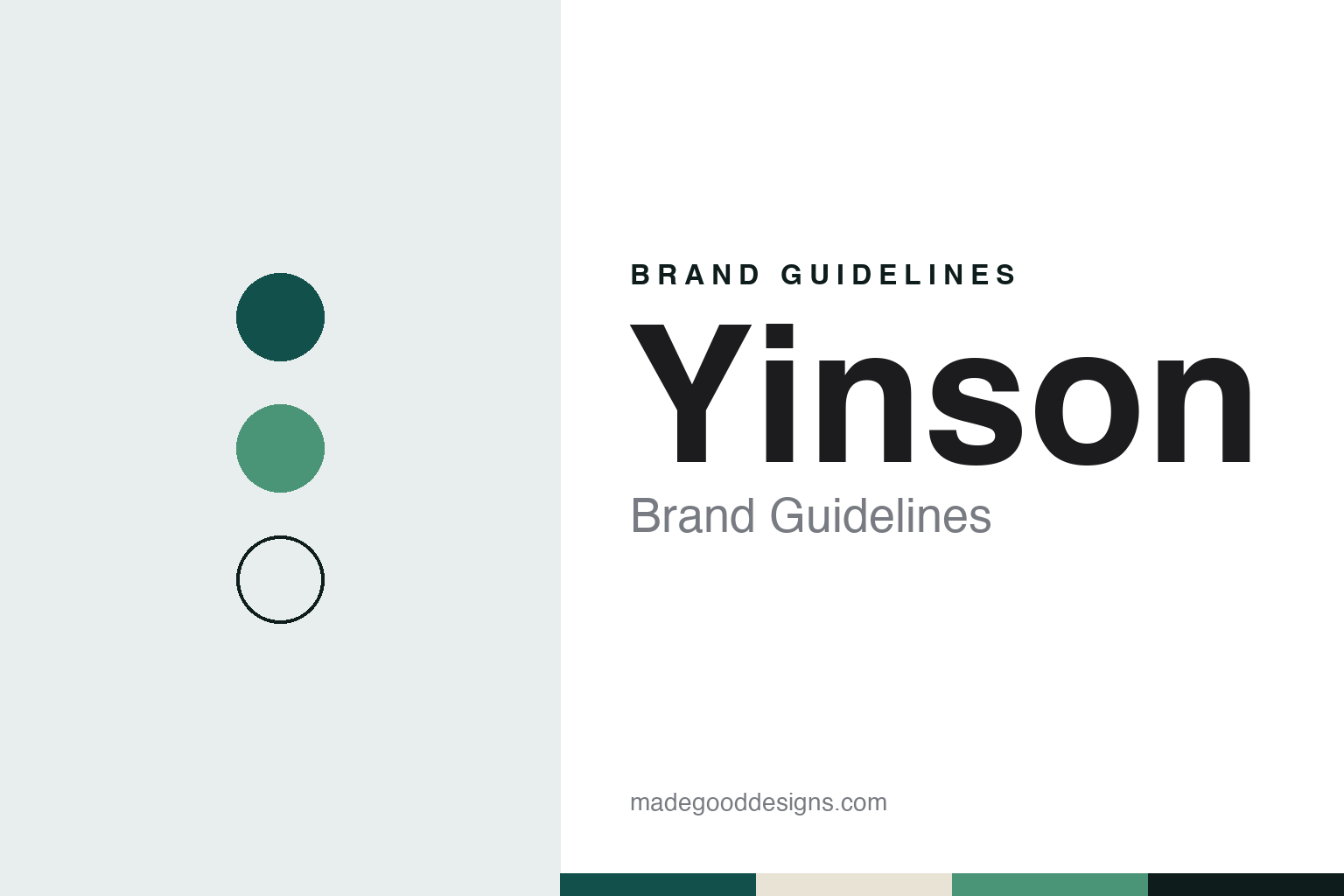
Two constants: a teal, green and sand palette and a rounded geometric sans register. Abstract homage — not a Yinson vessel, product or mark; no logo or unit is reproduced.
A transport agency
Trucks in Johor Bahru, 1984.
Yinson did not start at sea. Its history page says it began in 1984 as a transport agency in Johor Bahru, the Malaysian city across the strait from Singapore. English Wikipedia, citing Forbes and The Straits Times, names its founder as Lim Han Weng and describes the early business as logistics; The Star, carrying a Bloomberg report in November 2026, says the Lim family founded Yinson as a logistics business in the 1980s.
The company joined Bursa Malaysia in 1996 and moved to its Main Board in 2008, the history page says. The Chinese form of the name used by English Wikipedia is 云升, but the company presents itself to the world simply as Yinson, and the group is now headquartered in Kuala Lumpur.
The turn came in 2011, when Yinson went into offshore production through a joint venture with PTSC of Vietnam to build a floating storage unit and an FPSO. In 2013 it delivered the FSO PTSC Bien Dong 01 and acquired Fred. Olsen Production ASA, a floating production company, and in 2014 the FPSO PTSC Lam Son produced first oil. By 2016 Yinson had completed the sale of its non-oil-and-gas subsidiaries, ending the transport chapter that started it, according to the same timeline.
Colour
Ship-shaped units on long contracts.
The offshore arm is Yinson Production, which owns and operates FPSOs, the ship-shaped units that produce, store and offload oil and gas at offshore fields. Its company timeline traces the fleet field by field. Yinson won the contract for FPSO John Agyekum Kufuor off Ghana in 2015, and the unit, known as JAK, produced first oil in 2017. FPSO Helang followed in Malaysia in 2019 and FPSO Abigail-Joseph in Nigeria in 2020.
Brazil became a centre of the business. FPSO Anna Nery produced first oil in 2023, and FPSO Maria Quitéria and FPSO Atlanta did so in 2024, the year Yinson Production Brazil opened an office in Rio de Janeiro and the group was recognised as a Fortune Southeast Asia 500 company, according to its timeline. The Agogo FPSO for Angola reached first oil in 2025, the history page says.
Independent reporting tracks the contracts. The Star reported on 6 October 2026 that Yinson Production had secured a four-year extension with Eni for FPSO JAK, taking the firm lease to 2036, with two new topside modules to raise gas export capacity to 355 million standard cubic feet per day by early 2028. The same report said the unit is owned by a joint venture in which Yinson Production holds 74 per cent and a Japanese group of Sumitomo, K Line, JGC and the Development Bank of Japan holds the rest.
The offshore arm also brought in outside capital. In January 2025 The Star reported that Yinson Production had agreed to issue redeemable convertible preference shares to a group of investors made up of a unit of the Abu Dhabi Investment Authority, funds managed by British Columbia Investment Management and RRJ Group; Yinson’s timeline records the investment in 2025.
Typography
How floating production owners present themselves.
Companies that own and run floating production units rarely sell to the public, so their identities live in a small set of places: the photograph of a unit at sea, the fleet or project page, and the investor section. The unit is usually the hero image. A floating production, storage and offloading vessel, a floating storage unit or a floating LNG design is shown whole, in open water or alongside an integration yard, often as a rendering before the hull exists and as a photograph once it is on station.
Fleet and project pages do much of the identity work. Units are listed by name, field and country, and many names follow a house pattern, so a list of projects reads as a record of where the company has worked. Counts of units in operation, completed projects and years of operating experience are given as dated figures on “at a glance” pages, and they change from year to year as units are sold, redeployed or retired.
Standardised hull programmes have become part of the story. SBM Offshore describes its Fast4Ward programme as a generic new-build hull with a catalogue of topside modules, and its hulls are numbered in sequence, as with the seventh, MPF7, reported by Offshore Energy in 2026. Programmes like this give a company a repeatable product to show, rather than a series of one-off conversions, and the language around them leans on standard designs, modules and delivery schedules as the companies describe them.
The investor pages complete the picture. Annual and integrated reports, results presentations, shareholder lists and financial calendars sit next to newsroom image libraries, and the same unit photographs reappear across them. For a designer, the useful lesson is restraint: a short corporate name, a consistent naming system for assets, and large, plain images of the units themselves carry most of the visual identity.
Aa
A rounded geometric sans for a group with three businesses. (Specimen set in Manrope, a sans STAND-IN; NOT the Yinson logo.)
Yinson
Three businesses, one proposal.
Yinson describes itself as active in three businesses. Beside Yinson Production sits Yinson Renewables, set up in 2019, which English Wikipedia says runs solar plants in India such as the 285 MWp Nokh park and the 97 MWp Matarani plant in Peru, in commercial operation from 2024; in 2025 it acquired the 94.6 MW Mt Cass wind farm in New Zealand, the company says. English Wikipedia groups its portfolio into three regions: Asia Pacific, Latin America, and a Europe grouping that covers Italy and New Zealand. Yinson GreenTech, set up in 2020, runs the chargEV charging network and has launched electric harbour vessels named Hydromover and Hydroglyder. English Wikipedia, citing The Star, says chargEV partnered with Khazanah in March 2025, and that GreenTech left the electric motorcycle business, RydeEV, in April 2025.
Finance is part of the public story too. The history page records a senior secured bond placed in the Nordic bond market in 2024 and a project bond for FPSO Anna Nery listed on the London Stock Exchange the same year. The Star’s October 2026 report, citing CIMB Research, said the preference shares issued by Yinson Production were linked to a planned initial public offering of that unit in June 2030.
The group’s ownership is now the open question. The Star reported on 6 October 2026 that the shipping group MISC and Yinson Legacy Sdn Bhd proposed to acquire the shares they did not already control, which would leave MISC and Yinson Legacy with 41.5 per cent each and Malaysia’s Employees Provident Fund with 17 per cent; a Bloomberg report carried by The Star in November 2026 said the consortium, which includes the founding Lim family, had announced the indicative offer in August 2026. The deal was not completed at the time of writing, and The Star still described Yinson as Kuala Lumpur-listed in November 2026.
For a design guide, Yinson shows how a group that began with trucks presents itself through named offshore units, first-oil dates and long contracts, alongside renewables and electric mobility. Compare Bumi Armada, another Kuala Lumpur FPSO owner, and Petronas, Malaysia’s national oil company. For this guide we use a strait teal, mangrove green and sand with a sans, an unofficial interpretation; no product or logo is reproduced.
Explore & save
Keep Yinson’s identity on hand — save it to a board in the Made Good inspiration library.
Yinson identity set
Pin the Yinson teal, green and sand palette and the rounded geometric sans register to your own board.