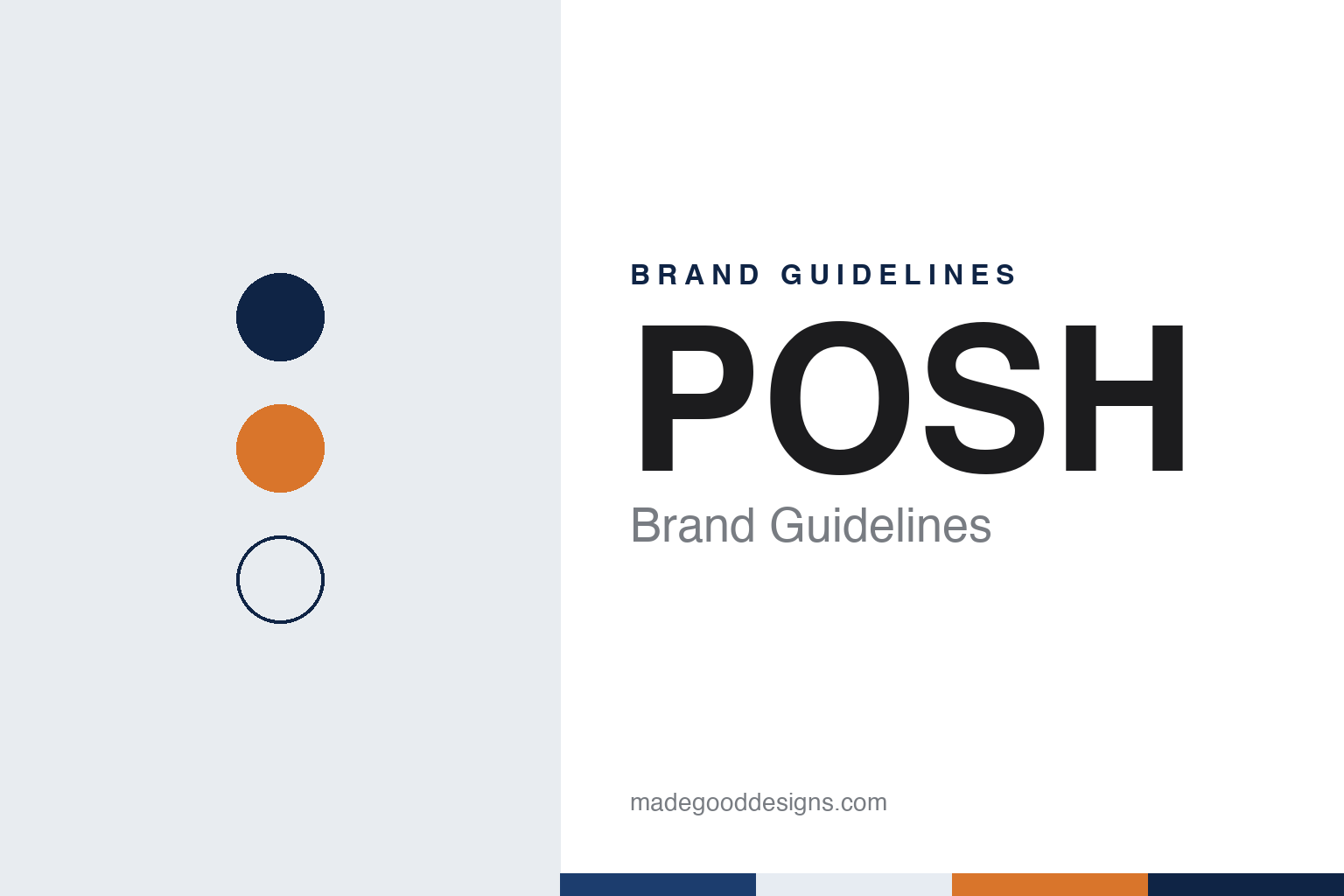
POSH Brand Guidelines
A Singapore fleet that tows, houses and supports offshore work.
Aa
Two constants: a strait blue, haze and towline orange palette and a grotesque sans register. Abstract homage — not a POSH vessel or mark; no logo, livery or funnel mark is reproduced.
PACC Offshore
A 2006 company built on older Singapore fleets.
POSH is the short name of PACC Offshore Services Holdings, an offshore marine company based in Singapore. Its own milestone list says it was incorporated in 2006 as PACC Offshore Pte. Ltd. In 2007 it acquired the offshore businesses of PSA Marine: SEMCO, which the company describes as an FPSO towage operator; Maritime Pte. Ltd., a transportation and installation operator; and several ship-owning companies. In the same year it took the name PACC Offshore Services Holdings, POSH for short.
The company’s home page claims more than 60 years of operating experience, a span that reaches back well before the 2006 incorporation, and the Kuok Group Singapore website uses the same figure. The two names were still used together in 2013, when a Reuters report carried by gCaptain called the business POSH Semco and described it as a member of the Kuok Group.
The company’s later milestones, as it lists them, add Singapore harbour work and partnerships abroad. In 2013 it received a public licence from the Maritime and Port Authority of Singapore to provide harbour towage in Singapore. In 2016 it formed a joint venture with Saudi Arabia’s Hamood Al-Khalaf Group to grow in the Middle East. In 2018 it set up POSH Subsea as its specialist subsea arm, and formed POSH Kerry Renewables with Kerry TJ Logistics to serve offshore wind in Taiwan.
Colour
Towage, subsea, accommodation and chartering.
POSH sorts its work into four services on its website: subsea support, offshore towage and project logistics, offshore renewables and vessel chartering. It says it supports upstream oil and gas and renewable energy operations, and gives figures of about 2,000 employees from 49 nationalities.
Its fleet page says the company owns, manages and operates more than 30 vessels, grouped by type. At the top are two semi-submersible accommodation vessels, the POSH Arcadia and POSH Xanadu, each listed with beds for 750 people. The largest anchor-handling tug on the list, the POSH Teal, is given a bollard pull of 255 tonnes, and the three platform supply vessels, Fulmar, Pelican and Sandpiper, are each listed with 670 square metres of deck. Below them come multipurpose support vessels and work barges, a diving support vessel, an offshore construction vessel, anchor-handling tugs, platform supply vessels and utility maintenance vessels. Every vessel carries the POSH prefix, and many are named after birds, such as Teal, Mallard, Pelican and Sandpiper, or antelopes, such as Gemsbok, Impala, Okapi and Springbok.
Towage of floating production units is the work the company publicises most. Its news page reported in May 2025 the transoceanic tow of the Agogo FPSO by a fleet of its anchor-handling tugs, and in September 2025 that it had been chosen by Wison New Energies to tow the Nguya floating LNG unit from China to the Republic of Congo. In July 2025 it added a new anchor-handling towing vessel, the POSH Courage.
The subsea side has grown alongside. In August 2022 POSH bought the offshore construction vessel BOA Deep C and renamed it POSH Deep C, and in November 2024 it announced its first SURF installation contract in the Arabian Gulf, extending its subsea construction work into the region. In January 2022 it sold its share of the Taiwan renewables joint venture, saying it wanted to concentrate on floating wind markets.
Typography
Design and documentation.
Offshore support vessel operators sell a service rather than a product, so their public face is the fleet itself. Their websites lead with photographs of platform supply vessels, anchor-handling tugs, fast crew boats and liftboats as the companies publish them, usually at sea or alongside a quay, with the working deck and the bridge in view.
Behind those photographs sits the fleet list. Operators sort their vessels by type, from supply vessels and anchor handlers to crew boats, liftboats and specialist ships, and give each class a short description, a named example and a length or deck size. Vessel names often run in families, such as a shared prefix, a family surname or a set of animal or place names, and those naming habits become part of how an operator is recognised in port and on charter lists.
Colour plays a similar role. Hull paint, superstructure colour and the mark on the funnel or the side of the bridge are what people see first from a distance, and many operators repeat the same few colours across a whole fleet. In this guide those colours are described in plain words rather than copied, and the palettes shown are our own interpretation.
The rest of an operator’s identity lives in plainer pages: contract and charter news, regional contact lists, sustainability reports and, for listed companies, investor pages with results and presentations. Ownership in the sector has changed often through mergers, restructurings and sales, so each guide sets out who owns the company today, what it says about its fleet, and which facts come from the company and which from independent reports.
Aa
A grotesque sans — compact capitals for a four-letter name. (Specimen set in Barlow, a sans STAND-IN; NOT the POSH logo.)
POSH
A Singapore listing and the Kuok Group.
POSH has been a public company. By 2019 its holding company, PACC Offshore Services Holdings Ltd, was listed in Singapore, MarineLink reported in November 2019. In December 2019 The Business Times named the Kuok Group companies linked to it: Kuok (Singapore) Limited, Trendfield Inc, a subsidiary of Kuok Brothers Sdn Bhd, and Merry Voyage Ltd, a subsidiary of Kerry Holdings. The same paper noted that POSH described itself as one of Asia’s largest operators of offshore support vessels.
The link to the Kuok Group is plain in the company’s own material today. Its website footer reads “A member of the Kuok Group,” and its values page says that, as part of the KSL Group, it shares five core values: integrity, effort, compassion, unity and gratitude. The Kuok Group Singapore website, in turn, lists POSH among its maritime businesses, alongside the shipping company Pacific Carriers and a shipyards group, and says the wider Kuok Group has grown from records that begin in 1949.
Visually, POSH’s public material is organised around its vessels. The fleet page is a set of tables by vessel type, with installed power, crane or bollard-pull figures and dynamic-positioning class for each ship, and a downloadable sheet per vessel; news items are illustrated with tows and installations at sea.
For a design guide, POSH shows how a short acronym and a shared naming system can tie a mixed fleet together, from accommodation semi-submersibles to harbour tugs. Compare Tidewater, another large offshore vessel fleet, and Gulf Marine Services, an offshore vessel operator working in the same Gulf waters. For this guide we use a strait blue, a morning haze and a towline orange with a sans, an unofficial interpretation; no product or logo is reproduced.
Explore & save
Keep POSH’s identity on hand — save it to a board in the Made Good inspiration library.
POSH identity set
Pin the POSH strait blue, haze and towline orange palette and the grotesque sans register to your own board.