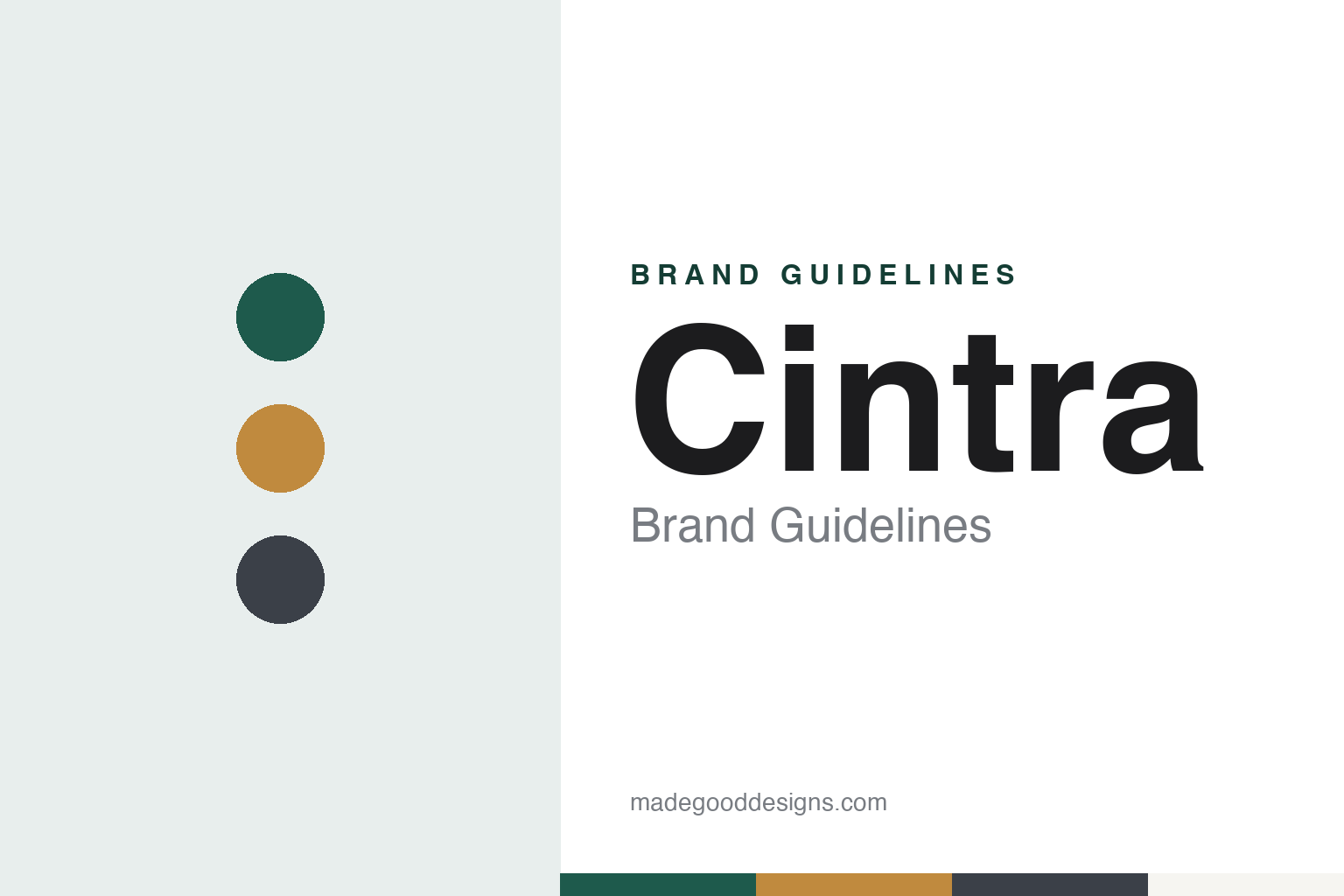
Cintra Brand Guidelines
The toll-road company that sits behind the names on the roads.
Aa
Two constants: a Cintra green, ochre and slate palette and a Franklin-style sans register. Abstract homage — not a Cintra or Ferrovial asset or mark; no logo, sign or map is reproduced.
Five motorways and a car-park business
Ferrovial spins out its concessions in 1998.
Cintra is the toll-road business of Ferrovial, the Spanish infrastructure group that Rafael del Pino y Moreno founded in 1952 as a railway-construction company. Spanish Wikipedia says Cintra was created in 1998, when Ferrovial put into it its stakes in five motorways in Spain and Chile together with its car-park business, along with the staff and funding needed to grow them. Ferrovial had moved into roads in the 1960s with the concession for the Bilbao–Behobia motorway, which English Wikipedia describes as the first toll road in Spain tendered with private financing and management.
Cintra soon became a company in its own right. English Wikipedia says it went public in 2004, and Spanish Wikipedia says its shares traded on the Madrid stock exchange, that it was part of the Ibex 35 index and that Ferrovial held about 68%. Ten years after its creation, according to the same Spanish article, it ran 23 motorways in Spain, Portugal, Ireland, Greece, Chile, Canada and the United States, about 2,841 kilometres in all. In 2007, English Wikipedia adds, it signed the contract for the Central Greece toll motorway, the E65.
Two changes in 2009 reshaped it. In June 2009 Cintra sold its parking division, which ran about 300,000 spaces in some 140 cities in Spain and Andorra, to the Portuguese group Emparque. At the end of 2009 Ferrovial absorbed Cintra, the separate listing ended, and Cintra continued as a Ferrovial company under the name Cintra Infraestructuras. In 2010, English Wikipedia says, Ferrovial sold 60% of Cintra Chile.
Colour
Toronto’s 407 and America’s managed lanes.
Its signature road is in Canada. The 407 Express Toll Route is the tolled western part of Highway 407 around Toronto, a 108-kilometre stretch between Burlington and Pickering that English Wikipedia describes as electronically operated, with no toll booths: transponders and number-plate cameras at entry and exit points record each trip. The first section of Highway 407 opened in June 1997. In 1999 the road was leased for 99 years to a consortium, 407 International, owned initially by Cintra (61.3%), SNC-Lavalin and CDP Capital. Under the lease the consortium built extensions west to the Queen Elizabeth Way and east towards Pickering, and English Wikipedia says the last sections opened in the summer of 2001. Ownership has shifted since: after AtkinsRéalis sold its remaining share in March 2025, Wikipedia gives Cintra’s stake as 48.29%, alongside the Canada Pension Plan Investment Board and the Public Sector Pension Investment Board.
The United States is the other centre of the business. English Wikipedia says Cintra signed an agreement with the Texas Department of Transportation in 2006 for segments 5 and 6 of the SH-130 toll road, and Spanish Wikipedia says it won two segments of the North Tarrant Express in the Dallas–Fort Worth area in January 2009; the LBJ Express in Dallas followed at the end of 2009. Spanish Wikipedia also says Cintra was chosen as a long-term partner of Texas for the Trans-Texas Corridor, a plan that the state transportation department split into separate tenders in 2009. These are managed lanes: tolled lanes built alongside free ones, with tolls that change with demand. In November 2022 Cintra opened the I-66 Express managed lanes in northern Virginia, a 36-kilometre (22.5-mile) road between Route 29 near Gainesville and the Capital Beltway in Fairfax County, under a 50-year concession; La Información reported on 29 November 2022 that Ferrovial owned 55.7% of the concessionaire, with the funds Meridiam and APG as partners. English Wikipedia also lists I-77 in North Carolina among the group’s barrier-free toll roads.
Cintra’s path has also crossed Atlas Arteria’s. Atlas Arteria’s history of the Chicago Skyway says that in 2005 the City of Chicago leased the road to a consortium of Cintra, Macquarie Atlas Roads and Macquarie Infrastructure Partners, which sold it in 2016. In Spain, English Wikipedia lists the Autema and the Autopista del Sol among the group’s concessions, and in Ireland stakes in the M3 and M4.
Typography
How toll-road and parking operators present themselves.
Toll-road and parking operators sell access to something the customer can already see: a stretch of motorway, a tunnel, a multi-storey car park. Their visual identity therefore lives in two places at once. On the road it appears on gantries, toll plazas, barrier arms, ticket machines and the signs at a car-park entrance; online it appears on corporate websites, annual reports and investor presentations, where the same company explains its concessions to shareholders and lenders.
Network maps and road photography carry much of the corporate side. Operators publish maps of the routes or sites they run, usually as simple lines and dots over a pale base, together with photographs of interchanges, viaducts, tunnels and car parks, often taken from above. Concession pages and investor sections list each asset with its length or number of spaces, its concession dates and its ownership structure, and many groups give each road or site its own page or its own website under its own name.
Parking brands meet a shared visual language at the kerb. The blue and white “P” sign is the common shorthand for parking across much of the world, and operators place their own name and colours beside it on entrance signs, pay stations and barrier arms. Customer apps have become a second front door: their screenshots, as the companies publish them, typically show a map of nearby sites, a booking or payment screen and a digital ticket or account page.
Toll operators increasingly present themselves through electronic tolling, with transponder tags, licence-plate accounts and apps that show trips and statements, so their customer materials lean on clear numbers, simple icons and plain instructions. Across the category the tone is practical and reassuring rather than playful: a name that needs to be read at speed, a limited palette and a sans-serif that stays legible on a sign, a phone and a results page alike.
Aa
A sturdy American-style grotesque for a business built on concessions. (Specimen set in Libre Franklin, a sans STAND-IN; NOT the Cintra or Ferrovial logo.)
Cintra
A name behind the roads.
New American work is now announced under the Ferrovial name. On 15 October 2026 Ferrovial said that Top End Mobility Group, a consortium it leads with Tikehau Star Infra, had been selected by the Georgia Department of Transportation for Phase 1 of the I-285 East Express Lanes around Atlanta: about 21 miles of new express lanes, under a long-term agreement to finance, design, build, operate and maintain them. It is a selection rather than a closed contract: announced in October 2026 and not completed at the time of writing. The release calls it Ferrovial’s first managed-lanes project in Georgia and names Dallas–Fort Worth, Charlotte and Washington, D.C., as places where the group already runs express lanes.
Ferrovial itself describes four divisions, according to English Wikipedia: Highways, Airports, Construction, and Mobility and Energy Infrastructure. Cintra is the company behind the highways, but its roads carry their own names, such as the 407 ETR and the I-66 Express, and recent announcements, like the Georgia selection, are issued by Ferrovial rather than by Cintra.
For a design guide, Cintra shows how an operator’s name can stay in the background while each road carries its own identity. Compare Abertis, another Spanish toll-road group, and Atlas Arteria, its former partner on the Chicago Skyway. For this guide we use a toll-plaza green, a meseta ochre and slate with a sans, an unofficial interpretation; no product or logo is reproduced.
Explore & save
Keep Cintra’s identity on hand — save it to a board in the Made Good inspiration library.
Cintra identity set
Pin the Cintra green, ochre and slate palette and the Franklin-style sans register to your own board.