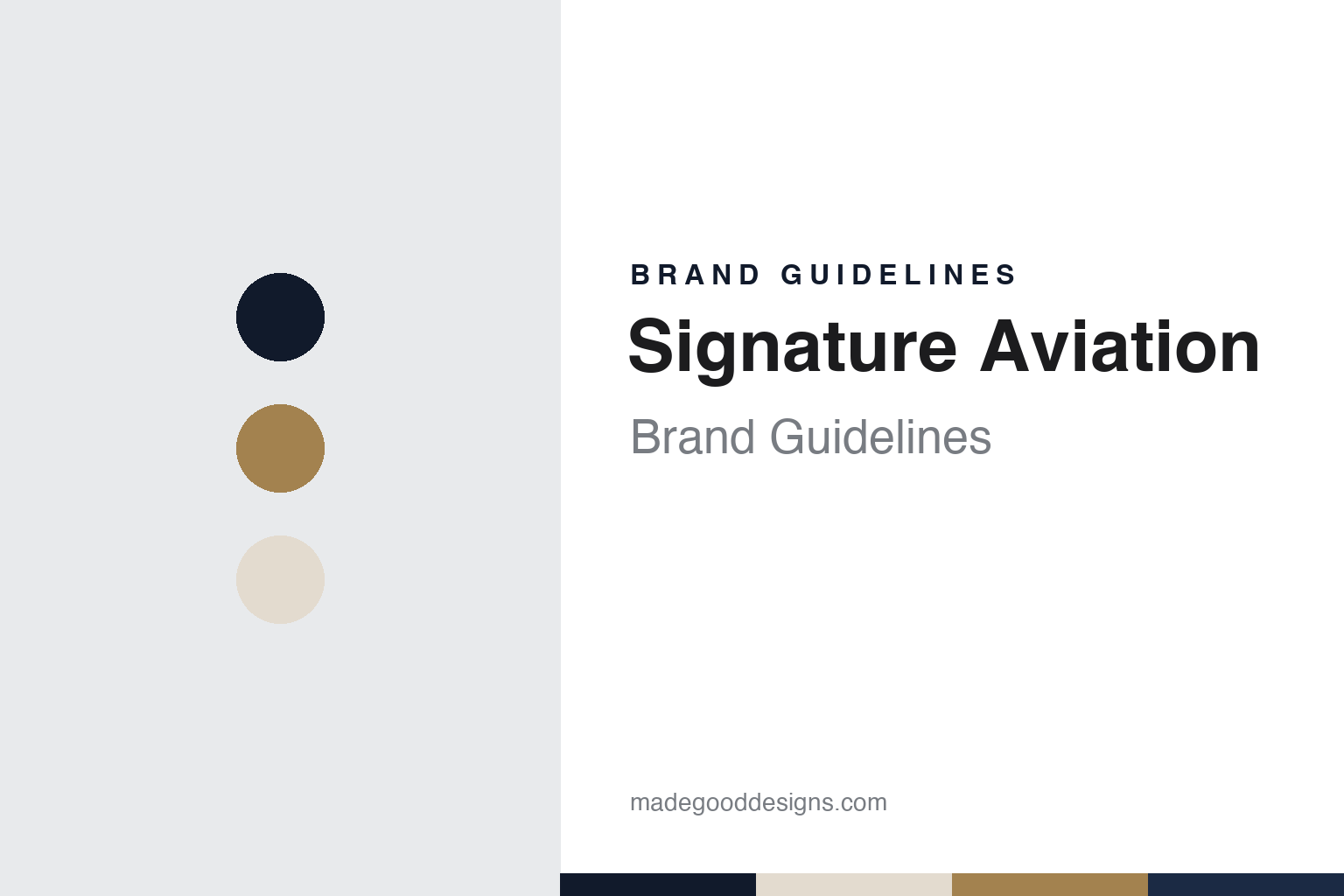
Signature Aviation Brand Guidelines
An 1879 belting works that became a network of private aviation terminals.
Aa
Two constants: a deep blue, stone and brass palette and a hospitality serif register. Abstract homage — not a Signature Aviation product or mark; no terminal, logo or signage is reproduced.
Belting to BBA
An 1879 belting works becomes an aviation group.
Signature Aviation’s corporate history starts far from airports. English Wikipedia, drawing on a company history published in November 2019, traces it to W. Wilson Cobbett Ltd, founded in 1879 by Sir William Fenton and Walter Cobbett to make textile belts for industrial machinery. UK Companies House lists the present company as incorporated in August 1897.
The firm changed its name as it grew: Scandinavia Belting in 1911 and British Belting & Asbestos in 1925. Between the wars it supplied the motor industry, Wikipedia says, including Ford for the Model T, and it was also active in aviation. In 1967 it became the BBA Group, then focused mainly on automotive materials such as brake pads.
The turn to aviation came through acquisitions. In 1986 BBA bought APPH, a British maker of aircraft undercarriages and hydraulics, and in 1998 it moved into jet-engine repair and overhaul with the purchases of H+S Aviation and UNC Airwork, according to Wikipedia. In 1992, Wikipedia says, it was involved in creating Signature Flight Support by merging Page Avjet, an executive aircraft interiors business, with the Butler chain of fixed-base operations, or FBOs. Flight International reported in October 1996 that BBA had bought the outstanding 32 percent of Signature that August, making it wholly owned; Signature was then the largest US player, with a chain of 35 locations, the magazine said.
Over the following decade BBA let go of its older industrial businesses — the Mintex brake-pad division in 2000 and the nonwovens arm, demerged as Fiberweb in 2006. Companies House records the change of name from BBA Group plc to BBA Aviation plc in November 2006; Wikipedia dates the rename to 2007. Later sales followed the same logic, Wikipedia says: APPH went to Héroux-Devtek in 2014, and the ground-handling business ASIG was sold to John Menzies in 2017.
Colour
From FBO chain to the company’s name.
Signature Flight Support grew by buying other FBO chains. In 2008 BBA Aviation bought Hawker Beechcraft’s line-service operations, Wikipedia says, and in September 2015 it sought shareholder approval to buy Landmark Aviation from the Carlyle Group, Flight International reported; Wikipedia describes the Landmark purchase as a large widening of the Signature network. Early in 2017 BBA Aviation and Gama Aviation agreed to combine their US charter and aircraft-management operations, Wikipedia says, citing Flight International.
The group then narrowed to that one business. In 2019 it agreed to sell Ontic, its aircraft-parts business, to CVC Capital Partners, and renamed itself after its main brand: Companies House shows the change from BBA Aviation plc to Signature Aviation plc on 22 November 2019.
It did not stay listed for long. In February 2021, Wikipedia reports, citing The Wall Street Journal, Cascade Investment, Blackstone and Global Infrastructure Partners made an offer to acquire the company. Companies House shows that it stopped being a public limited company on 9 June 2021, and Wikipedia records it as acquired by that group of investors. Its headquarters are in Orlando, Florida.
Growth continued under private ownership. In July 2022, AOPA reported, Signature agreed to buy the TAC Air FBO business of The Arnold Companies, with 13 FBOs and a foothold in 11 new markets including Salt Lake City, Buffalo and Knoxville; Wikipedia records the purchase in August 2022. Signature’s website now says it operates at more than 200 locations in 27 countries across five continents, with about 6,000 team members. In March 2026 it opened a new terminal at Glasgow Airport in Scotland, with 433 square metres of space, lounges, a meeting room, showers and a screening room, the company said.
Typography
Ramps, lounges and networks.
Business aviation companies sell something most visitors will never see in person, so their websites lean on photography and lists. Operators show cabins and aircraft on the ramp, as the companies themselves choose to publish them, and they tend to organise fleet pages by aircraft type — a turboprop, a super-midsize jet, a large-cabin Gulfstream or Bombardier — rather than by destination. Gama Aviation’s charter pages, for example, name individual types from the Citation Mustang to the Gulfstream G550.
FBO networks, the private terminals and hangars that serve business aircraft at airports, present themselves through places. Their websites carry location maps and airport pages that list lounges, crew rest rooms, hangarage, fuel and meeting rooms, often with airport codes and opening hours. Hangars appear as much as aircraft do, because the building is the product: Gama, for one, publishes separate pages for its facilities at Glasgow, Jersey and Sharjah.
Membership and charter programmes are a third strand. Operators describe jet cards, memberships and fixed-rate schemes in their own terms — deposit levels, guaranteed availability, capped hourly rates — and trade titles such as Private Jet Card Comparisons track and compare them. VistaJet, XO and, before its sale in 2022, Jet Edge all built consumer offers around such programmes, and Jet Edge ran branded lounges at Van Nuys and Teterboro.
Ownership changes often. Investment firms, listed groups and larger operators buy and merge these businesses, and a brand can disappear into its parent’s name, as Jet Edge’s operators did when Vista formed Vista America in 2023. This guide records who founded each company, who owns it and how it presents itself, and marks clearly what rests only on the company’s own word.
Aa
A high-contrast serif for a hospitality voice. (Specimen set in DM Serif Display, a serif STAND-IN; NOT the Signature Aviation logo.)
Signature Aviation
Precision, connection and progression.
The current look is recent. In March 2024, calling the new brand a sign of Signature’s transformation into a hospitality company in aviation, the company revealed what Business Airport International called a visual identity transformation, including a new logo, built on three design principles the company named as precision, connection and progression. New logos, colours and visual communications went onto its digital platforms at once, and terminal updates began in early 2024, including its location at Harry Reid International Airport in Las Vegas; the new brand was shown at the NBAA Schedulers and Dispatchers Conference in Fort Worth that month.
In October 2025 the company added a tagline, “Elevate Every Moment,” which it said built on the 2024 identity, together with a redesigned website; the line was showcased that week at the NBAA-BACE convention in Las Vegas, where Signature powered the show’s first Creator Studio. Its homepage pairs the line with stated values including integrity, service, responsibility, performance and people. Digital tools followed: Aviation International News reported in February 2026 on Signature Vision, a portal for direct reservations, service requests and real-time updates, and in October 2026 the company introduced Signature Access, which folds core charges based on aircraft size, time on the ramp and location into one price, rolled out in phases.
For a design guide, Signature Aviation shows how an industrial group that once made belts and brake pads rebuilt itself around a single service brand, then gave that brand a hospitality voice. Compare Atlantic Aviation, another US FBO network, and Jetex, a Dubai-based network of private terminals. For this guide we use a deep deep blue, a warm stone and a muted brass with a serif, an unofficial interpretation; no product or logo is reproduced.
Explore & save
Keep Signature Aviation’s identity on hand — save it to a board in the Made Good inspiration library.
Signature Aviation identity set
Pin the Signature Aviation deep blue, stone and brass palette and the hospitality serif register to your own board.