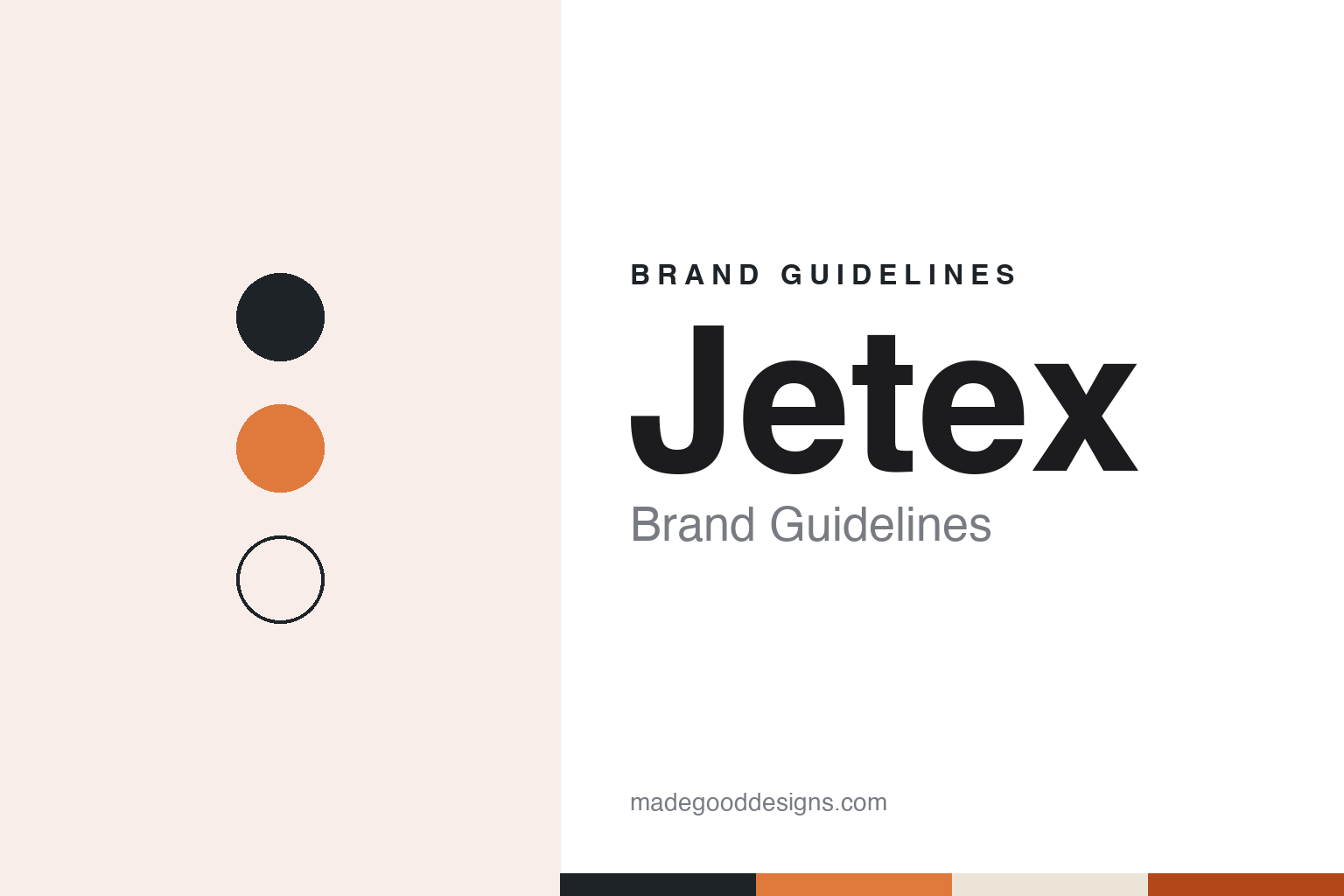
Jetex Brand Guidelines
A Dubai airshow launch that grew into a network of private terminals.
Aa
Two constants: a warm orange and charcoal palette and a geometric sans register. Abstract homage — not a Jetex product or mark; no terminal, logo or livery is reproduced.
Jetex Flight Support
A launch at the 2005 Dubai Airshow.
Jetex began in Dubai in 2005. Aviation International News reported in December 2012 that the company, then called Jetex Flight Support, had launched at the 2005 Dubai Airshow and was celebrating its seventh anniversary; its president and chief executive was Adel Mardini, whom later reports describe as the founder. CNN, profiling the company in May 2023, likewise said it had been launched in 2005 by Mardini.
The early business was trip support: handling business aircraft at airports around the world for their operators. In 2012, AIN reported, Jetex ran two fixed-base operations, or FBOs, in Europe and planned to add four more, including one at Dubai World Central, the airport also known as Al Maktoum International. That FBO opened in November 2013 in a temporary facility, AIN reported, with a lounge, ground support, fuelling, handling and on-site customs and immigration, and it arranged hotel accommodation, catering and limousine services for crews and passengers. Those services, sold to operators rather than to the public, remained the core of the business as it grew.
Expansion around the Gulf followed. In November 2017 Flight International reported that Jetex had been appointed the first operator and manager of FBOs in Oman, in an award signed at its flagship Dubai facility; the magazine described the move as part of a strategy to widen its network in the region.
Along the way the longer name gave way to a single word. Trade reports up to 2017 use “Jetex Flight Support”; more recent coverage and the company’s own announcements simply say Jetex, and in November 2025 the company marked its 20th anniversary.
Colour
Terminals, fuel and a named orange.
Jetex counts its network in terminals and locations. In May 2023, speaking on the eve of the EBACE business-aviation show in Geneva, Mardini told AIN that Jetex was present in 50 locations, with 37 terminals, and that some 2,100 airports offered Jetex fuel supplies. CNN reported the same month that the company had about 750 employees across dozens of private terminals, including Dubai, Miami, Paris and Beijing.
By 2026 the terminal count had grown. Aviation Week reported in May 2026 that the Dubai-based company operated a network of 40 private terminals, naming Abu Dhabi, London, Madrid, Marrakech, Milan, Paris and Singapore among them, and a Jetex announcement in August 2026 gave the figure as “more than 40 VIP terminals.” The company lists its services as private terminals, fixed-base operations, aircraft fuelling, ground handling and global trip planning, for owners and operators of business jets.
Fuel is part of that story. CNN reported that in 2021 Jetex began offering sustainable aviation fuel through a partnership with Neste at its Helsinki Airport terminal, and fuel produced by TotalEnergies at its Paris–Le Bourget terminal the same year, and that the company had also worked with the electric-aircraft developers Volocopter and Eve Air Mobility.
The brand also names its own colour. Announcing a limited-edition Epic X watch made with the Swiss watchmaker Jacob & Co. in November 2025, timed to Dubai Watch Week and its anniversary, Jetex said the piece was finished in “Jetex’s world-renowned orange.” The watch was put on view at the Jetex Dubai and Jetex Abu Dhabi private terminals, a sign of how far the company now pitches itself as a lifestyle name as well as a ground-services business. Jacob & Co. said the model kept the 41 mm case of its Epic X line and added a full dial with a diamond pattern.
The naming is just as consistent. In the company’s announcements each site takes the form of the brand name plus a city — Jetex Dubai, Jetex Abu Dhabi, Jetex Istanbul, Jetex Sofia — so that a single word does the work across dozens of airports, from the Gulf to Europe and Asia.
Typography
Ramps, lounges and networks.
Business aviation companies sell something most visitors will never see in person, so their websites lean on photography and lists. Operators show cabins and aircraft on the ramp, as the companies themselves choose to publish them, and they tend to organise fleet pages by aircraft type — a turboprop, a super-midsize jet, a large-cabin Gulfstream or Bombardier — rather than by destination. Gama Aviation’s charter pages, for example, name individual types from the Citation Mustang to the Gulfstream G550.
FBO networks, the private terminals and hangars that serve business aircraft at airports, present themselves through places. Their websites carry location maps and airport pages that list lounges, crew rest rooms, hangarage, fuel and meeting rooms, often with airport codes and opening hours. Hangars appear as much as aircraft do, because the building is the product: Gama, for one, publishes separate pages for its facilities at Glasgow, Jersey and Sharjah.
Membership and charter programmes are a third strand. Operators describe jet cards, memberships and fixed-rate schemes in their own terms — deposit levels, guaranteed availability, capped hourly rates — and trade titles such as Private Jet Card Comparisons track and compare them. VistaJet, XO and, before its sale in 2022, Jet Edge all built consumer offers around such programmes, and Jet Edge ran branded lounges at Van Nuys and Teterboro.
Ownership changes often. Investment firms, listed groups and larger operators buy and merge these businesses, and a brand can disappear into its parent’s name, as Jet Edge’s operators did when Vista formed Vista America in 2023. This guide records who founded each company, who owns it and how it presents itself, and marks clearly what rests only on the company’s own word.
Aa
A clean geometric sans for a one-word name. (Specimen set in Outfit, a sans STAND-IN; NOT the Jetex logo.)
Jetex
Hotel-style terminals under one word.
Recent openings show how Jetex presents itself: as a hospitality brand as much as a handling agent. On 6 May 2026 it opened the Jetex iGA Terminal at Istanbul Airport with the airport operator iGA, Aviation Week reported; the partners described it as a VIP terminal for both private-jet passengers and commercial airline travellers, used by reservation, with private suites, lounges and dedicated passport and security checkpoints. Jetex says the building’s design draws on the nazende çiçeği, a slender flower, and uses natural stone, wood and custom-made surfaces, and that it adds spa treatments and open-air terraces to the usual lounge offer.
More sites have been announced. In August 2026 Jetex said it had signed an agreement with SOF Connect to develop and run a VIP lounge in the western wing of Terminal 1 at Vasil Levski Sofia Airport in Bulgaria, with a private entrance, serving private-aviation guests and commercial passengers alike. The company expected it to welcome its first guests in the fourth quarter of 2026 and more than 30,000 passengers in 2027; at the time of writing that opening is still pending.
For a design guide, Jetex shows how a ground-services company can turn a chain of terminals into a hospitality brand, carrying one short name and one named colour from the ramp to a watch dial. Compare ExecuJet, another FBO network in this series, and Signature Aviation, a network of private terminals headquartered in Orlando. For this guide we use a warm orange, a deep charcoal and a desert sand with a geometric sans, an unofficial interpretation; no product or logo is reproduced.
Explore & save
Keep Jetex’s identity on hand — save it to a board in the Made Good inspiration library.
Jetex identity set
Pin the Jetex warm orange, charcoal and sand palette and the geometric sans register to your own board.