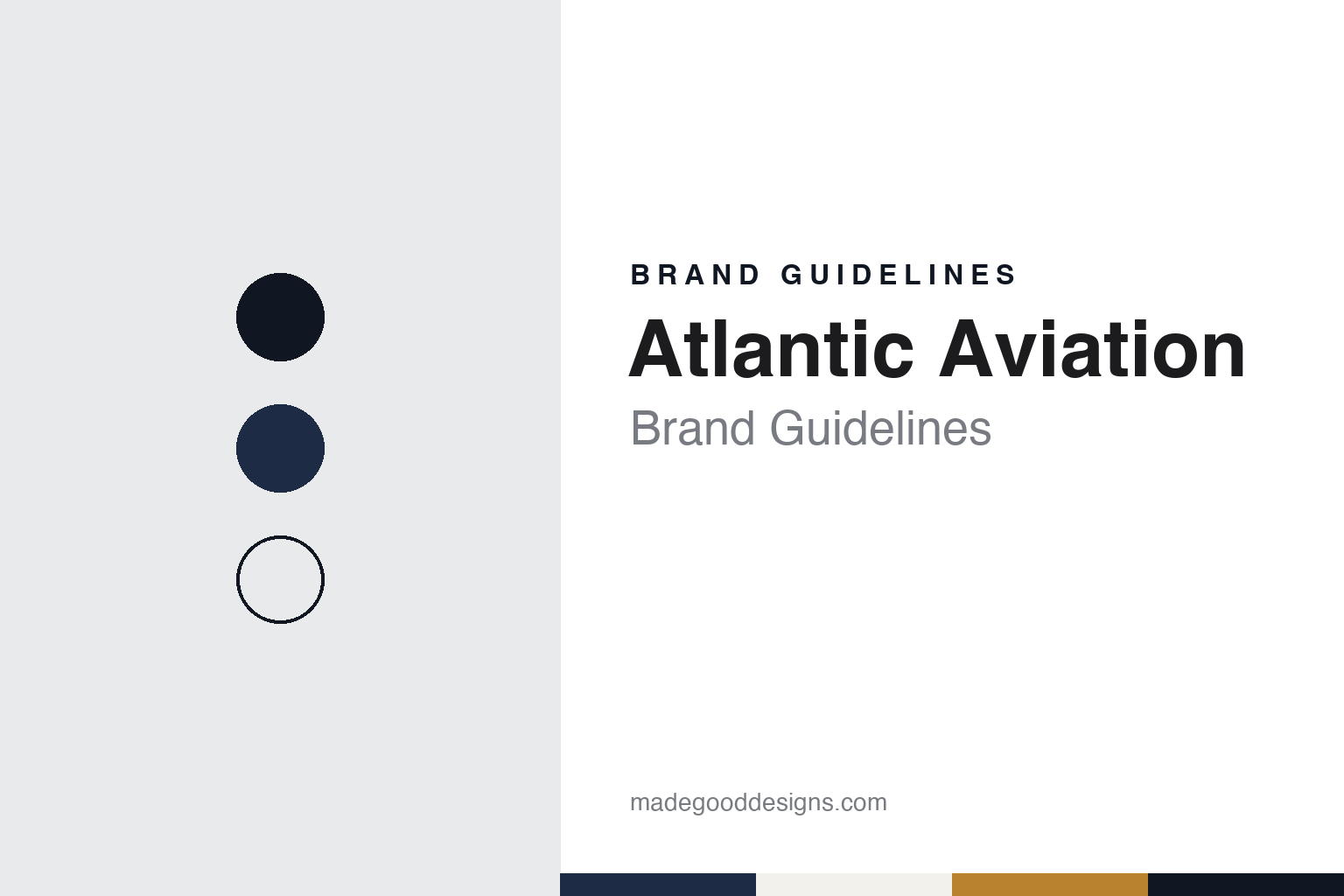
Atlantic Aviation Brand Guidelines
An FBO network built from one airport counter at a time.
Aa
Two constants: a deep blue, white and amber palette and a geometric sans register. Abstract homage — not an Atlantic Aviation sign, livery or mark; no logo is reproduced.
Macquarie to KKR
An airport-services arm becomes a stand-alone chain.
Atlantic Aviation is a network of fixed-base operators, or FBOs: the private terminals at airports where business jets and other general-aviation aircraft are fuelled, parked, hangared and handled, and where their passengers and crews arrive and leave. Its corporate office is in Plano, Texas, the company’s website says, and the legal name in its site footer is Atlantic Aviation FBO Inc.
For most of the past two decades Atlantic was part of a larger listed group. English Wikipedia’s article on Macquarie Infrastructure Corporation — the New York-based company managed by an arm of Australia’s Macquarie Group — describes Atlantic as one of its divisions. That company went public in December 2004, and in January 2006 its AvPorts airport-management division was folded into the Atlantic division; AvPorts was later sold, at the start of 2009. Alongside Atlantic, Macquarie Infrastructure held bulk liquid storage terminals, a gas business in Hawaii and district energy interests.
The group was taken apart in 2020–2022. It sold its storage terminals business in 2020 and Atlantic in 2021, to funds managed by the investment firm KKR, and in July 2022 the remainder merged with an affiliate of Argo Infrastructure Partners and left the New York Stock Exchange, according to English Wikipedia. When KKR took over, Atlantic operated 69 FBO locations in the United States, AeroTime reported in September 2026.
Colour
Fuel, hangars, deicing and a trip app.
Under KKR the network grew quickly. By 2026 Atlantic had 105 locations, more than 30 of them added through acquisitions, AeroTime reported, citing Apollo; the company’s own home page speaks of “over 105 locations in North America” and promises “one predictable Atlantic experience.” The services it lists are fuelling, deicing, concierge services, premium executive facilities and aviation real estate, meaning hangar and office space let at its airports.
Recent additions show how the network spreads. In November 2025 Atlantic bought Jet Center at Santa Fe, its third location in New Mexico, and said the site would begin operating under the Atlantic name at once. In December 2025 it bought Cedar Aviation Services at L.F. Wade International Airport in Bermuda, saying the location would move to the Atlantic name in the following months. In June 2026 it opened a new terminal and hangar at Napa County Airport in California, describing the lounge as having “a warm Wine Country aesthetic,” and in August 2026 it began building its first FBO at John C. Tune Airport in Nashville, due for completion in late 2027; AeroTime reported that work on a second FBO at Nashville International Airport, beside its existing one there, also began that month. The company says the Napa building uses recycled-content materials, low-glare lighting and native planting, and that its Bermuda site is the island’s only provider of general-aviation ground handling and air cargo services. Flying reported in August 2026 that the company is also planning electrified vertiports for future air taxis through a unit called Vertiports by Atlantic.
Much of the brand lives in software and loyalty schemes. Atlantic Gateway is a trip-planning platform with dashboards for dispatchers and real-time notices for pilots; Atlantic Awards rewards individual pilots; and Atlantic Ascend, rolled out across the whole network in August 2026, offers fuel savings and service-fee rebates to the flight departments, charter operators and aircraft owners behind the flying, the company says.
The tone of voice is deliberately informal. The website’s values page lists Quality, Innovation, Our People and Attitude, and talks about the “Atlantic Attitude” as “more than a catchphrase”; staff training runs through programmes it calls the Atlantic Certified Employee scheme and Tow Certification. Its employee recognition award is the “Attitude is Everything” pin.
Typography
Design and documentation.
Business aviation companies sell something most visitors will never see in person, so their websites lean on photography and lists. Operators show cabins and aircraft on the ramp, as the companies themselves choose to publish them, and they tend to organise fleet pages by aircraft type — a turboprop, a super-midsize jet, a large-cabin Gulfstream or Bombardier — rather than by destination. Gama Aviation’s charter pages, for example, name individual types from the Citation Mustang to the Gulfstream G550.
FBO networks, the private terminals and hangars that serve business aircraft at airports, present themselves through places. Their websites carry location maps and airport pages that list lounges, crew rest rooms, hangarage, fuel and meeting rooms, often with airport codes and opening hours. Hangars appear as much as aircraft do, because the building is the product: Gama, for one, publishes separate pages for its facilities at Glasgow, Jersey and Sharjah.
Membership and charter programmes are a third strand. Operators describe jet cards, memberships and fixed-rate schemes in their own terms — deposit levels, guaranteed availability, capped hourly rates — and trade titles such as Private Jet Card Comparisons track and compare them. VistaJet, XO and, before its sale in 2022, Jet Edge all built consumer offers around such programmes, and Jet Edge ran branded lounges at Van Nuys and Teterboro.
Ownership changes often. Investment firms, listed groups and larger operators buy and merge these businesses, and a brand can disappear into its parent’s name, as Jet Edge’s operators did when Vista formed Vista America in 2023. This guide records who founded each company, who owns it and how it presents itself, and marks clearly what rests only on the company’s own word.
Aa
A geometric sans for an airport network. (Specimen set in Manrope, a sans STAND-IN; NOT the Atlantic Aviation logo.)
Atlantic Aviation
Two investment firms, one network.
Ownership changed again in 2026. On 27 August 2026 Apollo and KKR announced that funds managed by Apollo had acquired a significant interest in Atlantic, while KKR-managed funds remained a substantial shareholder; the release called Atlantic “one of the largest private aviation infrastructure platforms in the United States.” AeroTime reported that the investment had been expected for several months as KKR looked at reducing its stake, and that chief executive Jeff Foland, a former United Airlines and Hertz executive according to the company, would continue to lead the business. The same report described Atlantic and Signature Aviation as the two major FBO chains at the upper end of the American market.
That scale explains the visual problem Atlantic has to solve. An FBO brand is met at a counter, on a fuel truck, on a hangar door and on a pilot’s phone, often at an airport where the site was bought from a local operator only months earlier. The company’s own news releases describe each acquisition in the same way: the local team stays, the location moves to the Atlantic name and identity, and the crews gain access to Atlantic Awards straight away.
For a design guide, Atlantic Aviation shows how a network built largely by acquisition uses one name, one app and one loyalty scheme to make very different airports feel like a single service. Compare Signature Aviation, the other large American FBO chain, and Clay Lacy, a Van Nuys company that now concentrates on its own FBOs. For this guide we use a deep deep blue, a warm white and an amber with a sans, an unofficial interpretation; no product or logo is reproduced.
Explore & save
Keep Atlantic Aviation’s identity on hand — save it to a board in the Made Good inspiration library.
Atlantic Aviation identity set
Pin the Atlantic Aviation deep blue, white and amber palette and the geometric sans register to your own board.