Atlas Arteria Brand Guidelines
A Macquarie spin-off that kept its roads and dropped the parent’s name.
Aa
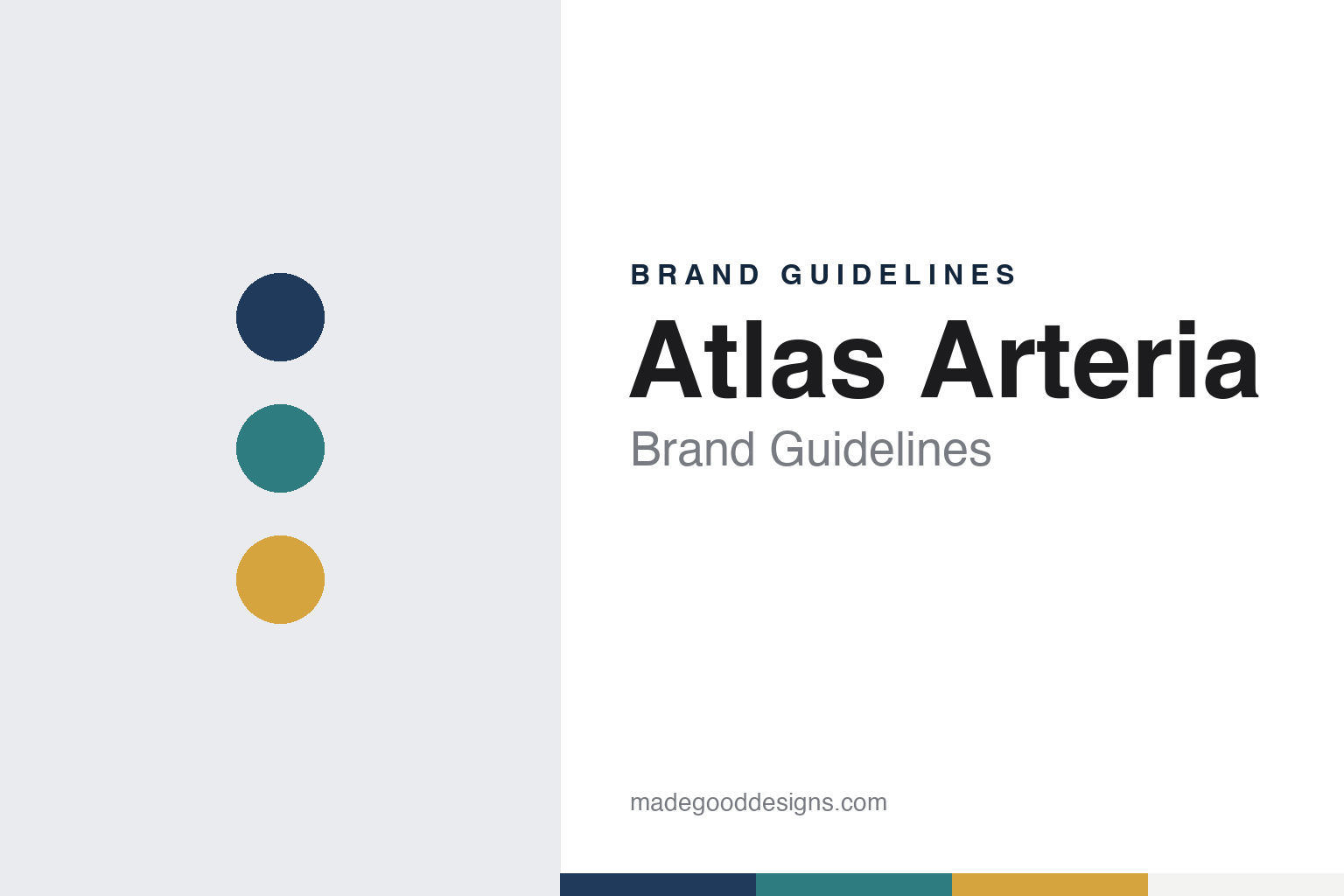
Two constants: an Atlas Arteria deep blue, teal and amber palette and a road-sign sans register. Abstract homage — not an Atlas Arteria asset or mark; no logo, sign or map is reproduced.
Macquarie Atlas Roads
A demerger in 2010 and a new name in 2018.
Atlas Arteria is a toll-road owner based in Melbourne and listed on the Australian Securities Exchange under the code ALX. It began in 2010, when Macquarie Infrastructure Group was reorganised into two separate ASX-listed toll-road groups. The company’s own history page says the part that became Atlas Arteria was then called Macquarie Atlas Roads, or MQA. An ALX security is “stapled”: each one combines a share in Atlas Arteria Limited, an Australian public company, with a share in Atlas Arteria International Limited, a company incorporated in Bermuda.
For its first eight years the group was run from outside. The company says Macquarie managed it under an external model from its start in January 2010. On 9 April 2018 it agreed with Macquarie Group to bring management in-house, and at the annual general meeting on 15 May 2018 securityholders approved both that change and a new name: Macquarie Atlas Roads became Atlas Arteria. The 2018 annual report describes the rename and the start of the handover in the same passage. The management agreements with Macquarie Fund Advisors ended on 31 March 2019, and the current team took charge the next day.
The rename took the Macquarie name off the listed group. The company now describes itself in a single line, saying it “partners to deliver world-class road experiences” and aims to create long-term value through “considered and disciplined management.”
Colour
France, Chicago, Virginia and Rostock.
The portfolio spans three countries. The largest part is in France: Atlas Arteria holds a 30.82% indirect interest in APRR Group, which its website describes as a 2,404-kilometre motorway network in the east of France made up of the APRR, AREA and A79 concessions; the August 2026 results release gives 2,424 kilometres once the ADELAC road is counted. APRR is jointly owned with Eiffage, the French concession and construction group, which holds the larger indirect share. The network links cities including Paris and Lyon. Its newest road, the A79, followed the selection of Eiffage and APRR as preferred bidder in 2019 and a contract signed in March 2020; tolling began on 4 November 2022. ADELAC, the 20-kilometre A41 north between Annecy and Geneva, opened in January 2008 and is run by APRR.
In the United States the group has two roads. The Chicago Skyway is a 12.5-kilometre elevated toll road between Chicago and northwest Indiana that first opened in 1958. Atlas Arteria’s history of the road says that in 2005 the City of Chicago leased it for 99 years to a consortium of Cintra, Macquarie Atlas Roads and Macquarie Infrastructure Partners; it was sold to three Canadian pension investors in 2016, and Atlas Arteria agreed to buy 66.67% in September 2022, completing on 1 December 2022, with Ontario Teachers’ Pension Plan keeping the rest. The Dulles Greenway is a 22-kilometre private toll road in Loudoun County, Virginia, running from Washington Dulles International Airport to Leesburg. English Wikipedia’s article on Virginia State Route 267 says the road opened in 1995, that Macquarie Infrastructure Group (now Atlas Arteria) announced the purchase of an 86.7% interest in August 2005, and that the road is owned by a partnership, TRIP II, in which Atlas Arteria holds the majority stake. Atlas Arteria now reports a 100% economic interest.
The smallest asset is in Germany: the Warnow Tunnel in Rostock, a crossing that opened in September 2003 and includes a 0.8-kilometre tunnel under the Warnow River. Macquarie Infrastructure Group bought into it in December 2000; Atlas Arteria took over the 70% stake at the 2010 demerger and bought the remaining 30% in August 2018. The company says the concession runs to September 2053.
Typography
How toll-road and parking operators present themselves.
Toll-road and parking operators sell access to something the customer can already see: a stretch of motorway, a tunnel, a multi-storey car park. Their visual identity therefore lives in two places at once. On the road it appears on gantries, toll plazas, barrier arms, ticket machines and the signs at a car-park entrance; online it appears on corporate websites, annual reports and investor presentations, where the same company explains its concessions to shareholders and lenders.
Network maps and road photography carry much of the corporate side. Operators publish maps of the routes or sites they run, usually as simple lines and dots over a pale base, together with photographs of interchanges, viaducts, tunnels and car parks, often taken from above. Concession pages and investor sections list each asset with its length or number of spaces, its concession dates and its ownership structure, and many groups give each road or site its own page or its own website under its own name.
Parking brands meet a shared visual language at the kerb. The blue and white “P” sign is the common shorthand for parking across much of the world, and operators place their own name and colours beside it on entrance signs, pay stations and barrier arms. Customer apps have become a second front door: their screenshots, as the companies publish them, typically show a map of nearby sites, a booking or payment screen and a digital ticket or account page.
Toll operators increasingly present themselves through electronic tolling, with transponder tags, licence-plate accounts and apps that show trips and statements, so their customer materials lean on clear numbers, simple icons and plain instructions. Across the category the tone is practical and reassuring rather than playful: a name that needs to be read at speed, a limited palette and a sans-serif that stays legible on a sign, a phone and a results page alike.
Aa
A plain, signage-like sans for a group named after roads. (Specimen set in Barlow, a sans STAND-IN; NOT the Atlas Arteria logo.)
Atlas Arteria
A takeover offer and a new majority holder.
In 2026 control of the company changed. On 27 April 2026 Atlas Arteria announced that it had received an unsolicited takeover offer from IFM, made through a wholly owned subsidiary of the IFM Global Infrastructure Fund, and in May its boards urged securityholders to reject it. The offer closed on 7 July 2026, and Atlas Arteria’s ASX release of 8 July said the bidder’s voting power stood at 67.43%. The half-year results of 27 August 2026 describe IFM’s relevant interest rising from 34.5% to 67.4% through the offer, and say the company remains focused on its own priorities while engaging with IFM. Atlas Arteria’s securities still trade on the ASX.
The same release says the company settled, in August 2026, a put option held by its Chicago Skyway partner, and that it is preparing for future concession retenders in France. At the Dulles Greenway it reports progress on a 2025 rate case and new tolling legislation in Virginia that streamlines future applications.
Visually, Atlas Arteria is an investor-facing name more than a roadside one. Its website gives each road its own page, with the concession dates, the ownership structure and a link to the road’s own website; APRR, the Chicago Skyway and the Dulles Greenway each operate under their own names. The group’s own name appears mainly on results presentations, annual reports, governance documents and its corporate website.
For a design guide, Atlas Arteria shows how a holding brand can sit above several road names that keep their own identities. Compare Transurban, another Melbourne toll-road group, and Sanef, a French motorway operator. For this guide we use a motorway deep blue, an arterial teal and a signal amber with a sans, an unofficial interpretation; no product or logo is reproduced.
Explore & save
Keep Atlas Arteria’s identity on hand — save it to a board in the Made Good inspiration library.
Atlas Arteria identity set
Pin the Atlas Arteria deep blue, teal and amber palette and the road-sign sans register to your own board.