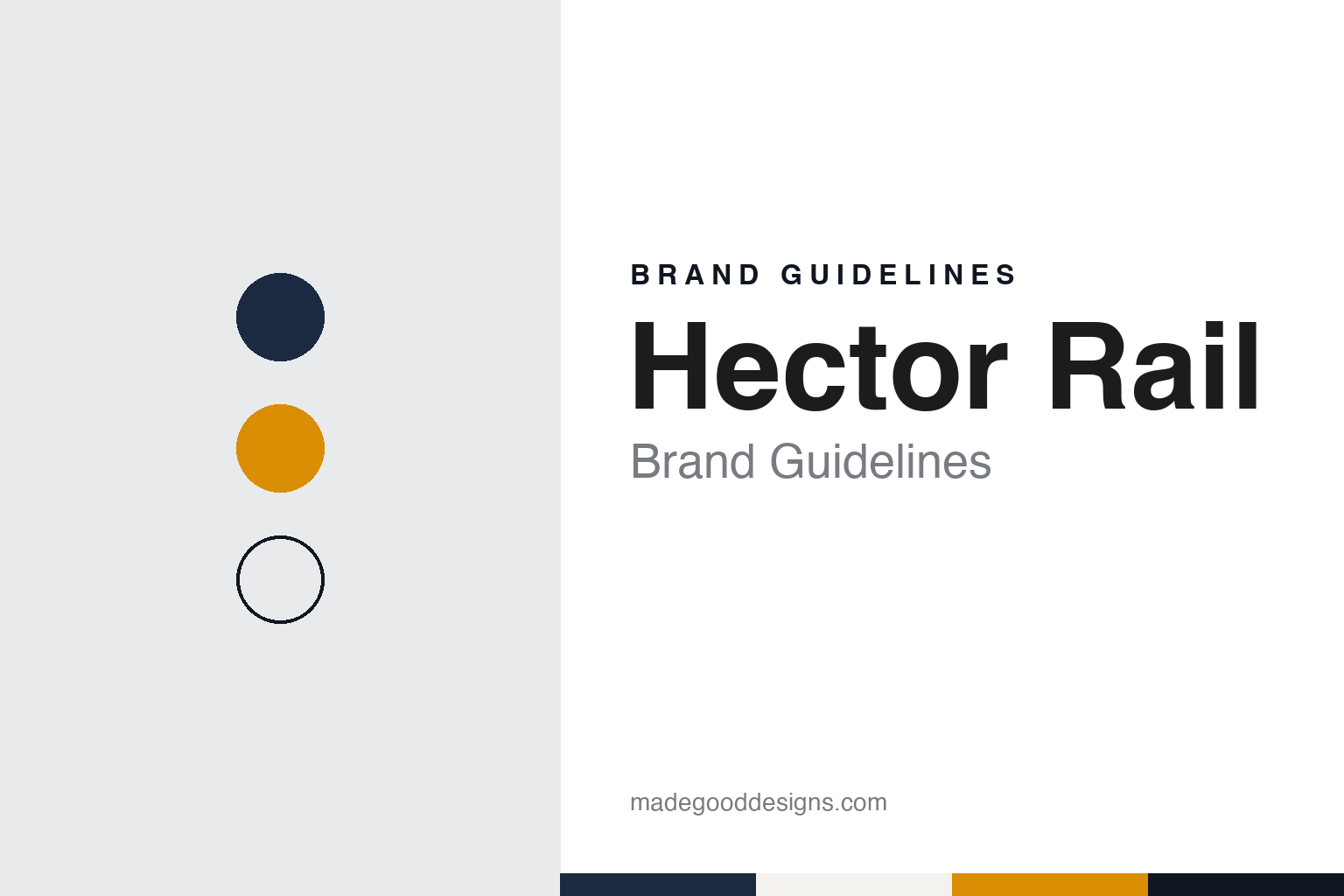
Hector Rail Brand Guidelines
The Swedish freight operator that numbers its own locomotives.
Aa
Two constants: a deep blue, amber and grey palette and an industrial sans register. Abstract homage — not a Hector Rail asset or mark; no locomotive, livery or logo is reproduced.
Høegh
A shipping family’s rail start-up.
Hector Rail ran its first train on 12 December 2004, shortly after the company was set up that year, according to English Wikipedia. At the start most of its shares were held by the Norwegian Høegh family, through Höegh Capital Partners; Swedish Wikipedia describes the family as a major international name in shipping. Early work centred on heavy goods between Sweden and Norway, and by 2007 the company was running about five million train-kilometres a year in the two countries, English Wikipedia says.
Expansion followed the freight corridors south. In January 2008 Hector Rail began operating in Denmark, and that year it ran its first trains between Sweden and Germany. It also formed a long-term partnership with the Dutch logistics group Samskip for direct rail services between Scandinavia and the rest of Europe; English Wikipedia says the frequency later reached six round trips a week between Sweden and Germany alone. In 2009 Hector Rail hauled its first passenger service, for Veolia.
The company’s own history page describes it, since 2004, as an independent, privately owned freight operator for the Scandinavian rail market. Its head office is in Danderyd, just north of Stockholm, and much of its operation sits in Örebro, where an operations centre plans and runs production around the clock, the company says. Swedish Wikipedia notes a large base at Hallsberg, south of Örebro, and traffic reaching from Piteå in the north of Sweden to Dortmund in Germany.
Colour
System trains and a numbering code.
Hector Rail runs system trains: whole trains hauled between two points to a regular timetable, for customers that are usually large industrial companies and freight forwarders, Swedish Wikipedia says. The company’s website lists four services — system, intermodal, wagonload and timber transport — and calls Hector Rail Europe’s second-largest carrier of timber, a claim it makes for itself. Loads for its customers include timber, steel and wood chips, it says, and in Germany it concentrates on segments such as energy and intermodal flows.
Unlike most private Swedish operators, Swedish Wikipedia notes, Hector Rail chose to invest in its own locomotives, buying new and second-hand machines from several sources. The fleet carries its own numbering system, which the company says makes it the only Swedish operator with numeric class designations. The first digit gives the number of electrical systems a locomotive can use, or marks diesel-electric or diesel-hydraulic transmission; the second gives the number of axles; the third separates similar types. The Class 241 is a Bombardier TRAXX built for two alternating-current voltages, Swedish Wikipedia says, and the Class 243 is a Siemens Vectron with a diesel engine for short stretches without overhead wire, the company says.
The fleet mixes new and older machines. English Wikipedia lists Austrian-built Class 141 and 142 electrics from ÖBB, Swedish Rc locomotives bought from SJ and numbered Class 143, Siemens EuroSprinters and Vectrons, and older diesels including former SJ T43s. The company’s locomotive page adds that it tries to name its locomotives after well-known characters, to underline their personalities, and that it treats each one as an individual. In 2019 the six Class 161 locomotives, former Norwegian El 15s that were its first engines according to Swedish Wikipedia, left service after new Vectrons arrived, and were sold in 2020 to Grenland Rail.
Passenger haulage has been a side line. Between 2016 and 2019 Hector Rail ran Blå Tåget between Gothenburg and Stockholm for Skandinaviska Jernbanor, and from May 2021 it hauled trains for FlixTrain in Sweden, English Wikipedia says.
Typography
How rail freight operators present themselves.
Rail freight operators sell a service that most people only glimpse from a level crossing or a station platform, so their identities lean heavily on the one thing everyone does see: the locomotive. Liveries, fleet numbers and named engines carry the brand across a whole network, and operators publish photographs of their fleets on their websites, in press releases and on social channels. A repaint for a customer, a partner or an anniversary is usually announced as news in its own right.
The second visual constant is the map. Operators that sell regular routes tend to show them as network diagrams, with ports, terminals and inland hubs joined by lines, much like a passenger timetable. Those that run trains to order describe their work in service categories instead, such as intermodal container trains, block trains for bulk goods, single wagonload and first- and last-mile shunting, and the wording on those pages is the company’s own description of what it offers.
Fleet pages are a genre of their own. Many operators list their locomotive classes with build dates, power systems and the routes they work, and new orders are presented as milestones, often with the builder and the leasing company named alongside. Numbers on these pages, from staff and trainloads to tonnage and market share, are figures the companies give about themselves at a particular date, and they change from year to year.
Sustainability pages have become standard across the sector. They usually set out targets, partnerships and new traction such as electric, bi-mode or biofuel locomotives, each tied to a dated announcement. In the guides that follow, those pages are treated as statements of what each company says it is doing and when, alongside its ownership history and the names it has traded under.
Aa
An industrial sans for a fleet that is identified by numbers. (Specimen set in Archivo, a sans STAND-IN; NOT the Hector Rail logo.)
Hector Rail
From EQT to Ancala, with a third sale agreed.
Ownership has changed twice, and a third sale has been agreed. In 2014 the Swedish investor EQT Infrastructure II bought the company — in September according to English Wikipedia, in November according to Swedish Wikipedia. At that point it had roughly 190 employees across Sweden, Norway, Denmark and Germany and a fleet of about 50 locomotives and 10 shunters, English Wikipedia says. A German subsidiary, Hector Rail GmbH, followed in 2015. From 2016 the British operator GB Railfreight sat under Hector Rail after EQT bought it, until EQT completed its sale to Infracapital in October 2019.
In June 2020 EQT agreed to sell Hector Rail to Ancala Partners, a mid-market investment manager; Railway Gazette International reported in September 2026 that Ancala acquired the business in 2020. Under Ancala the company invested in its electric fleet and brought its Scandinavian and German operations together, Hector Rail said in a press release.
On 28 September 2026 InfraRed Capital Partners announced that funds it manages had agreed to buy 100 percent of Hector Rail AB from Ancala. Railway Gazette International reported that the deal was subject to customary third-party consents and expected to close by late 2026; it had not been completed at the time of writing. The press release describes Hector Rail as the largest privately owned rail freight operator in Scandinavia, with just over 300 locomotive drivers and more than 100 locomotives including its German operations, and says planned investment includes additional locomotives and a programme of heavy maintenance. The company’s website gives about 400 employees and 80 locomotives in production.
Recent work includes a multi-year contract, from 1 June 2026, to run Södra’s shuttle carrying pulp and sawn timber between its Värö mill and the port of Varberg, the company announced. In June 2026 it also described a long-term fleet strategy covering ETCS upgrades and replacement locomotives, built around a ten-year vehicle plan.
For a design guide, Hector Rail shows a fleet presented through its own numbering code and named locomotives. Compare Green Cargo, the Swedish state-owned operator, and GB Railfreight, its former sister company under EQT. For this guide we use a deep deep blue, a signal amber and a cool grey with a sans, an unofficial interpretation; no product or logo is reproduced.
Explore & save
Keep Hector Rail’s identity on hand — save it to a board in the Made Good inspiration library.
Hector Rail identity set
Pin the Hector Rail deep blue, amber and grey palette and the industrial sans register to your own board.