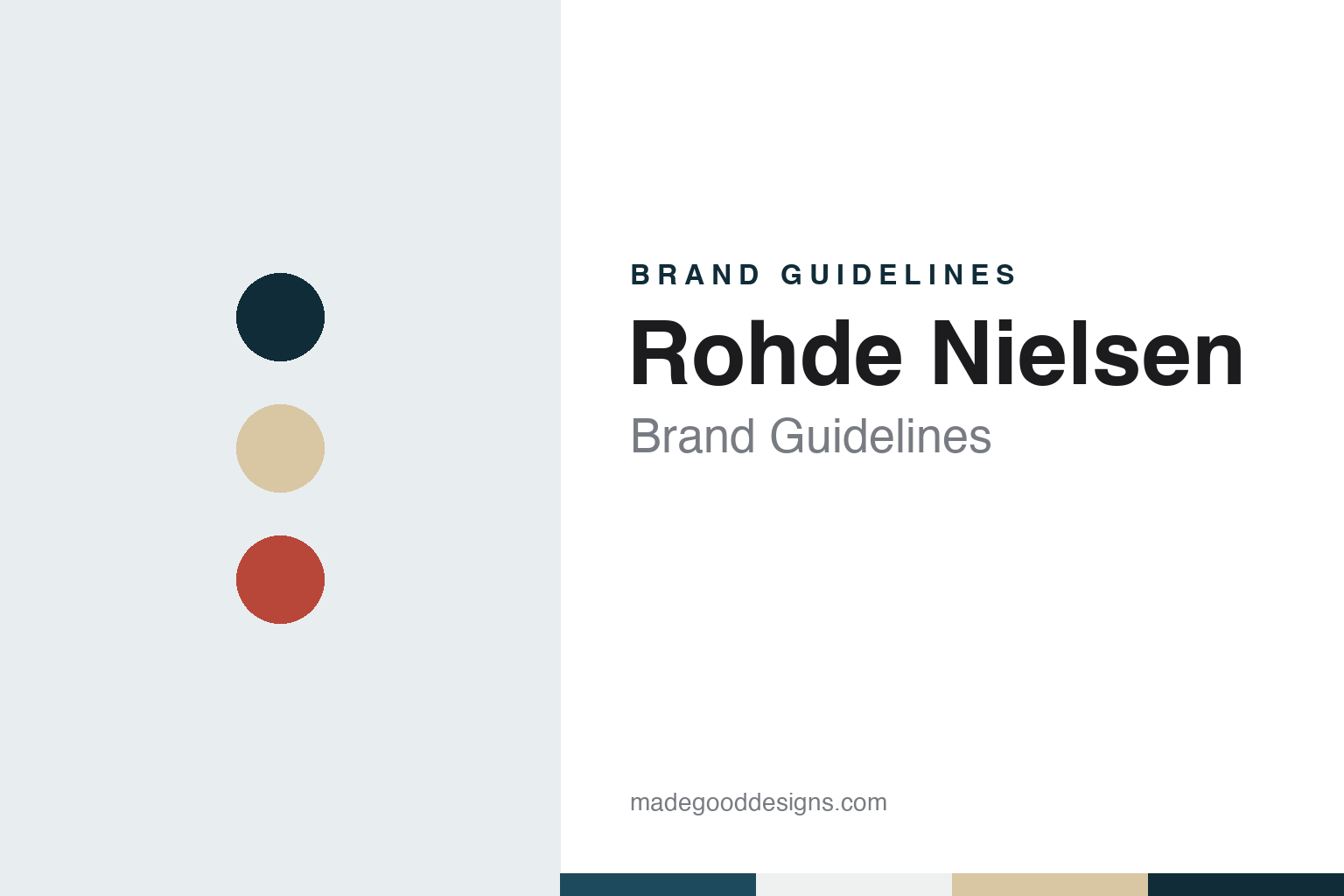
Rohde Nielsen Brand Guidelines
A Danish contractor that began with one ship and now names its dredgers after Norse myth.
Aa
Two constants: a teal, sand and buoy-red palette and a condensed sans register. Abstract homage — not a Rohde Nielsen product or mark; no vessel, logo or livery is reproduced.
M/S Amanda
One repurposed ship and a trip to England.
Rohde Nielsen dates its start to 1968, when Jens Rohde Nielsen founded the company with a single repurposed vessel, M/S Amanda, the company says on its website; Danish Wikipedia gives the same year and the same ship. Two years later, the company says, it took on its first job abroad, working on the shoals off the English coast on the foundations for the Royal Sovereign lighthouse, a manned offshore light station. Danish Wikipedia describes the early business as running routes to England and says that after the turn of the millennium the company changed focus and invested in ships for construction and civil works projects.
The company says that in 2002 Jeanette Rohde took over as managing director. Danish Wikipedia describes the group today as RN Holding A/S, a Danish shipowner, marine contractor and crewing business headquartered in Kastrup, on the island of Amager by Copenhagen, whose two main companies are Rohde Nielsen A/S and European Crewing ApS, a crewing agency set up in 2007 that supplies seafarers to shipowners.
The company’s own account of itself is compact. Its website gives figures of 45 vessels and items of equipment, 55 years of experience and 600 employees around the world, and calls the company “rather unusual” as a marine contractor because of its mindset rather than its machinery. Danish Wikipedia puts the fleet at 47 ships in 2026. The site works in English and Danish, and the older Danish address, rohde-nielsen.dk, now forwards to the Danish pages of rohde-nielsen.com; the company is unrelated to the German electronics group Rohde & Schwarz.
Colour
Hopper dredgers with Norse names.
Rohde Nielsen sorts its work into five activities on its website: coastal protection, land reclamation, port development, capital and maintenance dredging, and offshore services, which it describes as landfalls, trenching, seabed preparation and rock installation for cables and pipelines. Its fleet pages group the ships by type, from trailing suction hopper dredgers and grab dredgers to fallpipe vessels for rock installation, backhoe and bucket dredgers, hopper barges, barge unloaders, and tug and survey vessels.
The ships share a naming pattern. Trade reports give them names from Norse myth followed by the letter R. In April 2021 DredgingToday reported the arrival of Ask R and Embla R, two split trailing suction hopper dredgers of 2,700 cubic metres with diesel-electric drive and battery packs of 600 kilowatts, describing them as hybrid dredgers. In November 2025 the Danish trade site Maritime Danmark reported that the company had taken delivery of Hermod R, a diesel-electric trailing suction hopper dredger of 8,000 cubic metres built in 2020 by Jiangsu Haixin at Nantong in China, which had previously sailed for a Chinese contractor under another name; its first job was a coastal project in Portugal involving more than 3.3 million cubic metres of sand.
Other names appear in project reports: Grane R, Heimdal R, Toste R and Tjalfe R were among the ships on the Baltic Pipe gas pipeline, which Maritime Danmark reported in June 2022 that Rohde Nielsen had finished. The company’s slogan, repeated across its website, is “Safeguarding Tomorrow.”
Typography
Design and documentation.
Dredging and marine contracting is a business mostly seen from the shore. A trailing suction hopper dredger working a port channel, or a cutter suction dredger anchored off a reclamation site, is often the only public sign of a contractor, so the hull itself does much of the brand work: a strong field colour such as orange, red or blue, with the company’s wordmark painted large along the side so it reads from a quay or a news photograph.
The companies’ own websites tend to follow a shared pattern. Photographs of dredgers at work, as the firms publish them, sit beside fleet pages that sort the vessels by type, hopper dredgers, cutter suction dredgers, backhoe dredgers and support craft, each with a specification sheet of length, hopper capacity and dredging depth. Ship names are part of the identity too, whether a numbered series or a run of river and place names.
Project-reference pages carry the rest of the story. Rather than advertising, these firms describe what they have built or deepened: land reclamation, port deepening, channel maintenance, beach nourishment and coastal works, usually grouped by region or by type of work and illustrated with aerial views. Larger groups that also build roads, bridges and buildings sort a very mixed portfolio into categories so that a dredging job and a bridge contract sit side by side.
Because many clients are port authorities and governments, the most practical pages are often the plainest: tender notices, archives of completed contracts, investor and stock-exchange filings, and annual reports. For a designer, the useful lesson is how much of a marine contractor’s identity lives in operational material, vessel livery, fleet lists and contract pages, and how a restrained palette and a clear sans can hold that material together.
Aa
A condensed sans for a contractor’s register. (Specimen set in Barlow Semi Condensed, a sans STAND-IN; NOT the Rohde Nielsen logo.)
Rohde Nielsen
Beaches, ports and pipeline routes.
The company’s project pages run from Danish harbours to other continents. They include port work at Esbjerg, Frederikshavn and Hanstholm, the Horns Rev 3 offshore wind farm, beach work on the German island of Sylt and the Dutch coast, and projects at Cairns and Tauranga, Colombo and São Luís.
A recent example is documented in the trade press. In October 2026 Baird Maritime reported that Rohde Nielsen had completed coastal works at Matalascañas beach in Huelva, Spain, placing about 780,000 cubic metres of sand along four kilometres of coast over about three months with the hopper dredgers Idun R, Thor R and Njord R, and remodelling nine existing groynes. The work was carried out for Spain’s Directorate General for the Sustainability of the Coast and the Sea as part of a strategy for the Huelva coast, and was financed through the European Union’s recovery, transformation and resilience plan. According to the same report, the environmental assessment found that the most affected northern stretch of the beach was retreating by half a metre to a metre a year, and that the existing groyne field had been built along the town’s frontage in 1978. The contract was awarded to the company’s Spanish branch in June 2025 by Spain’s Secretariat of State for the Environment, the magazine said, and it noted that the project’s 2018 environmental assessment had set out a smaller original volume, 700,000 cubic metres along 3.7 kilometres, than the company’s completion figures.
That pairing of named ships with named beaches and harbours is how Rohde Nielsen presents itself: its website leads with activities, a fleet sorted by vessel type and a long list of project references, and it describes its fleet as among the greenest in the industry, which is the company’s own claim.
For a design guide, Rohde Nielsen shows how a fleet naming system, Norse names with a single shared letter, can work as an identity of its own. Compare Maersk, another Danish maritime name, and Royal IHC, a builder of dredging ships. For this guide we use a deep teal, a sand and a buoy red with a sans, an unofficial interpretation; no product or logo is reproduced.
Explore & save
Keep Rohde Nielsen’s identity on hand — save it to a board in the Made Good inspiration library.
Rohde Nielsen identity set
Save the Rohde Nielsen teal, sand and buoy-red palette and the condensed sans register to your own board.