Weeks Marine Brand Guidelines
A harbour stevedore that grew into a dredging and tunneling group.
Aa
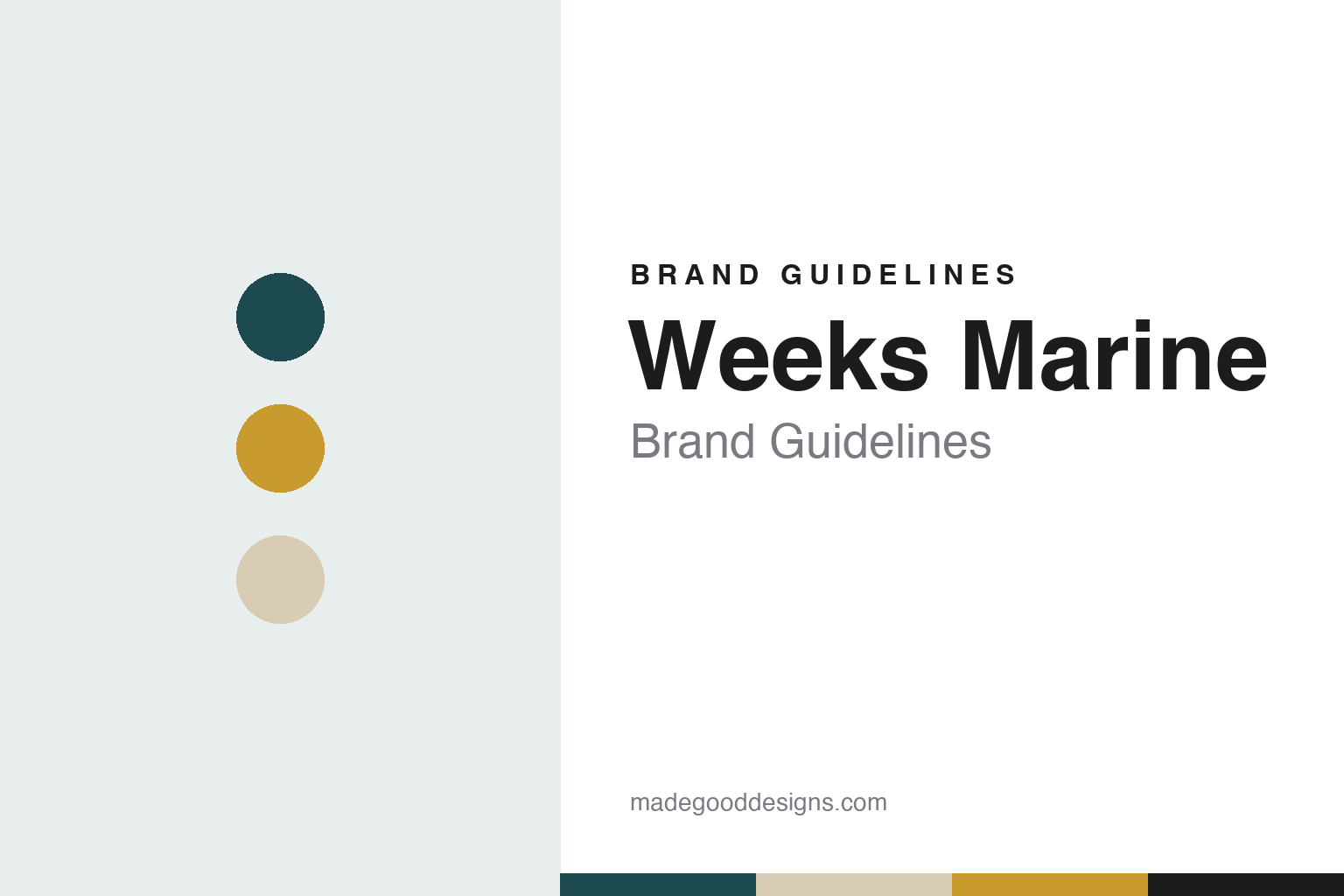
Two constants: a Weeks teal, sand and crane yellow palette and a Slab serif register. Abstract homage — not a Weeks Marine vessel or mark; no hull, logo or livery is reproduced.
Weeks Stevedoring
Two floating cranes in the Port of New York.
Weeks Marine began as a stevedoring firm. English Wikipedia and the company’s own timeline both say it was founded in 1919 by Francis H. Weeks and his son Richard B. Weeks as the Weeks Stevedoring Company, with two floating cranes in the Port of New York, handling bunker coal and dry ballast. The company says it was incorporated in New Jersey in 1934, and it is now based in Cranford, New Jersey.
The war years shaped the fleet. By the start of the Second World War the company had bought its seventh crane, English Wikipedia says, and was loading military equipment bound for Europe for the Allied forces. The heavy wartime workload wore out the wooden hulls of the cranes, and after the war they were replaced with steel hulls, creating the cranes Weeks #6 and #7, according to the same article; the company’s timeline also links the start of its fleet modernisation to the war effort.
In the 1950s the business moved beyond stevedoring. English Wikipedia says it took on salvage and dredging work, installed navigation aids for the US Coast Guard and built a breakwater for the air shaft of the Brooklyn–Battery Tunnel on Governors Island. It also became the prime contractor removing abandoned piers and vessels for the US Army Corps of Engineers in New York, the company says. In 1958 it bought the Weeks #500, its first crane used only outside stevedoring, English Wikipedia says.
The family stayed in the business. The company’s timeline records a third generation joining in 1952, a fourth in 1977 and a fifth in 2014.
Colour
Barges, dredges and a run of acquisitions.
The fleet grew in stages. In 1960 Weeks added two deck barges built by Richmond Steel, and in 1962 its first dump scow, the Weeks #250, English Wikipedia says. In the 1970s it bought its first dredge, the hydraulic dredge Venture, and its first large tug, the William J. McPhillips. The company says it developed its Greenville Yard in Jersey City in 1981 and built its first tugboat, the Elizabeth, in 1984.
Acquisitions followed. English Wikipedia and the company’s timeline list M.P. Howlett, a New York stevedoring company, in 1983; Healy Tibbitts Builders of Hawaii in 1989; the American Dredging Company in 1993; and hopper dredges and the Houma Yard in Louisiana from T.L. James & Co. in 1998. In 2011, the company says, it bought McNally International, a Canadian tunnel and marine contractor founded in 1949, which now leads its tunneling work.
Some of its work became public landmarks. Its 500-ton revolving barge crane, the Weeks 533, moved a Concorde and the Space Shuttle Enterprise onto the Intrepid Sea, Air & Space Museum in New York, English Wikipedia says. Between 2001 and 2003, and again from 2008 to 2010, Weeks carried retired New York City subway cars out to sea to form artificial reefs off several Atlantic states, according to the same article. In 2012, the company says, it joined Skanska and Kiewit as SKW Constructors on the Elizabeth River Tunnels in Virginia.
The company now describes four areas of work: marine construction, dredging, marine services and tunneling. Its dredging pages cover deepening and widening channels, maintenance dredging and coastal restoration of marshes, islands and beaches along the Gulf and East coasts.
Typography
Design and documentation.
Dredging and marine contracting is a business mostly seen from the shore. A trailing suction hopper dredger working a port channel, or a cutter suction dredger anchored off a reclamation site, is often the only public sign of a contractor, so the hull itself does much of the brand work: a strong field colour such as orange, red or blue, with the company’s wordmark painted large along the side so it reads from a quay or a news photograph.
The companies’ own websites tend to follow a shared pattern. Photographs of dredgers at work, as the firms publish them, sit beside fleet pages that sort the vessels by type, hopper dredgers, cutter suction dredgers, backhoe dredgers and support craft, each with a specification sheet of length, hopper capacity and dredging depth. Ship names are part of the identity too, whether a numbered series or a run of river and place names.
Project-reference pages carry the rest of the story. Rather than advertising, these firms describe what they have built or deepened: land reclamation, port deepening, channel maintenance, beach nourishment and coastal works, usually grouped by region or by type of work and illustrated with aerial views. Larger groups that also build roads, bridges and buildings sort a very mixed portfolio into categories so that a dredging job and a bridge contract sit side by side.
Because many clients are port authorities and governments, the most practical pages are often the plainest: tender notices, archives of completed contracts, investor and stock-exchange filings, and annual reports. For a designer, the useful lesson is how much of a marine contractor’s identity lives in operational material, vessel livery, fleet lists and contract pages, and how a restrained palette and a clear sans can hold that material together.
Aa
A slab serif with the weight of a crane barge. (Specimen set in Roboto Slab, a serif STAND-IN; NOT the Weeks Marine logo.)
Kiewit
A family firm joins an Omaha contractor.
Weeks Marine is no longer independent. On 11 January 2023 gCaptain reported that it had been acquired by Kiewit Corporation, the privately held construction company based in Omaha, Nebraska, together with its subsidiaries Healy Tibbitts Builders, McNally International and North American Aggregates. English Wikipedia dates the acquisition to 3 January 2023 and says Weeks continues to operate under its own name; the company says that “at the start of 2023” its businesses became wholly owned subsidiaries of Kiewit. The two firms already knew each other: Weeks told gCaptain it had worked with Kiewit companies in joint ventures since the 1960s, on projects including the Goethals Bridge and the Willis Avenue Swing Bridge.
At the time, gCaptain said, Weeks worked mainly along the US East and Gulf coasts, and through its subsidiaries in Central America, the Central Pacific and Canada. The company now says it has more than 1,800 employees. Its equipment page lists four trailing suction hopper dredges and seven cutter suction dredges; the cutter suction dredge J.S. Chatry was christened in Houma, Louisiana, in 2019, and the newest hopper dredge, the R.B. Weeks, built with Eastern Shipbuilding Group, was launched in June 2022, the company says. Its crane fleet now includes the W537, a fully electric floating crane.
For a design guide, Weeks Marine shows how a family name carried by its cranes and dredges can carry a century of harbour work into a larger group. Compare Manson Construction, another American dredging and marine contractor with founding-family roots, and Orion Group, a marine construction company on the Gulf Coast. For this guide we use a harbour teal, a sand and a crane yellow with a serif, an unofficial interpretation; no product or logo is reproduced.
Explore & save
Keep Weeks Marine’s identity on hand — save it to a board in the Made Good inspiration library.
Weeks Marine identity set
Pin the Weeks teal, sand and crane yellow palette and the Slab serif register to your own board.