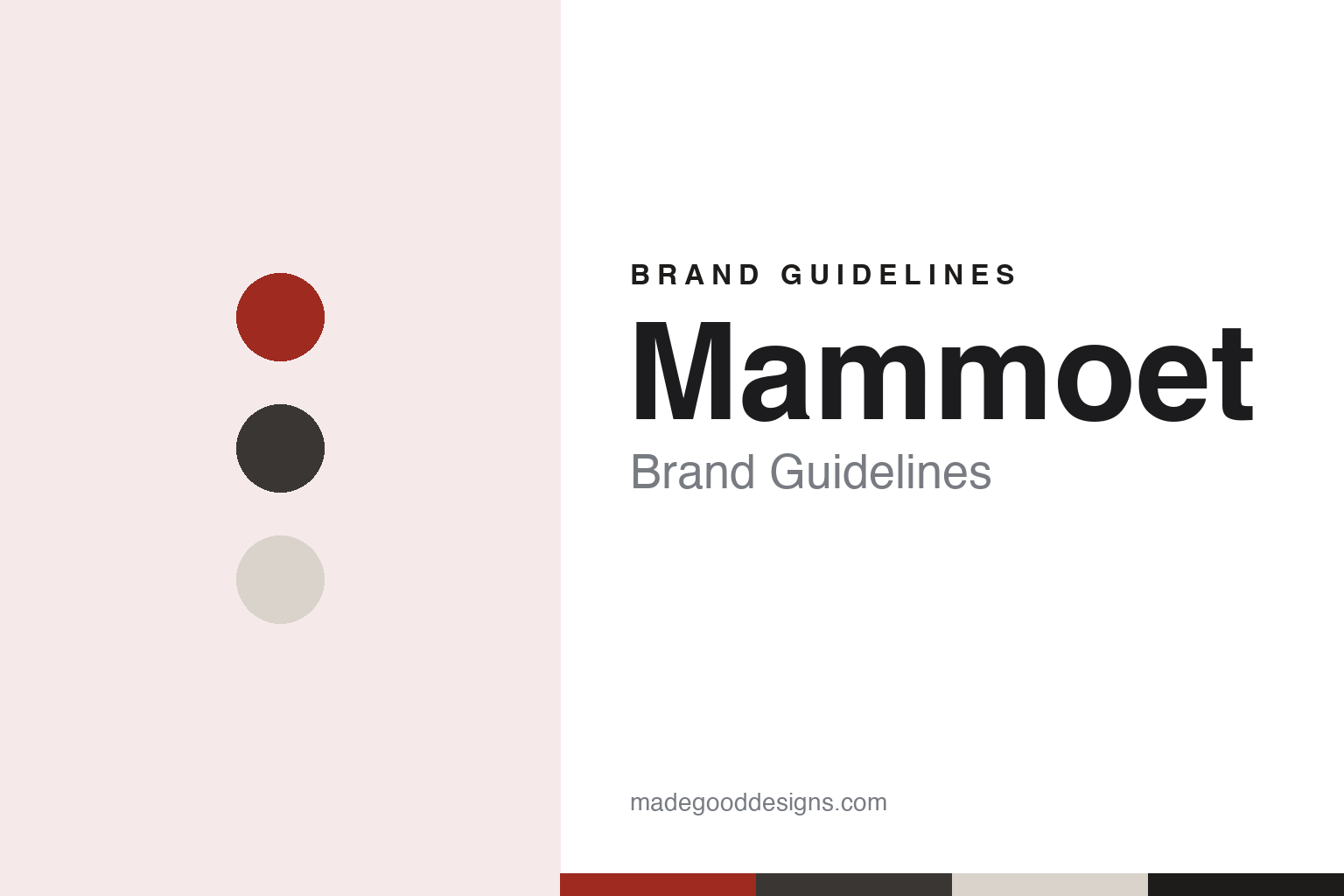
Mammoet Brand Guidelines
From an 1807 cargo vessel to ring cranes and modular transporters.
Aa
Two constants: a red, charcoal and grey palette of our own and a heavy grotesque sans register. Abstract homage — not a Mammoet product or mark; no crane, transporter, logo or livery is reproduced.
Gebroeders Goedkoop
A cargo vessel bought in 1807.
Mammoet traces its history to 13 May 1807, when the Dutch entrepreneur Jan Goedkoop, then 25, bought a 140-ton cargo vessel and started a maritime business. English and Dutch Wikipedia place the start in Utrecht; the company’s own history says Goedkoop expected heavy transport to be in demand as the Industrial Revolution began. The firm, called Gebroeders Goedkoop (“Goedkoop Brothers”), carried cargo and passengers on water. It bought its first tugboat in 1862, and from 1920 it concentrated on towing and salvage work with floating sheerlegs and inland vessels, Dutch Wikipedia says, partly because trains and trams were winning other traffic.
The sources used for this guide do not say how Gebroeders Goedkoop operated during the occupation of 1940–1945.
The name came with a merger. In 1971 Goedkoop joined Van Wezel of Hengelo, a heavy-transport and crane company, and the new business was called Mammoet Transport; mammoet is Dutch for mammoth. In 1972 it bought Stoof Breda, which the company describes as one of the Dutch market leaders in engineered heavy lifting and transport at the time. In 1973 Mammoet Transport became a subsidiary of the Amsterdam shipping company KNSM (Koninklijke Nederlandse Stoomboot-Maatschappij), the name was shortened to Mammoet, and a sea-going arm, Mammoet Shipping, was founded. The company says that arm let it offer what it calls “factory-to-foundation” work: moving vessels and modules from the factory to their site, anywhere in the world, and installing them there. In 1981 KNSM and Mammoet became part of the Nedlloyd group, according to English and Dutch Wikipedia.
The present company took shape around the turn of the century. Dutch Wikipedia says Mammoet took a majority stake in the heavy-lift firm Stotra in 1998. In 2000 Mammoet was acquired by and merged with Van Seumeren Kraanbedrijf, a crane company founded in 1966, and in 2001 it sold Mammoet Shipping to the Spliethoff Group, which renamed it BigLift Shipping. Since 2001, Dutch Wikipedia adds, the European head office has stood in Schiedam in a steel office building called De Bolder, which was built in Zwijndrecht, floated to Schiedam on a pontoon and driven into place on the company’s own modular transporters. English Wikipedia names Schiedam as the head office of the holding company.
Colour
SHV, ALE and the SK6000.
Ownership then passed to SHV, the Dutch family-owned trading group. The company’s history dates the SHV acquisition to 2006; Dutch Wikipedia says SHV gained 75 per cent of the shares at the end of that year through an investment subsidiary, the Van Seumeren family kept a quarter, and on 4 July 2011 the family sold its remaining shares to SHV and left the company.
In July 2019 Mammoet announced plans to take over its British counterpart ALE, Dutch Wikipedia says. Heavy Lift & Project Forwarding International reported on 8 January 2020 that Mammoet had completed the acquisition of the UK-headquartered company, and Dutch Wikipedia gives 7 January 2020 as the completion date; Mammoet’s own history calls the deal a merger. ALE’s story is told in our ALE guide.
SHV has twice tried to sell Mammoet. In March 2023 the Austrian transport weekly Österreichische Verkehrszeitung reported that SHV was reviewing the sale of its holdings in ERIKS and Mammoet as part of a strategy update. On 29 June 2023 NRC reported that SHV had dropped the plan, saying in a short statement that a sale would not lead to a better owner. In August 2026 de Volkskrant, citing Het Financieele Dagblad, reported that a renewed attempt to sell Mammoet had not succeeded and described SHV Holdings as the current owner.
The company’s history gives equipment a central place. It says it developed a container-sized Self-Propelled Modular Transporter (SPMT) in 1983; English Wikipedia says it did so with the German maker Scheuerle and that the machine became standard for heavy transport on site. English Wikipedia also says Mammoet designed and built its SK and PTC series of ring cranes in-house, while buying most of its mobile and crawler cranes from makers such as Liebherr, Terex and Manitowoc. In July 2024 Construction Digital reported that Mammoet had begun assembling the SK6000 ring crane at its Westdorpe facility in the Netherlands, with a maximum capacity of 6,000 tonnes and full electric operation, and called it the strongest land-based crane ever built.
English Wikipedia lists the raising of the London Eye over the Thames in October 1999 and the moving of Kiruna Church in Sweden in 2025, which Dutch Wikipedia says travelled more than two kilometres that August. The company groups its services as heavy lifting, heavy transport, crane rental and industrial solutions, for sectors from oil and gas, offshore and wind energy to civil engineering, ports and shipyards, mining, power grids and nuclear power. Its About page speaks of 7,000 Mammoet professionals; English Wikipedia gives about 5,000 people in more than 100 locations. Joost Goderie joined the Executive Board as chief executive in January 2024, the company says.
Typography
How heavy-lift companies present themselves.
Heavy-lift and project-cargo carriers sell something that is hard to show before it happens: the movement of a single object too large or too heavy for a container. Their websites lean on photographs of their own ships and cargo instead, heavy-lift vessels with paired cranes, decks loaded with modules, port cranes or offshore structures, published by the companies themselves as records of past voyages.
Colour carries much of the identity. Company names are painted large on hulls and crane booms, and across this sector the wordmarks often appear in strong orange, blue or red against white superstructures and dark hulls, so that they read from a quayside or in an aerial photograph. The same few colours then tend to run through the livery, the website and the printed material.
Fleet pages sit at the centre of these sites. Ships are grouped by class and described by crane capacity, deck area and deadweight: Jumbo lists its vessels as K3000, J1800 and H800 classes, and BigLift divides its fleet into heavy-lift types and heavy transport vessels such as the MC-Class. Engineering and transport services, from stowage planning to ship-motion analysis, are presented beside the fleet as a second product.
The rest of a typical site is evidence and reach: project-reference galleries sorted by market, from mining to offshore energy and port development; customer magazines and news of ships on order; and office maps showing sales and agency networks across several continents. This guide sets out what can be checked about each company, its founding, its ownership and its fleet, and marks clearly what rests on the company’s own word.
Aa
A heavy grotesque sans for a company named after a mammoth. (Specimen set in Archivo, a sans STAND-IN; NOT the Mammoet logo.)
Mammoet
A mammoth for a name.
The name carries the identity. Mammoet means mammoth, a plain image of size for a company whose business is lifting and moving very heavy objects, and it has been the company name since the 1971 merger and, in its short form, since 1973. Dutch Wikipedia notes that two former units still use the Mammoet name and a similar logo: Mammoet Ferry Transport, independent since 2000, and Mammoet Road Cargo, in which Mammoet keeps a 10 per cent share and whose trucks share the same colour. The encyclopedia says this sometimes causes confusion.
The name also has a following of its own. de Volkskrant wrote in 2026 that Mammoet has a fan club, complete with a club magazine, and that fans can buy scale models in its web shop. The company’s website reflects the same mix of engineering and public interest: pages by sector, from refinery turnarounds to wind-turbine installation and nuclear decommissioning; case studies; an equipment section; the Mammoet Academy; a used-equipment sales section; and the store.
For a design guide, Mammoet shows how a company with two centuries of history behind it can lead with one strong word and a fleet of machines that do the talking. Compare ALE, the British heavy-lift company Mammoet took over in 2020, and BigLift, its former shipping arm. For this guide we use a deep red, charcoal and warm grey with a heavy sans, an unofficial interpretation; no product or logo is reproduced.
Explore & save
Keep Mammoet’s identity on hand — save it to a board in the Made Good inspiration library.
Mammoet identity set
Save the Mammoet red, charcoal and grey palette and the heavy grotesque sans register for your own heavy-industry projects.