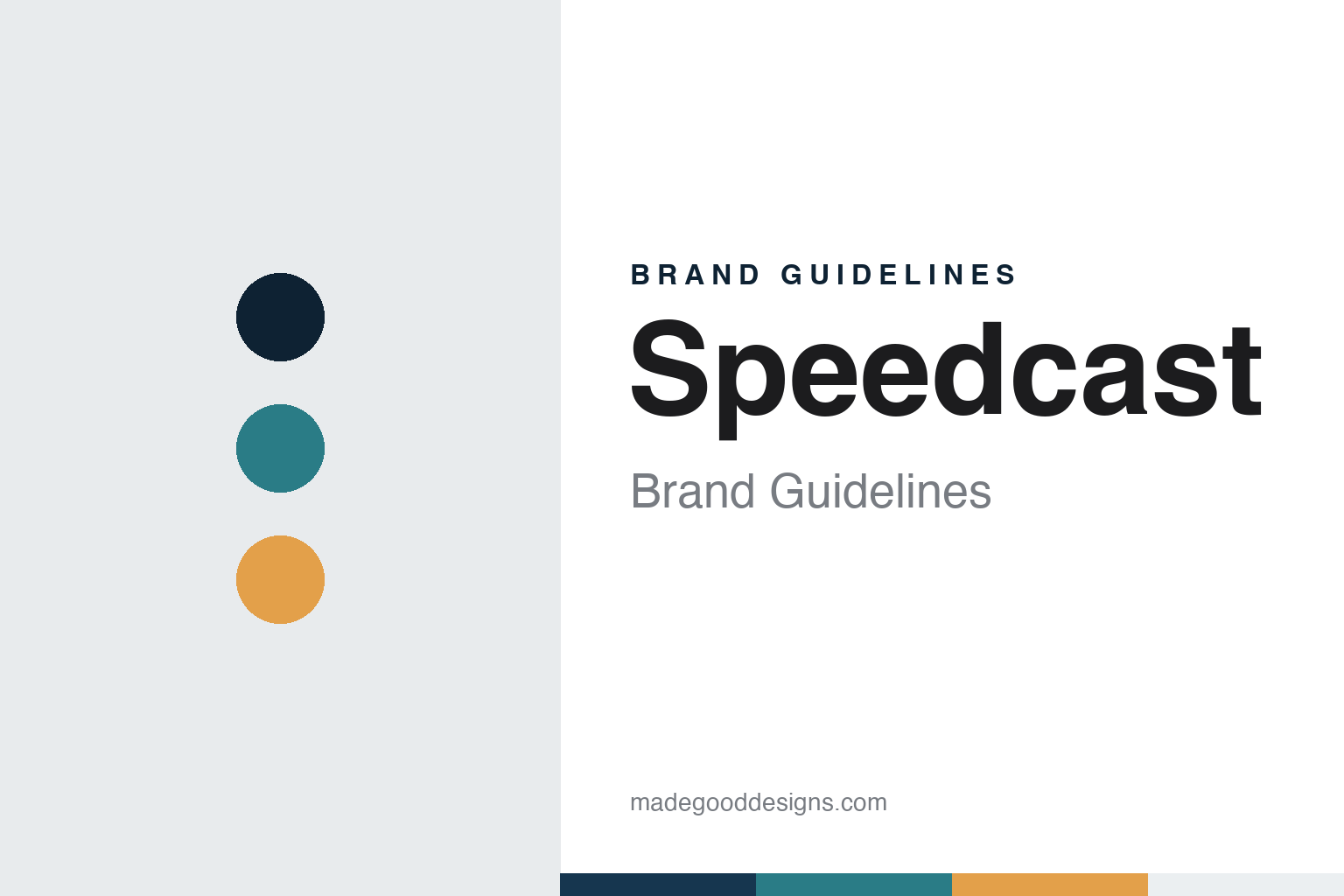
Speedcast Brand Guidelines
Remote connectivity, from Hong Kong roots to a Houston base.
Aa
Two constants: a deep sea, teal and amber palette and an engineered sans register. Abstract homage — not a Speedcast product or mark; no antenna, logo or wordmark is reproduced.
SpeedCast
A Hong Kong satellite-services start that grew by buying.
Speedcast is a communications and IT services company for remote operations: merchant ships, cruise ships and yachts, offshore and onshore energy sites, mines and other places that fibre does not reach. English Wikipedia’s history of the company dates it to September 1999, names Thomas Choi as its founder, and says the satellite operator AsiaSat became a principal shareholder in March 2000 and took full ownership in November 2007. When SpaceNews covered the company in November 2016, it still described it as “SpeedCast of Hong Kong” and spelled the name with a capital C.
The modern company was assembled through acquisitions. The private equity firm TA Associates bought it from AsiaSat in September 2012, according to Wikipedia, and three purchases followed within months: Australian Satellite Communications in December 2012, the Dutch firm Elektrikom in January 2013 and Pactel International of Australia in April 2013. Together they formed the Speedcast Group. In June 2014 it added the Australian integrator Oceanic Broadband, and in August 2014 the company listed on the Australian Securities Exchange.
The buying continued after the listing. Wikipedia counts six acquisitions in 2015 alone, among them Geolink Satellite Services, the Australian satellite provider NewSat, the Singapore teleport operator ST Teleport and Newcom International in Latin America, followed in 2016 by WINS, a maritime broadband and IT provider in Europe.
A bigger step came at the end of that year. On 1 November 2016, SpaceNews reported, Speedcast agreed to buy Harris CapRock, the energy and maritime communications business of Harris of Melbourne, Florida; the report said the combined company would have more than 6,200 maritime vessels under contract, plus hundreds of energy rigs and platforms. The purchase completed on 1 January 2017, Wikipedia says, and the communications group Globecomm followed in late 2018.
Colour
Chapter 11, a new owner and a Houston dateline.
The acquisitions brought debt with them. Trading in Speedcast shares was suspended on the ASX on 3 February 2020, and on 23 April 2020 Speedcast International filed for Chapter 11 bankruptcy in the United States. SpaceNews reported that day that the company, which leased capacity on more than 80 satellites, cited weakness in the cruise and oil markets.
The restructuring took nearly a year. On 11 March 2021 Speedcast emerged from Chapter 11 under the ownership of the private investment firm Centerbridge Partners, which, SpaceNews reported, had completed the necessary regulatory and administrative requirements; the deal wiped out the company’s debt. Speedcast told the magazine it would ease off acquisitions and concentrate on integrating the more than 60 networks it then ran. It has been privately held since, and its press releases now carry a Houston, Texas dateline.
Today the company describes itself as a communications and IT services provider whose services run over a hybrid network of satellite, fibre, cellular, microwave and IP links. At the centre of its offer is SIGMA, which it calls its proprietary “intelligent edge network management platform”: software that manages several connections at once on a ship or remote site, hosts applications at the edge and runs crew and guest Wi-Fi, according to a 2025 company blog post. Speedcast is an authorised Starlink reseller and also sells Eutelsat OneWeb services, and it says it serves more than 3,200 customers in over 140 countries, with more than 750 people in 40 countries.
A release from August 2026 shows how those parts fit together at sea. Speedcast said it was installing an all-low-Earth-orbit system across the seismic survey fleet of TGS, the energy data company, using Starlink’s Dedicated Service and Eutelsat OneWeb, with SIGMA’s Elite version orchestrating the links, so that survey data could be sent ashore for processing instead of being carried off the vessels on physical media.
Typography
Marine electronics and satcom.
Marine electronics and satellite-communications companies tend to present themselves through their equipment first. Their websites lead with product photographs of radars, chartplotters, sonar displays, antennas and satellite terminals, usually shown on a plain background or mounted on a mast, a wheelhouse roof or a radar arch. Domes and displays are shot from the same few angles so that a whole range reads as one family, and model names, sizes and frequency bands do much of the descriptive work.
Coverage is the second recurring image. Satellite-service providers and antenna makers publish coverage maps for each network or plan, from regional cellular zones to global satellite beams, and many now show several networks side by side as low-orbit services join older geostationary ones. Bridge and wheelhouse photography carries the human side: officers at consoles, screens glowing in a dark bridge, yachts at anchor, fishing boats and offshore vessels at work.
Airtime and connectivity plans are a large part of how these companies describe themselves. Data allowances, subscription terms, crew-internet packages and backup services are laid out in plan tables, named and grouped the way each company chooses, and a hardware maker may sell plans on its own network next to those of other operators. Network-management software, cyber security services and content for crews increasingly sit alongside the hardware.
Partner pages complete the picture. Dealer and installer networks, service points in ports, and the satellite operators and equipment makers a company works with are listed with their own names and marks. This guide describes each company’s identity from dated sources and the company’s own pages, and the colours and typefaces shown are unofficial interpretations rather than reproductions of any mark.
Aa
An engineered sans for a network company. (Specimen set in Barlow, a sans STAND-IN; NOT the Speedcast logo.)
Speedcast
Teleports sold, software kept.
The company changed shape again in 2026. On 3 November 2026 Speedcast said it had completed the sale of its teleport infrastructure business to SatPort Infrastructure, a ground-station company backed by EQT Infrastructure. The sale covered 12 teleports in 11 countries on five continents, with related terrestrial infrastructure and the teams that run them. The teleports continue to carry Speedcast’s managed connectivity services under a long-term ground infrastructure-as-a-service agreement, and the company said the sale gives it a lighter asset base and lets it put more resources into SIGMA. The same release states that the core connectivity and managed services business remains owned by Centerbridge, which acquired it in March 2021.
The spelling of the name has changed over the years as well. Coverage from 2016 spells it SpeedCast; the company’s own website and releases in 2026 write Speedcast, with a lower-case c, and that is the spelling this guide uses. The 2026 releases also describe the company as moving from connectivity provider to what it calls an “AI-enabled network and edge intelligence company,” with SIGMA as the product it intends to develop. Its website is organised by industry rather than by hardware, with sections for commercial maritime, cruise and ferries, yachts, energy, mining, telecom and broadcast media, and by service lines such as connectivity, network management, systems integration and professional services.
For a design guide, Speedcast shows a services company presenting itself through its network, its partners and its software rather than through a product range. Compare Marlink, another managed satellite-services provider for ships and remote sites, and Inmarsat, the satellite operator behind the Fleet Xpress maritime service. For this guide we use a deep sea blue, a teal and an amber with a sans, an unofficial interpretation; no product or logo is reproduced.
Explore & save
Keep Speedcast’s identity on hand — save it to a board in the Made Good inspiration library.
Speedcast identity set
Pin the Speedcast deep sea, teal and amber palette and the engineered sans register to your own board.