VTG Brand Guidelines
From WiFo tank wagons to a Hamburg wagon-hire fleet and traigo.
Aa
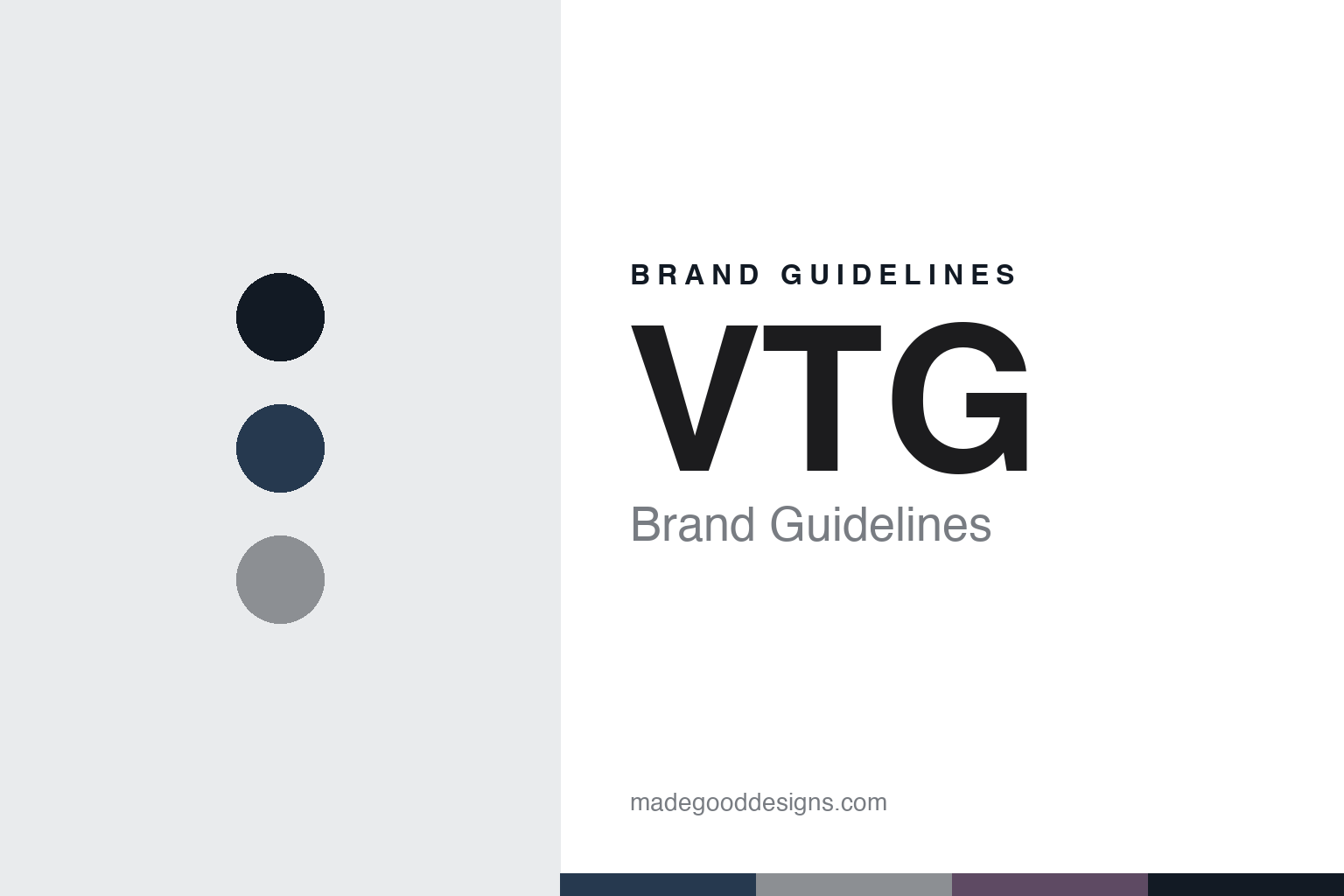
Two constants: a VTG harbour blue, grey and plum palette and a technical sans register. Abstract homage — not a VTG product or mark; no wagon, logo or nameplate is reproduced.
WiFo and VTG
A state fuel-depot company and its successor.
VTG is a Hamburg company that hires out rail freight wagons across Europe and runs rail logistics services. The company dates its founding to 1951, when VTG Vereinigte Tanklager und Transportmittel GmbH — “united tank depots and means of transport” — was founded in Hamburg as a state-owned company. German Wikipedia explains where that company came from: it took over the tank depots, tank wagons and tank ships that had until then been run under the name of the Wirtschaftliche Forschungsgesellschaft, or WiFo.
Despite its name, which means “economic research company,” the WiFo was not a research business. German Wikipedia’s article on it says it was founded in Berlin in August 1934 on behalf of the Reich economics ministry as a cover company to obtain, store and produce raw materials considered vital for war, and to ensure fuel supplies for the Wehrmacht. Its main task was building secret large fuel depots, many of them underground, and it also ran mineral-oil tank wagons and tank barges; by 1942, the article says, it had more than 38,000 rail tank wagons and 35 tank barges. In 1942 it employed almost 10,000 people and kept barrack camps for forced labourers and prisoners of war at several of its sites, the article says.
After 1945 most of the large depots were demolished, and in 1951 the WiFo’s management decided to wind the company up, German Wikipedia says. Three successors emerged: a company in liquidation that managed its property, the state holding IVG, and VTG, which began as a wholly owned IVG subsidiary and took over most of the tank wagons and tank ships. VTG says it was privatised in 1961 through its sale to Preussag, the group later renamed TUI; the WiFo article gives 1962. Under Preussag the company concentrated on wagon hire, and from 1999, as VTG-Lehnkering AG, it was also active in inland shipping and tank storage.
Colour
From Preussag to private owners.
Growth came largely through acquisitions. In 2002 VTG bought the European wagon-hire business of the Australian Brambles group, which it says added about 23,000 wagons, and in 2004 it sold its bulk and special logistics activities and became VTG Aktiengesellschaft. In June 2005 TUI sold VTG to Compagnie Européenne de Wagons, whose shares German Wikipedia says were mostly held by funds managed by an investment group around the American investor Wilbur Ross. VTG listed on the Frankfurt Stock Exchange in 2007 and entered North America in 2008 with Texas Railcar Leasing. In January 2015 it completed the takeover of the Swiss lessor AAE, which German Wikipedia says brought 30,000 wagons; VTG says its fleet then passed 80,000. The purchase of CIT Rail and its Nacco group in 2018 took it past 90,000, the company says, and German Wikipedia adds that 3,000 Nacco wagons were sold for competition reasons to a consortium of the Swiss lessor Wascosa and Aves One.
Ownership changed in stages. Morgan Stanley Infrastructure Partners bought a 29 per cent stake in 2016, reached almost 50 per cent in July 2018 and held 70.6 per cent after a takeover offer whose acceptance period ended in December 2018, German Wikipedia says. VTG delisted its shares in 2019, and German Wikipedia says shareholders approved a squeeze-out of the remaining minority in September 2021. In 2019 the Canadian pension fund OMERS bought a stake from Morgan Stanley. On 29 June 2022 VTG announced that Morgan Stanley’s holding company and the Joachim Herz Stiftung had agreed to sell a 72.5 per cent stake to a consortium of funds managed by Global Infrastructure Partners and a subsidiary of the Abu Dhabi Investment Authority, with OMERS keeping 27.5 per cent; German Wikipedia records GIP and ADIA as holding the 72.5 per cent. In December 2022 VTG became a GmbH, a limited liability company, with an advisory board in place of its supervisory board.
The portfolio has since narrowed. VTG says it sold its North American wagon-leasing business and its tank container unit’s overseas activities in 2021, and German Wikipedia says it gave up tank container transport and forwarding in mid-2023. In September 2026 VTG signed an agreement to sell VTG Rail UK to the Universities Superannuation Scheme; Pensions Expert reported that the deal was expected to complete in the fourth quarter of 2026, and it had not completed at the time of writing.
Typography
Design and documentation.
Railcar and wagon lessors sell something most people only glimpse from a level crossing: the use of a freight car for a fixed term. Their identities are built for two audiences at once. One is the shipper, railroad or logistics firm signing a lease; the other is everyone who sees the car roll past, because the lessor’s name is often painted on the side of the wagon itself. The car body works as a moving sign for the company that owns it.
Their websites tend to be organised around equipment. Fleet pages are usually split by wagon type, so tank cars for chemicals and mineral oils sit apart from covered hoppers, gondolas, flat cars, boxcars and intermodal wagons, and locomotives often have their own section. Photographs show the cars as the companies publish them, side-on and in yards or on the main line, with the lessor’s name and markings clearly legible.
Service pages carry much of the rest. Lessors describe maintenance workshops and field teams, training on handling wagons, and customer portals where fleets can be managed online. Several now present telematics: sensors and wireless devices that report a car’s location, condition and cargo status in near real time. Sustainability pages make the case for rail freight more broadly, and some describe the conversion or rebuilding of older cars.
Several of these companies are listed or owned by infrastructure investors, so investor pages, quarterly results and fleet counts take up a large share of what they publish. Palettes in this category are often restrained, with blues, reds, greens, greys and black recurring as our interpretation of the sector rather than as any company’s official colours. The guides that follow use tones of our own choosing.
Aa
A technical sans for a wagon-hire fleet. (Specimen set in IBM Plex Sans, a sans STAND-IN; NOT the VTG logo.)
VTG
A fleet and one digital platform.
Wagon hire remains the core. VTG’s website describes a fleet of 75,000 rail freight wagons for liquid, bulk and intermodal transport in 26 countries and calls it Europe’s largest privately owned fleet; its June 2022 release gave about 88,500 railcars, mostly tank wagons, intermodal wagons, standard freight wagons and sliding-wall wagons. German Wikipedia counts about 1,000 wagon types and four repair works in Germany, France and Slovakia, and says VTG holds half of the Swiss lessor Transwaggon. Alongside hire, VTG runs rail logistics, mainly for mineral-oil and chemical products, liquefied gases and bulk goods, and operates its own workshops. In June 2026 it said it would close its intermodal wagon workshop at Großräschen, in Brandenburg, at the end of 2026.
The digital side has its own name. Since 2020 VTG has grouped its online services under traigo, a customer platform for wagon tracking, fleet information and documents. German Wikipedia notes that VTG shared the Privatbahn Magazin innovation prize for 2018–2019 with the federal transport ministry and DB Cargo for the “Innovative Freight Wagon” project. In 2026 the company marked its 75th anniversary and moved into a new office building, and its website uses the line “Moving you forward.” Its chief executive is Alberto Nobis, according to its September 2026 release.
For a design guide, VTG shows how a wagon lessor with a long and complicated history presents itself through its fleet, sorted by wagon type, and a single digital platform. Compare DB Cargo, the German rail freight operator, and Wascosa, the Swiss wagon lessor. For this guide we use a deep harbour blue, a tank-wagon grey and a muted plum with a sans, an unofficial interpretation; no product or logo is reproduced.
Explore & save
Keep VTG’s identity on hand — save it to a board in the Made Good inspiration library.
VTG identity set
Pin the VTG harbour blue, grey and plum palette and the technical sans register to your own board.