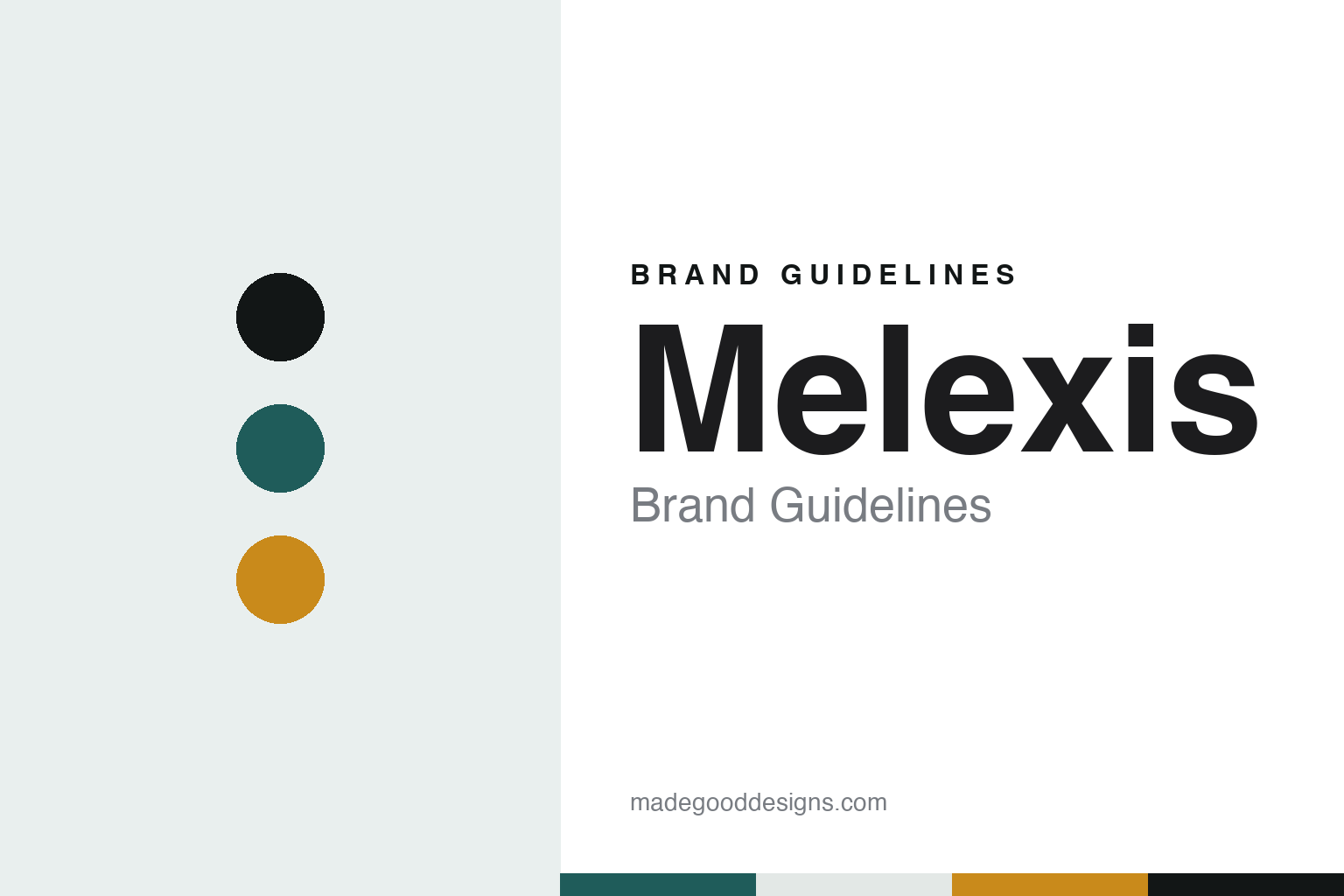
Melexis Brand Guidelines
The Ieper sensor-chip designer behind car electronics.
Aa
Two constants: a teal, mist and amber palette and a rounded technical sans register. Abstract homage — not a Melexis product or mark; no chip, sensor or logo is reproduced.
Three founders
A Flemish chip company built around the car.
Melexis is a Belgian semiconductor company with its registered home in Ieper (Ypres), in West Flanders. Sources differ by a year on its start. The Dutch investor site Beursgenoten, drawing on market-data supplier ShareCompany, gives 1988; the Flemish business title Made in wrote in January 2025 that the company was founded in 1989 by Roland Duchâtelet, Françoise Chombar and Rudi De Winter. In a November 2014 interview, eeNews Europe said Chombar had helped create Melexis 25 years earlier with De Winter and Duchâtelet.
The three founders have shaped the company for its whole life. Duchâtelet, a Limburg entrepreneur, is the founder most often named in the Belgian press; he chaired the board for many years. De Winter led Melexis as chief executive before Chombar, eeNews Europe reported, and in 2014 was also chief executive of X-FAB, the foundry in which the same holding company had a majority stake. Chombar was chief executive for seventeen years until early 2021, when, Computable reported citing De Tijd, she handed over to Marc Biron and succeeded Duchâtelet as chair of the board.
Ownership has stayed close to those founders. In 2014 eeNews Europe described Xtrion NV of Tessenderlo, a holding company founded by Duchâtelet, as holding majority stakes in both Melexis and X-FAB. More recent shareholder data on Beursgenoten lists two known shareholders, Elex NV and Sensinnovat BV, at 25 percent each, and the company’s shares trade on Euronext Brussels.
Melexis also keeps a major site in Tessenderlo-Ham, in Limburg, and in 2025 Made in described the micro-electronics engineering company as coming from Tessenderlo-Ham, while other reports place it in Ieper.
Colour
Hall sensors, current sensors and car networks.
The car has always been the core market. In the 2014 interview, Chombar said automotive accounted for 87 percent of turnover in 2013, and eeNews Europe described Melexis as a supplier to the sector of Hall-effect magnetic sensors, pressure sensors, optical and wireless chips and sensor-interface ICs. The range then also took in MEMS sensors, current sensors and image sensors, and Melexis had built up expertise in in-car network protocols such as LIN, used among other things to drive RGB ambient lighting.
Its wireless unit, the same interview said, had worked for more than a decade on short-range connectivity and identification: RFID, passive keyless entry, near-field communication and tyre-pressure monitoring. In the optical field it sold rain and light sensors, proximity sensors and gesture-recognition sensors for cockpit controls. Computable noted in 2021 that its chips also find their way into washing machines, air conditioners, drones and motorcycles, though cars remain the main market.
Melexis is fabless. “We buy wafers and assembly services but we do test ourselves,” Chombar told eeNews Europe, explaining that many automotive circuits need calibration. She named X-FAB as its main foundry and said Melexis also worked with other foundries. That close link between a chip designer and a foundry with overlapping shareholders is one of the defining features of the Belgian group.
Development reaches beyond Flanders. In January 2025, Made in reported that Melexis was opening a new research and development centre in Sophia Antipolis, the technology campus between Nice and Cannes, where engineering teams would develop the next generation of current sensors for automotive, alternative mobility and robotics. Chief executive Marc Biron, who Computable said had spent almost 25 years at the company and had run its Hall-sensor and engine-management, development and quality, and sense-and-drive divisions, was quoted on the move.
Typography
How power-chip makers present themselves.
Analog and power chipmakers sell parts that most people never see. Their products sit inside chargers, cars, motor drives and power supplies, usually as small black packages soldered to a board, so the industry’s visual language has to make something tiny and hidden look solid and precise. The usual answer is the macro photograph: a packaged chip or a power module shot close up against a dark or plain ground, its leads and markings sharp and its edges lit like an object in a catalogue.
Materials are the second subject. Makers that work with silicon carbide tend to show the wafer itself, a thin disc that often looks faintly green or amber under studio light, while gallium-nitride and silicon makers show wafers patterned with rows of dies. These images stand in for the factory, which tends to appear as clean-room suits and wafer carriers rather than as a building.
The third subject is the application. Power-chip makers lean heavily on electric-car chargers, inverters, solar installations and data-centre racks, because those are where their parts do visible work. Closer to the engineer, the pictures shift to evaluation boards on lab benches, probes and cables, and oscilloscope traces showing a clean switching edge — an image that speaks to the people who will design the chip in.
Trade shows complete the picture. Europe’s electronica in Munich and PCIM in Nuremberg, and APEC in the United States, are where many of these companies set out their stands, demonstration boards and new packages each year. In each of these settings the hardware and the technical data are meant to carry the message, with the brand kept to a name on the stand and the board.
Aa
A rounded technical sans for a sensor-chip designer. (Specimen set in Manrope, a sans STAND-IN; NOT the Melexis logo.)
Melexis
A supplier inside other makers’ cars.
Melexis works one step removed from the driver. Its customers are carmakers and their suppliers, and its chips sit inside other companies’ products. In August 2026, Made in reported that Melexis had announced, in a press release, that it had become a direct supplier to the Chinese carmaker BYD; the paper noted that Melexis also has a site in China. In 2014 Chombar told eeNews Europe that she wanted to grow the non-automotive share of the business while keeping cars at its core, and in 2021 Computable reported that Melexis supplied roughly all the major carmakers.
Leadership has passed within the company. Biron, an engineer who had worked at Melexis for almost a quarter of a century, became chief executive in 2021, and Chombar chairs the board, on which Duchâtelet still sits, according to Beursgenoten. The founders’ holding companies remain the two largest known shareholders.
The brand’s story is about what its chips sense and control inside a vehicle. An investor analysis published by DualEdge Invest in January 2025 described the company’s focus on electrification, thermal management, battery monitoring, lighting and driver-assistance functions such as electronic braking and steering, and said automotive made up about 90 percent of revenue in 2023. The coverage read here tells that story through engineers, research centres and supply relationships rather than consumer products.
For a design guide, Melexis shows how a Flemish chip designer can build a clear identity around sensing, measurement and the car without making a single finished product. Compare Elmos, a German automotive mixed-signal specialist, and Infineon, a large European supplier of car chips. For this guide we use a field teal, mist and amber with a rounded sans, an unofficial interpretation; no product or logo is reproduced.
Explore & save
Keep Melexis’s identity on hand — save it to a board in the Made Good inspiration library.
Melexis identity set
Pin the teal, mist and amber palette and the rounded technical sans register to your own board.