Grupa Azoty Brand Guidelines
A 1927 state nitrogen works near Tarnów that became Poland’s chemical group.
Aa
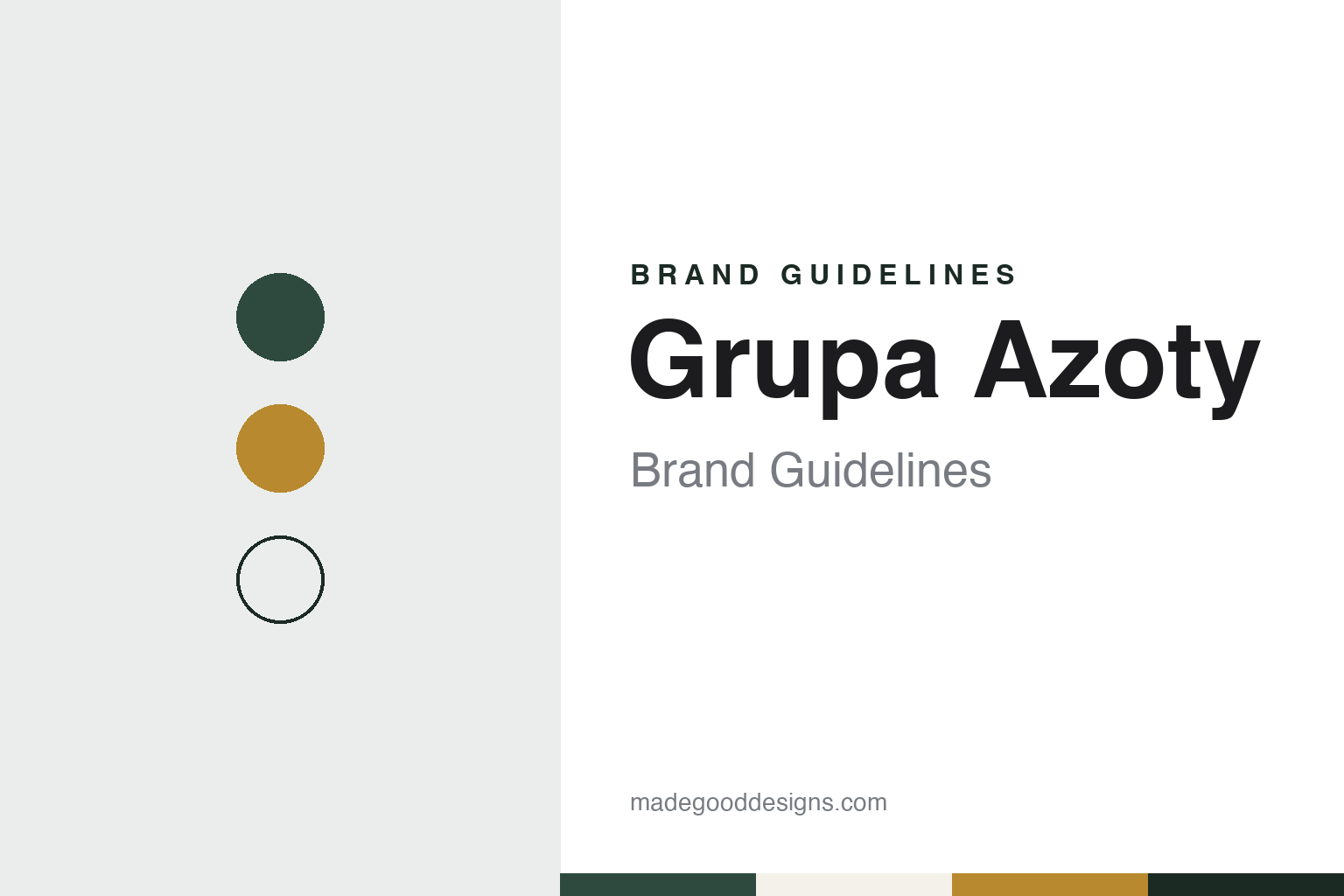
Two constants: a pine, limestone and ochre palette and an industrial grotesque register. Abstract homage — not a Grupa Azoty product or mark; no logo, sack or plant is reproduced.
Mościce
A state nitrogen works on the Dunajec.
Grupa Azoty traces its history to 1927. Polish Wikipedia’s history of the Tarnów works says the decision to build a second large Polish nitrogen-compounds factory, west of Tarnów, was taken on 12 March 1927, that land was bought from the Sanguszko family that May, and that the first roads and rail sidings were begun in 1927. The plan came out of the Chemical Research Institute in Warsaw founded by Ignacy Mościcki, a chemistry professor from Lwów who later became President of Poland; the new settlement around the works was named Mościce after him. The site lies about four kilometres from the town centre, where the Dunajec and Biała rivers meet, and Mościce has been a district of Tarnów since 1951.
The Państwowa Fabryka Związków Azotowych — the State Nitrogen Compounds Factory — was formally opened on 18 January 1930, Polish Wikipedia says, with the president, the prime minister and the industry minister Eugeniusz Kwiatkowski present. It began by making about 60 tonnes of ammonia a day, turning part of it into nitric acid and a nitrogen fertiliser called nitrofos. The world slump arrived in its first year, and Kwiatkowski himself became its general director in 1931. The works widened its range with granulated calcium nitrate, made with technology bought from Norway, and in 1934 built a plant for concentrated nitric acid. On 1 August 1933 it was merged with the older state works at Chorzów into a single state-owned company, and natural gas reached Mościce by pipeline in 1937.
During the German occupation from September 1939, Polish Wikipedia says, the occupation authorities put German citizens in charge of the works. Much of its output was cut back or stopped, the occupier kept mainly the products of wartime use, and from the start of 1944 the Germans ordered equipment to be dismantled and moved into the Reich, after which production practically ceased. The sources used for this guide do not say whether forced labour was used at the works during the occupation. In June 1945 the Polish government resolved to rebuild the factory; workers traced removed machinery to sites such as Brzeg Dolny in Silesia, and ammonia synthesis restarted in July 1947.
Colour
From fertiliser works to chemical group.
The post-war works broadened beyond fertilisers. Polish Wikipedia records methanol and formalin, its first organic product on an industrial scale, in the early 1950s, and a caprolactam plant — the raw material for polyamide fibres and plastics — in 1957. From July 1951 to July 1989 the plant carried the name of Feliks Dzierżyński; it later became Zakłady Azotowe w Tarnowie-Mościcach, the Tarnów-Mościce nitrogen works.
The modern group was built through a run of purchases. According to Polish Wikipedia, the Tarnów company bought a 52.5% stake in Zakłady Azotowe Kędzierzyn in 2010 and a further 41% in 2011, and in August 2011 bought 66% of Zakłady Chemiczne Police. In 2012 it signed a consolidation agreement with Zakłady Azotowe Puławy, the large nitrogen and melamine producer, which created Grupa Azoty; the parent company took the new name in April 2013. The member companies now carry the group name — Grupa Azoty Puławy, Grupa Azoty Police and Grupa Azoty ZAK among them. The name comes from azot, the Polish word for nitrogen, and “tarnowskie Azoty” is how Polish Wikipedia refers to the Tarnów works, so the group name describes the business as much as it brands it.
Polish Wikipedia also lists Compo Expert, the German specialty-fertiliser maker, among the group companies, after a conditional agreement to buy its holding company signed on 6 September 2018, and Grupa Azoty ATT Polymers, a producer of polyamide 6 in Germany. Production, the same source says, takes place at Tarnów, Puławy, Kędzierzyn-Koźle, Police, Gdańsk, Grzybów, Chorzów and Guben. The group makes nitrogen and compound fertilisers, melamine, engineering plastics, oxo alcohols and plasticisers; citing 2016 data, Polish Wikipedia calls it the second-largest maker of mineral fertilisers in the European Union and the third in compound fertilisers, and describes Puławy as one of the largest melamine producers worldwide.
Typography
Fertiliser makers and their records.
Fertiliser makers sell to two very different audiences at once: farmers and dealers on one side, and industrial buyers, investors and governments on the other. Their public material tends to reflect that split. Green fields, ripening crops and harvest scenes sit beside photographs of mines, process plants, storage domes and port terminals, so that the farm and the factory appear under the same name.
Much of what these companies publish is practical. Crop-nutrition guides, product-grade explainers and nutrient ratios printed as plain numbers, such as an NPK grade written out in full, do a good deal of the identity work. Many makers add agronomy tools, soil-testing services, call centres or field demonstrations for growers, and present them as part of the brand rather than as an extra.
The investor side has its own documents. Annual reports, quarterly statements, sustainability and emissions reports and filings to stock exchanges give these companies a steady, formal voice, often with maps of plants and shipping routes. Capacity figures, new plant projects and joint ventures appear there first, usually dated and attributed, and they are the most reliable record of how a maker has grown.
Distribution is the last layer. Fertiliser reaches farms through dealer networks, cooperatives, regional offices and state channels, and the bag, the dealer sign and the product name are often what a grower actually sees. The guides that follow look at each company through what can be checked: who founded it, who owns it, where it makes its products, how it presents itself and, where it matters, how its name and ownership have changed over the decades.
Aa
An industrial grotesque — the register of a chemical works. (Specimen set in Archivo, a sans STAND-IN; NOT the Grupa Azoty logo.)
Grupa Azoty
One name over Tarnów, Puławy, Police and Kędzierzyn.
The group’s headquarters remain at Mościce, in Tarnów. The company itself describes one recent investment as a heavy financial burden for years. Grupa Azoty Polyolefins, a company set up to build a propylene and polypropylene complex at Police — the project known as Polimery Police — went into restructuring in November 2025, the Szczecin newspaper Kurier Szczeciński reported on 9 November 2026. Its creditors accepted a partial arrangement on 27 March 2026, and on 6 November 2026 the district court in Szczecin approved it; the ruling was not yet final, the paper said.
Court approval was a condition set by Orlen, the Polish refining group, which signed a preliminary agreement with Grupa Azoty on 31 March 2026 to buy the shares of GA Polyolefins and take full control. That sale was agreed in March 2026 and had not been completed at the time of writing: its completion still depends on the conditions in the agreement, the paper reported. The group’s chief executive described the court’s decision as confirmation that the chosen restructuring path was right, while adding that it did not end the work of rebuilding the group.
For a design guide, Grupa Azoty shows how a shared group name can sit over several older works, each with its own town and history, while the parent keeps the site where it started in 1927. Compare Yara, the Norwegian nitrogen group with its own century of plants and mergers, and EuroChem. For this guide we use a deep pine green, a pale limestone and an ochre with a sans, an unofficial interpretation; no product or logo is reproduced.
Explore & save
Keep Grupa Azoty’s identity on hand — save it to a board in the Made Good inspiration library.
Grupa Azoty identity set
Pin the Grupa Azoty pine, limestone and ochre palette and the industrial grotesque register to your own board.