Arcadis Brand Guidelines
A land-reclamation society of 1888 that took a name from Greek myth.
Aa
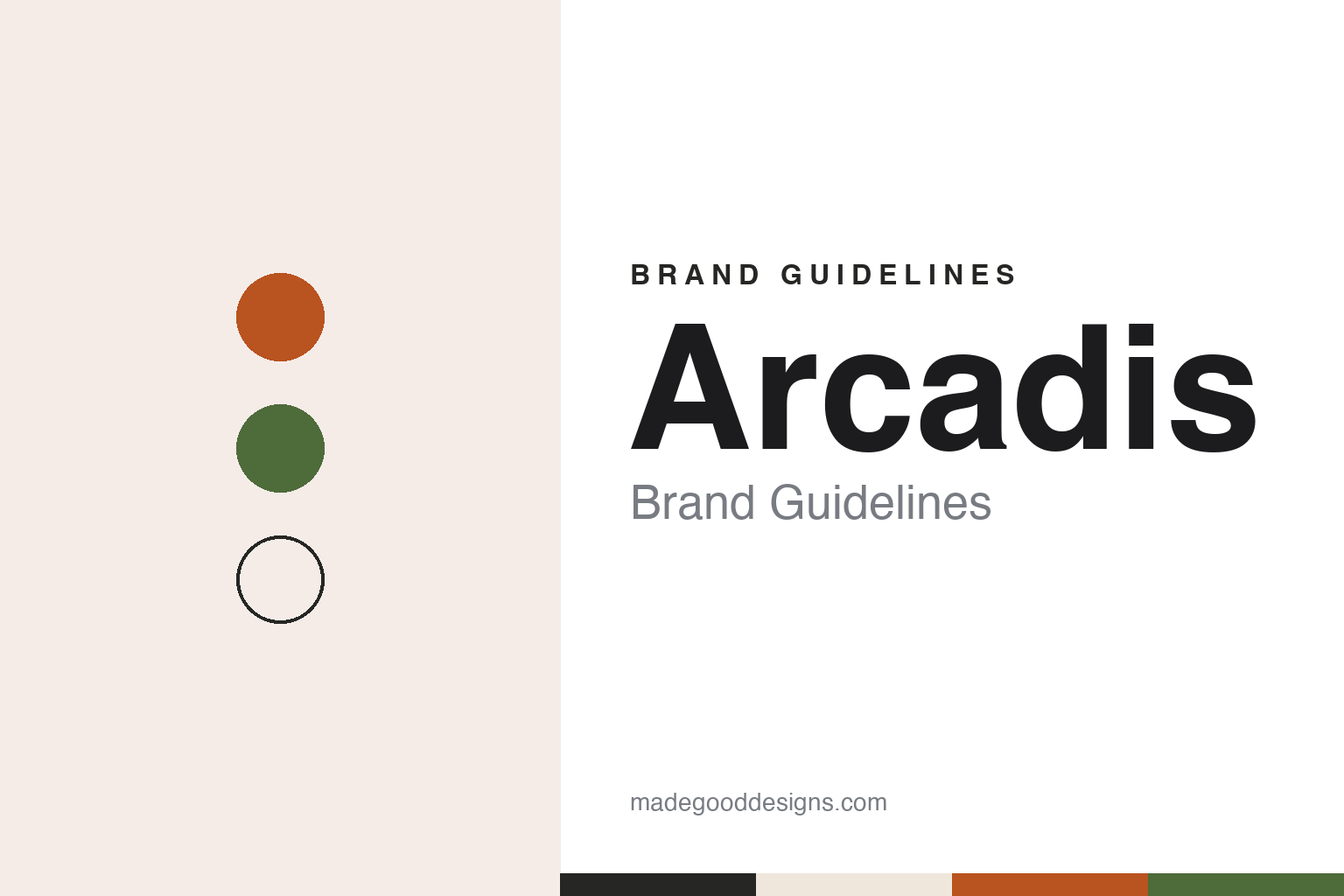
Two constants: a burnt orange, charcoal and heath green palette and a rounded geometric sans register. Abstract homage — not an Arcadis product or mark; no logo, emblem or sign is reproduced.
Arnhem, 1888
A society for reclaiming the Dutch heath.
Arcadis began as a society for reclaiming land. On 5 January 1888 the Nederlandsche Heidemaatschappij was founded in Arnhem as an association to advise on and encourage the reclamation of waste land, the planting and upkeep of forests and the building of irrigation and soil-improvement works, Dutch Wikipedia says; English Wikipedia translates the name as the Association for Wasteland Redevelopment. Its first field was the heather land of the Netherlands, and from 1897 it also worked on freshwater fisheries. Until well after the Second World War most of its members were private notables, among them King Willem III; later municipalities, water boards, provincial services and schools joined.
The association soon carried out work as well as advising on it, drawing up plans and budgets, running the works and maintaining them afterwards. Its first reclamation in Drenthe, at Zeijerveld, took place in 1907, and after 1930 it ran many heath-clearing and forestry projects in that province, Dutch Wikipedia says. In the 1930s it became the principal private contractor in the government’s work-relief schemes, in which unemployed men cleared heath, planted forests and dug ditches and canals. A Radboud University press release of 23 March 2023 says tens of thousands of labourers worked by hand under the “Heidemij” on projects such as the Goffertpark in Nijmegen and the Twente Canal.
The work continued under the German occupation. According to the same press release, which presented the historian Lennert Savenije’s book Werk in uitvoering, commissioned by the KNHM Foundation, the association supervised the segregated employment of Jewish Dutch workers from work camps reserved for them from January to October 1942. On the occupier’s orders, Dutch bodies imposed lower pay than usual in work relief, little or no leave and, in the end, smaller rations. In March 2023 Arcadis, which co-financed the research, apologised for the conduct of its predecessors. It said the organisation had not opposed the racist measures in the camps before they were cleared in October 1942, and it expressed regret that the organisation had reckoned only to a limited extent with that involvement after the war. Arcadis said it and the KNHM Foundation would support the Herinneringscentrum Kamp Westerbork, the memorial centre, in putting the personal histories of those employed in the camps online.
Colour
From Heidemij to a name taken from Arcadia.
After the war the Heidemaatschappij looked abroad. Dutch Wikipedia says that in 1953 it set up IMLO, an international company for agricultural development, and that it received the title “Koninklijk” (Royal) in 1963. Arcadis dates its first export of water and infrastructure services to emerging economies to 1959, and its move into urban development to 1960. In the early 1970s the organisation was split in two: the association, later the KNHM Foundation, kept the public-interest work, while a new commercial company, Heidemij, took the engineering business. Both Wikipedias date the split to 1972; the company’s heritage page gives 1974. The association became a foundation in 2020 and took the name Katalys in 2023.
Heidemij merged with Geraghty & Miller of Long Island, New York, in 1993, gaining a Nasdaq listing, and joined the Amsterdam exchange in 1995. In 1997, after taking over Articon, the engineering bureau of the Dutch railways, it changed its name to Arcadis. Dutch Wikipedia says the name comes from Arcadia, the place in Greek myth held to be the pleasantest on earth to live, and that the company’s emblem is the fire salamander, chosen because the animal can only live in an ecologically stable environment. Arcadis left Nasdaq in 2007 and continued trading on Euronext.
Growth then came largely by acquisition. Arcadis bought the American architects RTKL in 2007, the water specialist Malcolm Pirnie in 2009, the British consultancy EC Harris in 2011, the Asian cost consultants Langdon & Seah in 2012, and Hyder Consulting and the Seattle architects Callison in 2014, according to English Wikipedia and the company. In 2015, the company says, the Arcadis brand was rolled out worldwide and the older names were gradually phased out. Later purchases included Canada’s IBI Group and the Irish life-sciences consultancy DPS Group in 2022. English Wikipedia lists projects that include London City Airport, completed in 1987, the Millau Viaduct in France, the tunnel section of the A2 motorway in the Netherlands and ten stations on the Doha Metro Gold Line.
Typography
How engineering consultancies present themselves.
Engineering and infrastructure consultancies sell expertise rather than objects, so their identities have to stand in for work that is often invisible once it is finished: a tunnel, a water network or a power connection. Most of them present themselves with restraint. Their wordmarks tend to be short, set in a clean sans, and many are acronyms, founders’ surnames or invented names left over from mergers. Colour is usually limited to one strong tone, often a blue, an orange or a green, used against plenty of white space.
The pictures do much of the talking. Websites and reports in this field lean on project photography of bridges, rail lines and stations, water and wastewater works, energy plants and city districts, often taken wide and from the air so that the scale of the work is clear. People appear as teams on site or in the studio rather than as models, and diagrams, maps and drawings sit beside the photographs.
The structure of the websites is similar from firm to firm. Pages are commonly organised by sector, such as transport, water, energy, buildings and industry, and by service, such as design, engineering, project management and advisory work. Sustainability usually has a section of its own, and careers pages carry a large share of the message, since these businesses depend on recruiting architects, engineers and other specialists.
Much of the brand also lives in documents. Listed consultancies publish annual reports and sustainability reports, and many put out technical papers, research reports, indexes and case studies on individual projects. Typography in those documents is usually plain and functional, with charts and tables carrying the detail, so the identity has to work as well on a page of figures as on a hoarding around a building site.
Aa
A rounded geometric sans for a short invented name. (Specimen set in Manrope, a sans STAND-IN; NOT the Arcadis logo.)
Arcadis
Two approaches from WSP and a reset plan in 2026.
In 2026 Arcadis became the target of a takeover attempt. In July the Canadian group WSP made an unsolicited approach, which Arcadis’ executive and supervisory boards rejected unanimously, and then a revised cash-and-shares proposal, which Arcadis also rejected, Construction Enquirer reported on 24 July 2026. On 22 September WSP said it would not pursue a public offer, having been unable to engage with Arcadis on terms, RTTNews reported; Arcadis said both proposals had “fundamentally undervalued” the business, Construction Enquirer reported the next day. Its chief executive, Heather Polinsky, said the company would now concentrate on sharpening performance while keeping its culture.
At a Capital Markets Day in Amsterdam on 29 September 2026 Arcadis presented a plan called “Arcadis’ Reset: Focused Growth, Sustainable Value,” Idéal Investisseur reported. It sorts the business into “Core” industries (transport, and energy and water), “Accelerate” industries (industrial manufacturing and technology, including data centres, life sciences and semiconductors) and an “Optimize” group, the real estate and development division. The plan announced the sale of most of the architecture business and of the operations in China; those sales were announced in September 2026 and not completed at the time of writing.
The company’s website describes Arcadis N.V., based in Amsterdam, as one of the largest design, engineering and consulting organisations in the world, with about 34,000 people in more than 30 countries. Its pages are organised by industries and sectors, services, projects and insights, with separate sections for careers and investor information.
For a design guide, Arcadis shows how a firm with a history reaching back to 1888 can carry one short invented name across many acquired businesses. Compare WSP, the group that tried to buy it in 2026, and Sweco, which grew in the Netherlands by buying Grontmij. For this guide we use a burnt orange, charcoal and a heath green with a sans, an unofficial interpretation; no product or logo is reproduced.
Explore & save
Keep Arcadis’s identity on hand — save it to a board in the Made Good inspiration library.
Arcadis identity set
Pin the Arcadis burnt orange, charcoal and heath green palette and the rounded geometric sans register to your own board.