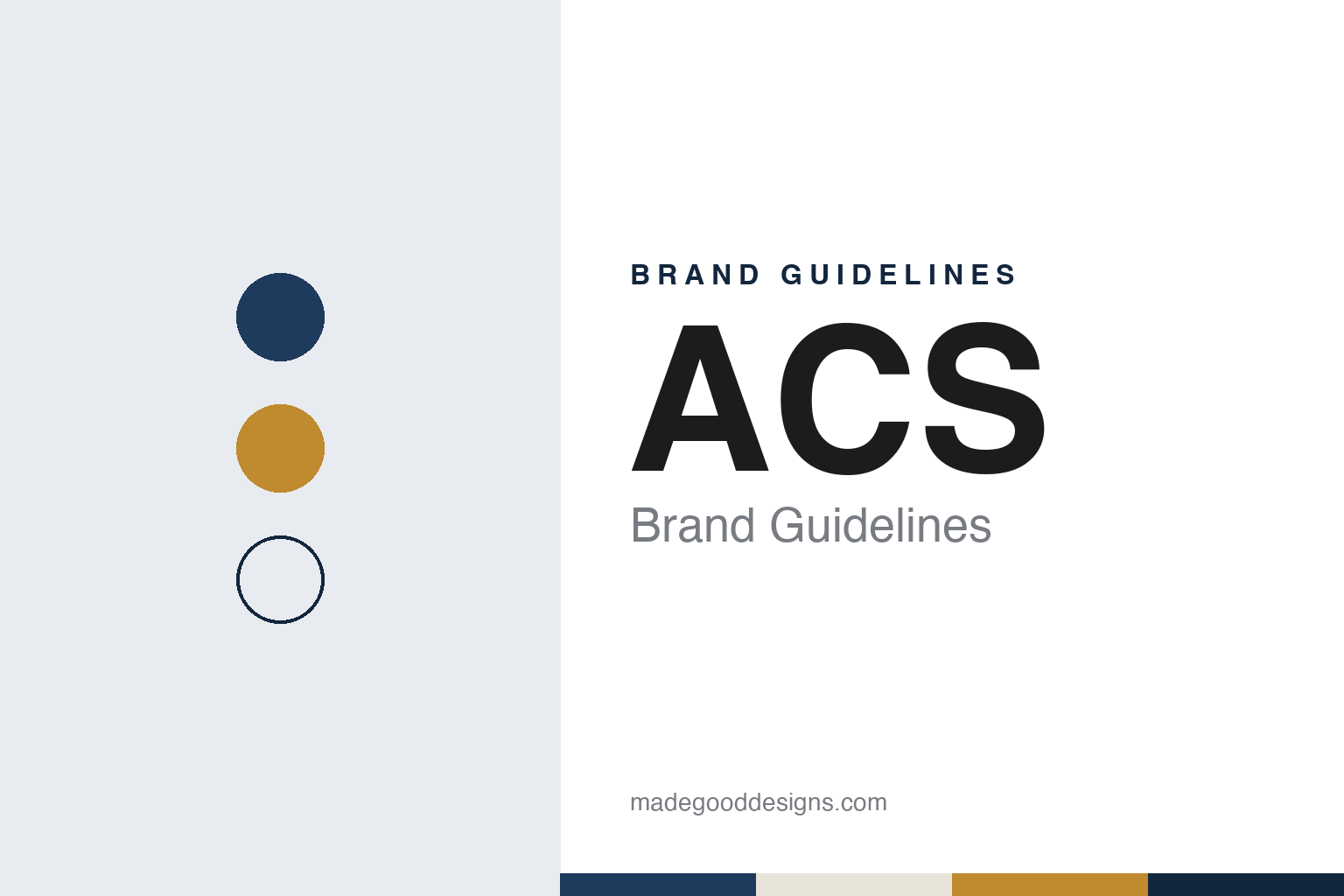
ACS Brand Guidelines
A Madrid group built by merger, holding builders on four continents.
Aa
Two constants: a harbour blue, ochre and limestone palette and an engineering sans register. Abstract homage — not an ACS asset; no logo, wordmark or project image is reproduced.
Built by merger
A 1942 company, a 1983 rescue and a 1997 name.
ACS — in full Actividades de Construcción y Servicios — is a Madrid construction and services group listed on the Madrid stock exchange and included in the IBEX 35 index. It was not founded in a single moment. Spanish Wikipedia says the legal company behind it was incorporated in Madrid on 3 October 1942 as Obras y Construcciones Industriales (OCISA). English Wikipedia picks up the story in 1983, when a group of engineers bought Construcciones Padrós, a builder in financial difficulty, and went on to take a majority holding in Cobra, a services business.
The pieces were joined in two mergers. Spanish Wikipedia says OCISA absorbed Construcciones Padrós and changed its name to OCP Construcciones in 1993, and that in 1997 it absorbed Ginés Navarro Construcciones and took the name Actividades de Construcción y Servicios. That 1997 merger is the date English Wikipedia gives for the formation of the group, and it is the date the ACS name begins.
Growth then came largely by acquisition. English Wikipedia records the purchase of the environmental contractor Onyx SCL in 1999 and telecoms stakes in 2000, before the move that changed the scale of the group: the takeover of Dragados. Spanish Wikipedia says ACS took control of Dragados in 2002 by buying the stake held by the bank Santander Central Hispano, and English Wikipedia dates the acquisition of Dragados to 2003.
Dragados brought its own long history. Spanish Wikipedia, citing a 2004 paper in a Spanish history-of-technology journal, says it was created in 1941 by two civil engineers, Luis Sánchez Guerra and Ildefonso Sánchez del Río, to build the western breakwater of the port of Palma de Mallorca; English Wikipedia instead links its start to dredging work at the port of Tarifa. Spanish Wikipedia also says, citing the 2004 history El canal de los presos published by Crítica, that in the years after its founding Dragados used forced prison labour supplied under the state system known as Redención de Penas por el Trabajo, in which prisoners worked to shorten their sentences; its article on that system lists Dragados among several construction firms that used such labour.
Colour
Dragados, Hochtief and Turner.
The second step was Germany. English Wikipedia’s article on Hochtief says ACS bought the Hochtief shares held by Custodia Holding in March 2007, built its stake to 29.9 per cent by September 2010 and then made a takeover offer, which Hochtief opposed. By April 2011 ACS held 50.16 per cent, effectively taking control, and the same article puts the holding at 75.71 per cent in 2023. Through Hochtief, ACS gained the American builder Turner and the Australian group CIMIC, formerly Leighton Holdings, which Hochtief has owned outright since 2022.
The group has also been an investor in toll roads. English Wikipedia says that in October 2018 ACS joined the Italian holding company Atlantia to buy the motorway operator Abertis, a deal approved by the European Commission; Hochtief has held a 20 per cent stake in Abertis since June 2018. In the other direction, ACS agreed in October 2020 to sell its industrial services division to the French group VINCI, and English Wikipedia says the sale was completed the following year.
Projects are told through those companies. English Wikipedia’s list of major work includes the Torre Agbar in Barcelona and the Palau de les Arts Reina Sofía in Valencia, both completed in 2005, the Alqueva Dam in Portugal, completed in 2002, and the eastern running tunnels of London’s Crossrail, completed in 2021. Dragados entered the United States in 2005 through Dragados USA, whose early work included the East Side Access tunnels for New York’s Metropolitan Transportation Authority. On 30 July 2024 ACS and Hochtief announced that Dragados North America would be combined with Hochtief’s Flatiron, and the ACS website now lists Flatiron Dragados among its companies.
Today the ACS website describes a group delivering “next-generation infrastructure,” with data centres, energy networks and semiconductor plants named among its sectors, and it points to Turner in North America and Europe and CIMIC in the Asia-Pacific region as the main platforms. As an example it gives a data-centre campus that Turner is building for Meta in Indiana. The company also says it has “more than 150 years of history.”
Typography
How construction groups present themselves.
Large construction groups present themselves less through products than through places. Their identities usually rest on a strong wordmark, often in a blue, a red or an orange, used across hoardings, site vehicles, workwear and reports, with the group name repeated in the names of its subsidiaries. Eiffage, for example, runs its business lines as Eiffage Construction, Eiffage Route, Eiffage Métal and so on, while Bouygues keeps separate names such as Colas alongside Bouygues Construction.
Photography does much of the work. Group websites tend to alternate pictures of active sites — cranes, tunnel-boring machines, road crews — with finished bridges, stadiums, towers and rail lines, and they organise their pages by activity: infrastructure, buildings, concessions such as motorways and airports, and energy works. Named landmark projects serve as the main proof of capability, from the Channel Tunnel to the Millau Viaduct.
Commitments are presented in a structured way. Groups describe their environmental and social aims through named programmes, plans and reports rather than slogans; Eiffage, for instance, publishes a climate report and a biodiversity action plan alongside its universal registration document. Values pages, codes of ethics and statements on site safety appear as standard sections, written in the language of programmes and targets.
Two other audiences shape these identities. Careers pages address the large numbers of engineers, site managers and trades staff the groups recruit each year, and many groups promote employee shareholding as part of their story. Investors and lenders read the annual and sustainability reports, where the identity system is often applied most completely, in charts, maps and project photographs. This guide sets out what can be checked about each group: who founded it, how it was formed, who owns it, and which projects dated sources connect to its name.
Aa
An engineering sans for a group of builders. (Specimen set in Archivo, a sans STAND-IN; NOT the ACS logo.)
ACS
Three letters over many names.
ACS has also been the subject of competition proceedings in Spain. In July 2022 the national competition authority, the CNMC, fined six of the country’s largest builders, Dragados among them, after finding that between 1992 and 2017 their representatives met weekly to share technical work for bids in public tenders, the Logroño newspaper La Rioja reported on 7 July 2022; the other firms named were Acciona, FCC, Ferrovial, OHL and Sacyr. The companies said they would appeal to the Audiencia Nacional, Spain’s national court. Spanish Wikipedia says the court suspended the fine on Dragados as a precaution, and in September 2026 the Madrid news site Vozpópuli reported that the case had been heard and was awaiting judgment.
For a design reader, the striking thing about ACS is how little of the group appears under its own name. Its website sends visitors on to a directory of companies — Turner, Dragados, Hochtief, CIMIC, Flatiron Dragados and Abertis among them — each with its own website, while the three letters ACS sit above them as the listed parent. The group’s own home page leads with results presentations, its annual general meeting and a capital markets day.
For a design guide, ACS shows how a holding brand can stay quiet while the companies beneath it carry the public face of the work. Compare Hochtief, the German builder ACS controls, and Turner Construction, the American builder that came with it. For this guide we use a harbour blue, an ochre and a limestone with a sans, an unofficial interpretation; no product or logo is reproduced.
Explore & save
Keep ACS’s identity on hand — save it to a board in the Made Good inspiration library.
ACS identity set
Save the ACS harbour blue, ochre and limestone palette and the engineering sans register to your own board.