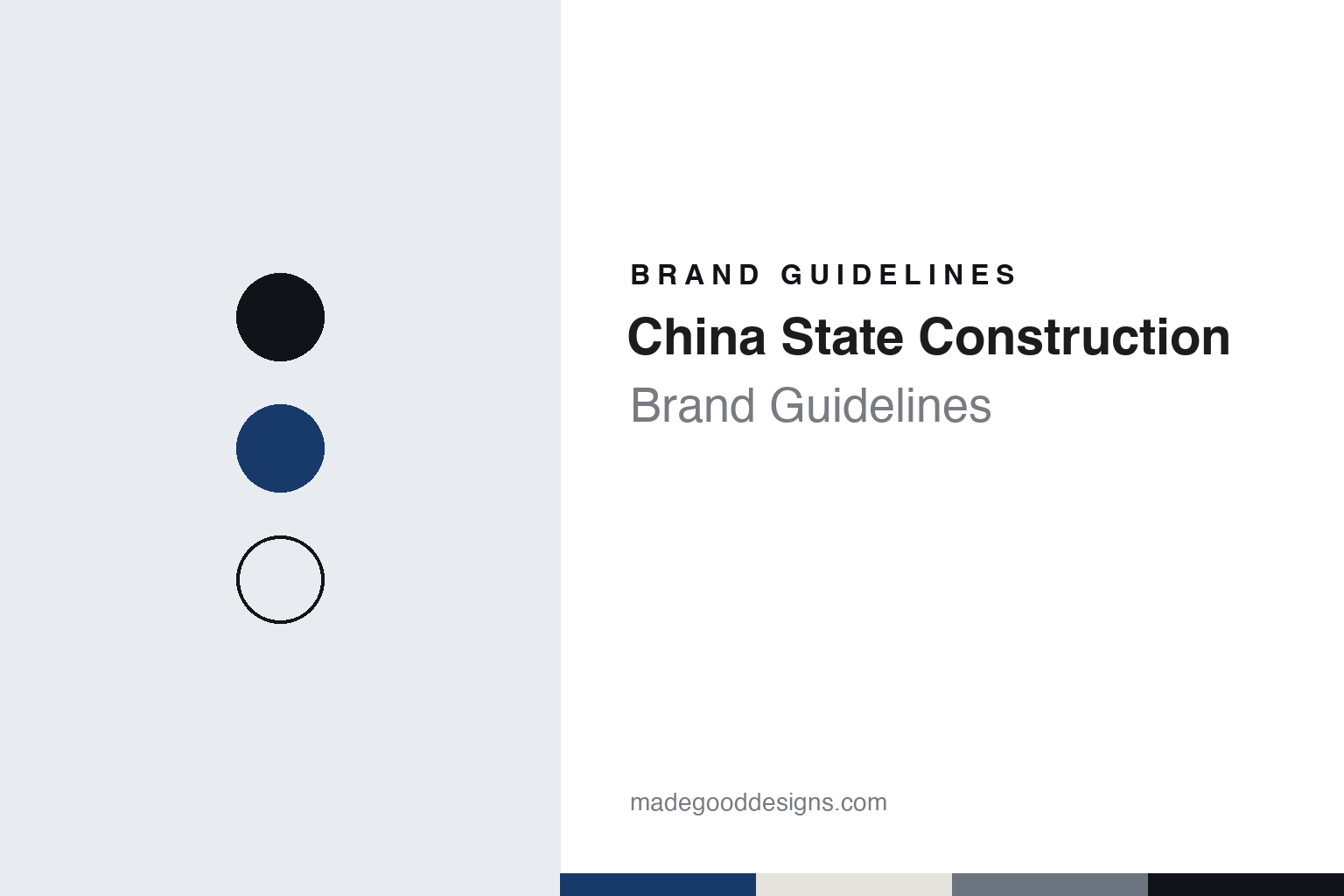
China State Construction Brand Guidelines
A 1982 state builder behind a square, deep-blue CSCEC mark.
Aa
Two constants: a deep sea blue, concrete and steel palette and a structural sans register. Abstract homage — not a CSCEC building, product or mark; no logo is reproduced.
CSCEC
A national builder formed in 1982.
China State Construction Engineering Corporation — CSCEC, shortened in Chinese to 中建 — dates its official founding to 1982, its English website says. Chinese Wikipedia gives the date as 11 June 1982, when the State Council approved a new national construction enterprise. It was formed from the enterprise and management functions of the State Construction Engineering Administration, together with the units that reported to it, while the administration’s government functions passed to a newly created ministry for urban and rural construction.
The roots go back further. Chinese Wikipedia traces a predecessor, the China Construction Engineering Company, to February 1960, when the State Council approved it under the same administration; English Wikipedia gives 1957 as the year the state company was founded. English Wikipedia says the predecessor opened its first overseas office, in Kuwait, in the late 1970s, and that the group entered the United States in 1985 with an office in Atlanta, first building housing with joint-venture partners.
The group was reshaped twice in this century. A subsidiary, China State Construction Engineering Corporation Limited, was set up in 2007 to hold most of the group’s assets and was listed on the Shanghai Stock Exchange on 29 July 2009, Chinese Wikipedia says; English Wikipedia describes it as the largest flotation of that year. English Wikipedia adds that the parent kept some assets outside the listed company. In November 2017 the parent was restructured as a wholly state-owned company under the Chinese name 中国建筑集团有限公司, Chinese Wikipedia says, while the English website still uses the name China State Construction Engineering Corporation.
Today the group is headquartered in Beijing. Chinese Wikipedia describes it as a central state-owned enterprise, and the company says it runs its business through the listed company, with 38 second-tier subsidiaries and eight listed companies.
Colour
Towers, airports and modules.
CSCEC describes five main sectors on its website: housing construction, infrastructure, real estate development, survey and design, and newer areas such as green and low-carbon technology and digital construction. It says it works in nearly 100 countries and regions, and names China Overseas as its property brand. English Wikipedia lists China Overseas Land and Investment and China Construction Design International among its subsidiaries, along with numbered engineering bureaus such as China Construction Third Engineering Bureau.
Its name appears on many towers. English Wikipedia lists among the group’s projects the Shanghai World Financial Center, the Beijing National Aquatics Centre, known as the Water Cube, Leeza SOHO in Beijing and the Federation Tower in Moscow, as well as airport work at Beijing Daxing and Hong Kong’s Chek Lap Kok. In June 2021 Arab News reported that Egypt had completed concrete work on the Iconic Tower in the New Administrative Capital east of Cairo, a project carried out jointly by the housing ministry’s New Urban Communities Authority and CSCEC, which the paper described as one of the largest contracting companies in the world. English Wikipedia says the 394-metre tower topped out in August 2021, was completed in 2024 and was designed with Dar al-Handasah as architect of record; Arab News called it the tallest tower in Africa.
The group has also pushed factory-made building. In April 2025 Built Offsite reported that CSCEC had released 11 industrialised building products under a “building good house” concept, and that its modular integrated construction programme ran on three platforms: Concrete MiC, Steel MiC and an X-expansion Module. The trade title said the Huapichang Hutong No. 8 Building in Beijing had been rebuilt in three months with concrete modules, and that a light public housing project in Hong Kong was the first local use of the group’s steel modular housing. The company presents these systems as a complete, end-to-end housing offer.
Typography
Design and documentation.
Asia’s large construction and engineering groups tend to present themselves through scale rather than ornament. A short wordmark or a set of initials, often in a bold sans and a single strong colour such as red, blue or green, sits above aerial photographs of towers, bridges, dams, plants and rail lines. Larsen & Toubro, for example, greets visitors to its website under its initials, “L&T,” and describes its aim as being “a builder of nations.”
Their websites are usually organised by business rather than by product. Building, civil works, plant and housing appear as separate divisions, and Korean Wikipedia describes Hyundai E&C’s business in exactly those terms: civil engineering, building, housing and plant. L&T adds manufacturing, defence and technology arms alongside construction, according to English Wikipedia.
Housing often carries a second identity. In South Korea the large builders sell apartments under their own consumer brands: Hyundai E&C uses Hillstate and THE H, according to Korean Wikipedia, alongside the company name. Overseas work is presented project by project, with named highways, ports, stadiums and metro lines standing in for a portfolio; a metro extension in Noida, reported by IBEF in November 2026, is a recent example for L&T.
Corporate reporting is part of the identity too. Annual reports, annual reviews and sustainability reports sit alongside the project pages; L&T, for instance, offers an Annual Review for 2026 on its corporate pages. This guide sets out what can be checked about each group — who founded it, who owns it today, and what it builds — and marks clearly what rests on the company’s own word.
Aa
A structural sans for a square, deep-blue letter mark. (Specimen set in Archivo, a sans STAND-IN; NOT the CSCEC logo.)
China State Construction
Five letters in a square, in a blue like the sea.
The mark is built from the initials. Chinese Wikipedia says the logo derives from the abbreviation of the English name, China State Construction Engineering Corporation, and that its square, solid outline is meant to suggest a building’s foundation stone, integrity and an operation that joins domestic and overseas markets. The letters are arranged as a small “c,” three capitals and another small “c,” a combination the same article reads as a sign of pioneering spirit, care for quality and service across five continents. Its colour, the article says, is a deep blue like the sea, chosen to express breadth of outlook and a hopeful future.
The company frames its culture in plain statements. Its English website gives its mission as “expanding a happy living environment” and its core values as “quality assurance and value creation,” and it publishes a code of conduct with ten headings, among them “Being Professional,” “Stick to the Rules” and “Keep on Innovation,” each split into organisational behaviour, individual behaviour and a list headed “We are Against.” The site, offered in Chinese, English, French, Russian and Arabic, also carries annual reports, sustainability reports and an investor relations section for the listed company.
Its visual presentation leans on the projects themselves: the overview page counts the group’s share of China’s buildings above 300 metres, key airports, satellite launch bases and nuclear power plants, in round fractions that are the company’s own figures. Those claims, like its global rankings, are the company’s statements rather than independent findings.
For a design guide, China State Construction shows how a very large builder can rest its identity on one compact letter mark in a single deep blue and let towers, airports and housing estates carry the rest. Compare China Railway Group and PowerChina, two other Beijing construction groups, or VINCI, a French contractor with a capitalised name. For this guide we use a deep sea blue, concrete and a steel grey with a sans, an unofficial interpretation; no product or logo is reproduced.
Explore & save
Keep China State Construction’s identity on hand — save it to a board in the Made Good inspiration library.
China State Construction identity set
Pin the deep sea blue, concrete and steel palette and the structural sans register to your own board.