China Taiping Brand Guidelines
A 1929 Shanghai insurer, a Hong Kong head office and a name shared since 2009.
Aa
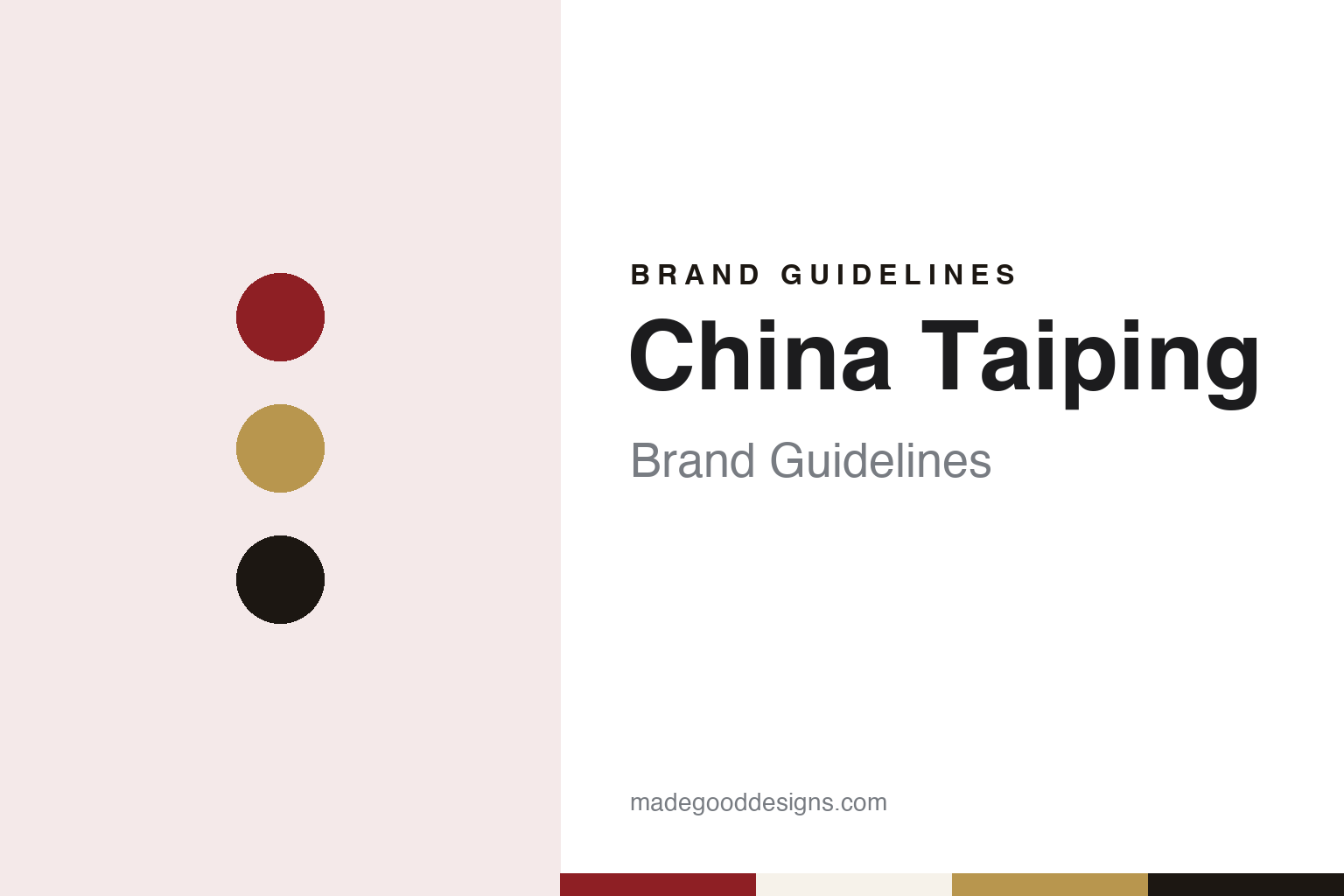
Two constants: a red, gold and ink palette and a bilingual serif register. Abstract homage — not a China Taiping product or mark; no logo, seal or document is reproduced.
Taiping
A bank’s insurer on Jiangxi Road, Shanghai.
China Taiping’s history starts in Shanghai. Chinese Wikipedia says the Kincheng Bank founded the Taiping insurance company on 20 November 1929, under a name that translates as Taiping Water and Fire Insurance, to write marine, fire, hull and motor cover. The bank’s head, Zhou Zuomin, served as general manager, and the company opened for business on 19 February 1930 in the Kincheng Bank building on Jiangxi Road.
The business grew by buying other insurers and by adding shareholders. In 1933 it bought Anping Insurance, and in 1934 several other banks, among them the Bank of Communications, took stakes, giving Taiping seven main shareholders, Chinese Wikipedia says. It opened a Hong Kong office in 1935 and in 1936 bought China Tianyi Insurance; by then, the same article says, Taiping was one of the largest Chinese-owned insurers.
A 1937 insurance law kept life and non-life business in separate companies, and on 30 December 1938 Taiping’s life business became a company of its own, Taiping Life Insurance, according to Chinese Wikipedia. The sources used for this guide do not say how Taiping operated during the occupation of 1937–1945.
They do record the path of a second predecessor. China Insurance Company, founded by the Bank of China, opened in Shanghai on 1 November 1931, added life cover in 1933 and opened a Hong Kong branch in 1938. After Japanese forces occupied Shanghai’s foreign concessions in December 1941, it sent part of its staff to Chongqing and set up an office there, Chinese Wikipedia says.
Colour
From Shanghai to Hong Kong.
After 1949 the insurers were reorganised. In November 1951 Taiping reopened as a joint state-private company formed from 15 insurers in Shanghai and Tianjin; in 1956 it merged with Xinfeng Insurance and moved its head office to Beijing, and in 1958 it stopped all business in mainland China, Chinese Wikipedia says. Its offices abroad carried on, with branches in Hong Kong, Singapore, Kuala Lumpur and Jakarta. English Wikipedia says Taiping and China Insurance became part of the People’s Insurance Company of China while still trading in Hong Kong.
A third predecessor came from Hong Kong itself. Shanghai’s Min An Insurance prepared a Hong Kong branch in 1947, and Hong Kong Ming An Insurance was registered on 1 October 1949, according to Chinese Wikipedia; English Wikipedia dates its founding in Hong Kong to 1947. On 9 September 1980 PICC, China Insurance, Taiping and Ming An formed China Reinsurance (Hong Kong), the company renamed Taiping Reinsurance in 2009.
The modern group took shape around a listing. In 1999 PICC was split into several groups, among them China Life, China Re and the present PICC, and China Insurance Company took on the overseas businesses, English Wikipedia says. In June 2000 China Insurance listed a new Hong Kong company, China Insurance International Holdings, which Chinese Wikipedia calls the first listed company in China’s insurance industry; Swiss Re took 9.9 percent at the time, English Wikipedia says.
The same year the group resumed business in mainland China under the Taiping Life and Taiping names. In September 2001 the listed company took a controlling stake in Taiping Life, and in October the Belgian group Fortis, now Ageas, took 24.9 percent, Chinese Wikipedia says.
Typography
How the category presents itself.
China’s large insurers and securities firms are mostly listed groups with sizeable state shareholders, and many trade in more than one market, typically Shanghai or Shenzhen alongside Hong Kong, and in a few cases London. Their brands therefore have to work in at least two scripts. A full Chinese company name usually sits beside a shorter Chinese form and a set of English initials, as with PICC and 人保, or CPIC and 太保, and designers need all three versions to stay recognisable together.
The visual language this guide looks at includes wordmarks in reds, blues and golds, lettering with roots in Chinese calligraphy, and square, seal-like symbols that echo a traditional name chop. Websites and reports commonly pair those marks with photography of office towers and city skylines, and with images of the people and places the companies serve.
The products shape the pages. Insurers organise their sites around life, property, health and pension cover, policy and claims services and branch finders, while securities firms present brokerage, investment banking, asset management and the wealth apps through which retail investors trade. Group sites often link out to separate websites for each subsidiary, each carrying the parent’s initials.
Much of the most carefully designed material is financial reporting. Annual and interim reports, results presentations and ESG or sustainability reports are published in simplified Chinese, traditional Chinese and English for investors on several exchanges, and they set the tone that the rest of a brand often follows. This guide sets out what can be checked about each company — when it was founded, who owns it and where it is listed — and marks clearly what rests on the company’s own word.
Aa
A bilingual serif — Chinese and English names set side by side. (Specimen set in Noto Serif, a serif STAND-IN; NOT the China Taiping logo.)
China Taiping
One name for three old companies.
The “China Taiping” name arrived in 2009. Chinese Wikipedia says the China Taiping Insurance Group name took effect on 29 June 2009, bringing the Taiping, China Insurance and Ming An companies under one name. The listed company became China Taiping Insurance Holdings, and Ming An’s Hong Kong insurer became China Taiping Insurance (HK) later that year. In 2013 the listed company bought further stakes and overseas insurers from its parent, completing what English Wikipedia calls a reverse IPO.
Ownership is a matter of record. As of 31 December 2018 China Taiping Insurance Group owned 59.64 percent of the listed company, and the Ministry of Finance owned 90 percent of the group, with the National Social Security Fund holding the rest from January 2019, English Wikipedia says. China Daily described China Taiping in June 2024 as the country’s only state-controlled financial corporation with its headquarters in an overseas market. The same report said Ageas and Goldpark International Investments together held 24.9 percent of Taiping Life, and that Ageas had confirmed, on 20 May 2024, a transaction under which it would hold 10 percent of Taiping Pension. On 6 September 2026 China Taiping Insurance Group said the Ministry of Finance would make a capital injection, China Daily reported; it was announced, and not reported as completed, at the time of writing.
The group’s business spans life, property and pension insurance, reinsurance and asset management, English Wikipedia says. Its English website links to units in the United Kingdom, Singapore, Macau, Indonesia and Luxembourg, where the company says China Taiping Insurance (LU) opened on 13 June 2024; in August 2024 it launched a family-office service brand in Hong Kong called SMILE, and in October 2025 it says it issued the first cross-border vehicle policy under the scheme for Guangdong cars entering Hong Kong.
For a design guide, China Taiping shows how one name can gather several older companies — Taiping, China Insurance and Ming An — and carry a Shanghai founding date into a Hong Kong group. Compare PICC, of which Taiping and China Insurance were once part, and China Life, another company formed in the 1999 split. For this guide we use a deep red, a muted gold and a warm ink with a serif, an unofficial interpretation; no product or logo is reproduced.
Explore & save
Keep China Taiping’s identity on hand — save it to a board in the Made Good inspiration library.
China Taiping identity set
Pin the China Taiping red, gold and ink palette and the bilingual serif register to your own board.