Banamex Brand Guidelines
An 1884 national bank that took its own name back.
Aa
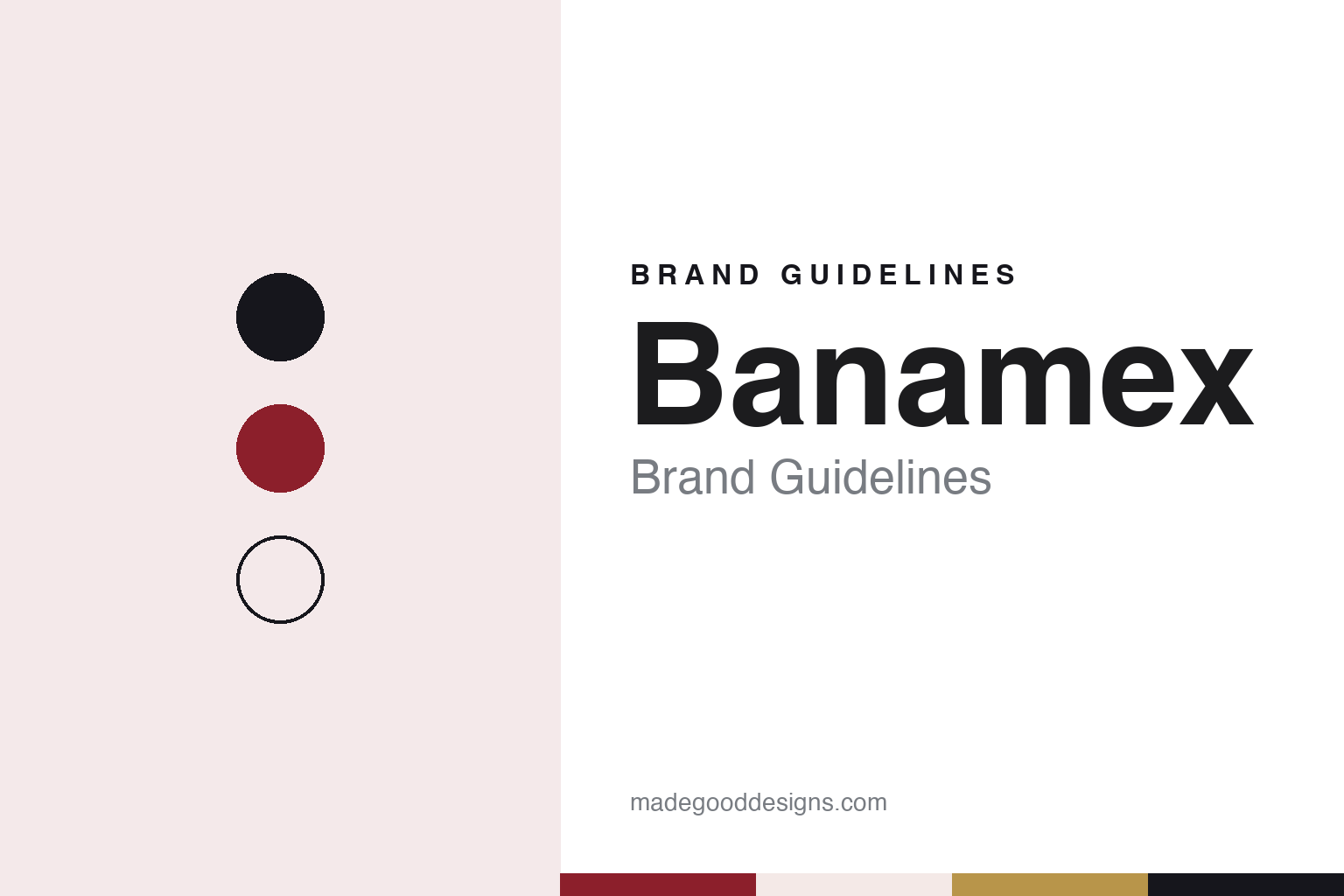
Two constants: a deep red, ink and gold palette and a Banknote serif register. Abstract homage — not a Banamex product or mark; no card, logo or banknote is reproduced.
Banco Nacional de México
Two banks of 1882, merged in 1884.
Banamex, formally Banco Nacional de México, was formed in Mexico City on 2 June 1884 by the merger of two banks that had opened in 1882, according to English and Spanish Wikipedia. The first, the Banco Nacional Mexicano, was set up under a government concession of August 1881 with mainly French and Mexican capital, with the Franco-Egyptian Bank behind it, and began serving the public in February 1882; the second, the Banco Mercantil Mexicano, was founded in August 1881 by merchants of Spanish origin and opened in March 1882, Spanish Wikipedia says.
The merged bank had a double role from the start. Spanish Wikipedia describes it as the first large private bank in Mexico, acting both as an agent of the federal government, in foreign-debt negotiations and tax collection, and as an issuer of banknotes at a time when the country had no central bank, while also taking deposits and making loans. Its head office was in the former palace of the Counts of San Mateo de Valparaíso in Mexico City, and by 1910 it had 33 branches and 24 agencies.
Retail services followed through the twentieth century: savings accounts in 1929, personal loans in 1958, a first computer in 1966 and round-the-clock cash machines in 1972, according to Spanish Wikipedia, which also says the bank launched the first credit card in Latin America in 1968. With the rest of the country’s private banks it was nationalised on 1 September 1982 and operated as a national credit company until 1990. Spanish Wikipedia dates the adoption of the acronym Banamex to 1984, the bank’s centenary, though the same article elsewhere says the name has been used since 1976.
Colour
Accival, Citigroup and a return to Banamex.
Banamex returned to private ownership in the early 1990s, bought by a group of investors around the brokerage Acciones y Valores de México, or Accival; English Wikipedia dates the reprivatisation to 1991, and the two formed Grupo Financiero Banamex-Accival. In August 2001 Citigroup acquired the group, and Citibank’s smaller Mexican operations were folded into Banamex under the Banamex name, according to both Wikipedia articles.
In 2016 the bank took the name Citibanamex, Spanish Wikipedia says. Six years later the direction reversed. In January 2022 Citigroup announced that it would sell its retail and business banking in Mexico and keep its institutional clients under a separate banking licence. In December 2024 it completed the separation: corporate and private banking moved to Grupo Financiero Citi México, and the retail bank went back to the name Banamex. In October 2026 El Economista, citing Reuters, described that 2024 split as part of a wider plan for Citi to dispose of its stake in the retail bank.
The sale has come in stages. On 24 September 2025 the sale of a 25% stake to the Mexican businessman Fernando Chico Pardo was announced, El Economista reported, and in April 2026 the paper quoted him, as reference shareholder and chairman of the board, referring to the closing of that acquisition. A further sale of about a quarter of the shares to institutional investors was announced later; the paper names General Atlantic, Afore SURA, BTG Pactual, Chubb, funds managed by Blackstone, Liberty Strategic Capital and the Qatar Investment Authority. In April 2026 Chico Pardo said the new investors would together hold 49% and that Banamex was close to being deconsolidated from Citi in the first quarter of 2027; as of November 2026 that step is pending.
Typography
How Latin American banks present themselves.
Latin American banks tend to present themselves through bold wordmarks and a small set of strong colours. Blues, reds, greens and yellows recur across the region’s banking brands, usually paired with a short name or acronym that has to work on a branch front, a debit card and an app icon alike. Many names are Spanish and carry a place, a nation or a founding purpose in them, and slogans are written for a home audience first.
Photography does much of the work. Bank websites and reports in the region often show branches, city streets and customers rather than abstract imagery, and some banks make a landmark headquarters building part of their public face. Financial-inclusion programmes — accounts for people new to banking, credit for small businesses, scholarships — are a recurring theme, presented alongside the core pages on accounts, cards, loans, remittances and mobile apps.
Sponsorship is another constant. Football leagues, stadiums and clubs carry bank names in several countries, and banks also run cultural foundations, art collections and exhibitions that put the brand in a setting far from the branch counter.
The paper trail matters too. Listed banks and the subsidiaries of international groups publish annual reports and sustainability reports, and these, together with dated press coverage and public histories, are what this guide draws on. Each entry sets out who founded the bank, who owns it now and how its name has changed, and marks what rests only on the bank’s own word. The colours and typefaces shown here are unofficial interpretations, not the banks’ own specifications.
Aa
A banknote-era serif for a bank that once issued Mexico’s paper money. (Specimen set in Fraunces, a serif STAND-IN; NOT the Banamex logo.)
Banamex
A listing still to come, and a collection on the road.
A stock-market listing is the next step Citi has set out. In September 2026 El Economista, citing Bloomberg, reported that Citigroup was lining up Wall Street banks for an initial public offering of Banamex, which the report said was planned for January, with the details still under discussion; Citi’s finance chief had said the group planned to cut its stake below half before the listing. A Reuters report published by the same paper in October 2026 described the offering as planned for 2027, so the listing remains pending. Edgardo del Rincón, formerly head of Banco del Bajío, became director general on 1 June 2026, El Economista reported in April.
The bank’s cultural arm is one of the most visible parts of the brand. Patrimonio y Fomento Cultural Banamex holds a painting collection of almost a thousand works, El Universal reported in April 2026, when it took the collection outside Mexico City for the first time in ten years for an exhibition of 55 paintings at the Hospicio Cabañas in Guadalajara. The show included the only Frida Kahlo painting the bank owns, a still life it bought in New York in the 1970s. In June 2026 Crónica reported the opening of the Copa de Arte Popular Banamex at the regional ceramics museum in Tlaquepaque, a show of 57 football-themed folk-art pieces drawn from a national call that received 877 entries; a Banamex official spoke of more than three decades of the institution’s work on folk art. In the April 2026 message, Chico Pardo also listed the launch of a new brand in 2025 among the bank’s recent achievements.
For a design guide, Banamex shows how a bank formed in 1884 can drop a parent’s prefix and return to its own name, with an art collection and a folk-art programme carrying the brand beyond the branches. Compare Citi, which bought it in 2001, and BBVA México, the Mexico City bank founded in 1932. For this guide we use a deep red, a near-black and a muted gold with a serif, an unofficial interpretation; no product or logo is reproduced.
Explore & save
Keep Banamex’s identity on hand — save it to a board in the Made Good inspiration library.
Banamex identity set
Pin the Banamex deep red, ink and gold palette and the Banknote serif register to your own board.