Banco Azteca Brand Guidelines
The Mexico City bank that opened its first branches inside a chain of shops.
Aa
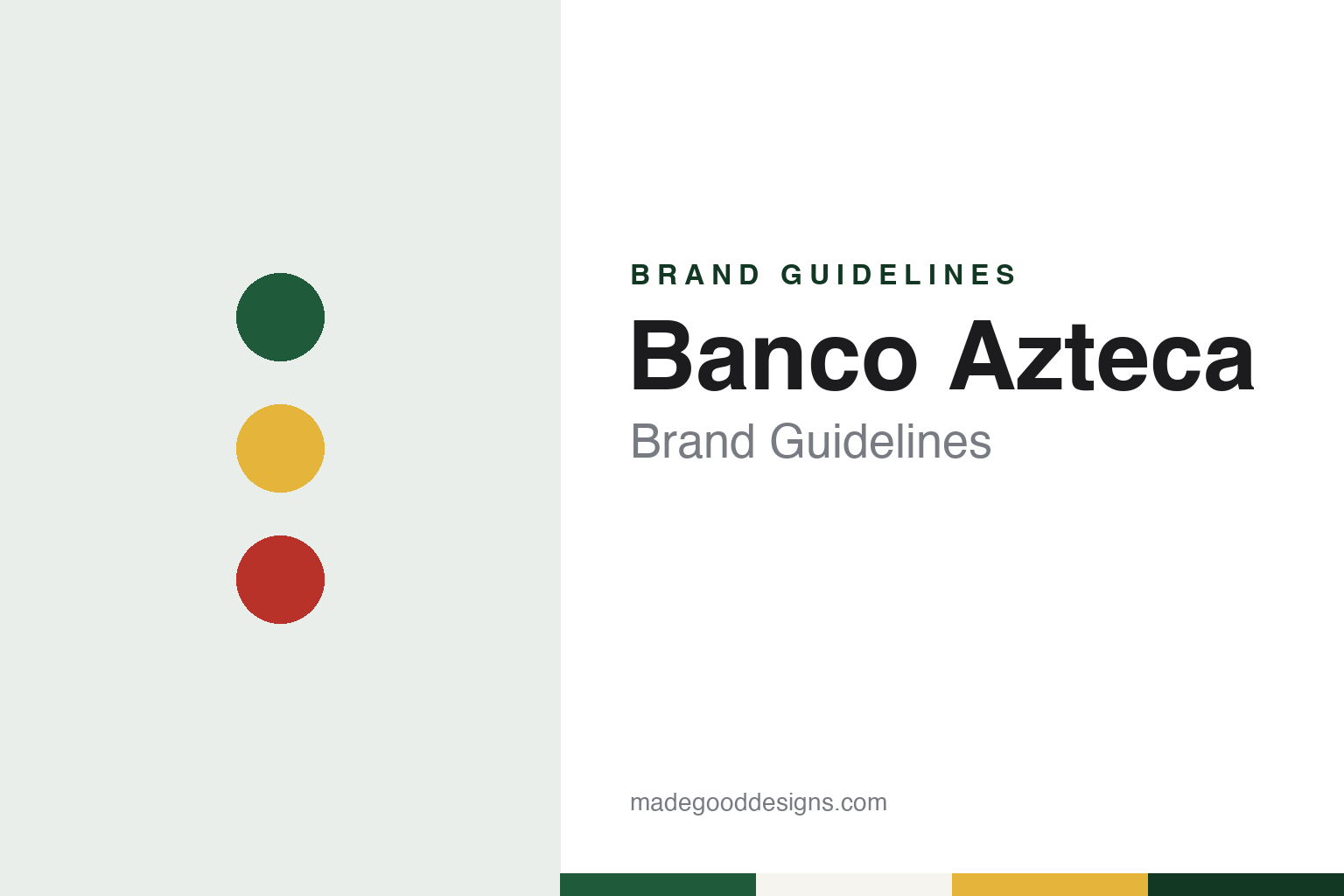
Two constants: a forest green, maize and red palette and a plain-spoken sans register. Abstract homage — not a Banco Azteca asset; no logo, card or branch sign is reproduced.
A bank in a shop
A retail group applies for a banking licence.
Banco Azteca is a Mexican bank that grew out of a chain of shops. It was founded in 2002 by the businessman Ricardo Salinas Pliego as part of Grupo Elektra, the retail and financial group that in turn belongs to Grupo Salinas, according to English and Spanish Wikipedia. Wikipedia says the group had applied to Mexico’s finance ministry, the Secretaría de Hacienda y Crédito Público, for a licence a year earlier; it was granted in March 2002, and, citing Grupo Elektra’s own annual report, the bank formally began operating on 30 October 2002.
The retail side is much older. English Wikipedia traces Grupo Elektra to 1950, when Hugo Salinas Price opened a small appliance shop in Monterrey, Nuevo León. It first sold radio equipment and later added furniture, televisions and household goods, moving from wholesale to retail and sales on credit. Ricardo Salinas Pliego took over as president in 1987, the same entry says.
Forbes México, marking the bank’s fifteenth anniversary in October 2017, described its purpose from the start as bringing savings, investment and, above all, credit to the part of the Mexican population that ordinary banks had largely left out. Spanish Wikipedia describes the focus in the same terms: middle- and lower-income households, the segments of the population “olvidados” by traditional banking.
The first network was the group’s own shop floor. By 2003, Wikipedia says, Banco Azteca had more than 800 branches inside Elektra stores, eight stand-alone points and 96 modules in other retailers’ channels. That same year it reached an agreement with INFONAVIT, the national workers’ housing fund, to offer mortgage loans. In 2004 the group created the insurer Seguros Azteca, began lending to small farmers and launched Empresario Azteca, a programme to finance small and medium-sized businesses.
Colour
Central America, a football shirt and an Effie.
Expansion abroad followed quickly. Wikipedia dates branches in Panama to 2005, entries into Guatemala, Honduras and Argentina to 2007, Brazil and Peru to 2008, and El Salvador to 2009. The Honduran daily El Heraldo, reporting on the Honduran bank’s eleventh anniversary in October 2018, said it had begun operating there in 2007 and listed the group’s banking presence at that time as Mexico, Guatemala, El Salvador, Peru, Panama and Honduras. As of March 2025, English Wikipedia’s entry on Grupo Elektra lists operations outside Mexico in Guatemala, Honduras and Panama.
The products carry the Azteca name or a plain Spanish phrase. Wikipedia lists the prepaid Monedero Azteca card at the start of the 2010s, a mobile app from 2014, and the Aprende y Crece (“learn and grow”) financial-education programme, begun in Guatemala in 2015. Forbes México wrote in 2017 that the bank had been the first to use fingerprint reading to identify its customers, and that it had renewed its website and app for the anniversary year. In 2019, Wikipedia says, it opened the Academia Espacial de Ahorronautas, a children’s exhibition about saving that was shown for two years at Mexico City’s Museo Interactivo de Economía. By 2020 the app had 10 million registered users, according to a Grupo Salinas report cited by Wikipedia.
Sport has been a main stage for the name. Banco Azteca sponsored the Mexico national football team around 2007 and, from 2023, the Mexican Olympic team on the road to Paris 2024 and Los Angeles 2028, according to Wikipedia citing Infobae.
Its advertising has won awards. Spanish Wikipedia lists a bronze Effie in Mexico in 2020 for the campaign “Viernes de Quincena” (payday Friday). In October 2026, Líderes Mexicanos reported, the bank won a gold Effie in the social-responsibility category for “Ponte Atento” (“pay attention”), a campaign about spotting fraud attempts that ran on broadcast television, digital channels and an original YouTube series under the line “Detente, duda y verifica” — stop, doubt and check. The same report says the bank had won a silver Effie in 2024 for “El poder está en ti.”
Typography
How Latin American banks present themselves.
Latin American banks tend to present themselves through bold wordmarks and a small set of strong colours. Blues, reds, greens and yellows recur across the region’s banking brands, usually paired with a short name or acronym that has to work on a branch front, a debit card and an app icon alike. Many names are Spanish and carry a place, a nation or a founding purpose in them, and slogans are written for a home audience first.
Photography does much of the work. Bank websites and reports in the region often show branches, city streets and customers rather than abstract imagery, and some banks make a landmark headquarters building part of their public face. Financial-inclusion programmes — accounts for people new to banking, credit for small businesses, scholarships — are a recurring theme, presented alongside the core pages on accounts, cards, loans, remittances and mobile apps.
Sponsorship is another constant. Football leagues, stadiums and clubs carry bank names in several countries, and banks also run cultural foundations, art collections and exhibitions that put the brand in a setting far from the branch counter.
The paper trail matters too. Listed banks and the subsidiaries of international groups publish annual reports and sustainability reports, and these, together with dated press coverage and public histories, are what this guide draws on. Each entry sets out who founded the bank, who owns it now and how its name has changed, and marks what rests only on the bank’s own word. The colours and typefaces shown here are unofficial interpretations, not the banks’ own specifications.
Aa
A plain-spoken sans for short Spanish lines. (Specimen set in Archivo, a sans STAND-IN; NOT the Banco Azteca logo.)
Banco Azteca
One name across a store, a bank and an insurer.
Banco Azteca remains part of Grupo Elektra and Grupo Salinas, with its head office in Mexico City. In October 2017 Forbes México, citing the bank’s own figures, reported more than 15 million customers and more than 1,700 branches, with a presence in 778 Mexican municipalities, in 167 of which it was the only bank. Wikipedia, citing the regulator CNBV and the company, gives 2,029 branches in 813 municipalities as of mid-2025. In February 2026, Spanish Wikipedia says, the bank began offering investment funds with the launch of Fondo Azteca 1.
The Azteca name is shared across the group’s financial businesses. English Wikipedia lists Banco Azteca, the insurer Seguros Azteca and the pension-fund manager Afore Azteca in Grupo Elektra’s financial division, alongside a commercial division made up of the Elektra stores, the Salinas y Rocha chain and Italika, the motorcycle brand the group launched in November 2004 with the South Korean maker Hyosung. The broadcaster TV Azteca belongs to the same wider Grupo Salinas, which Wikipedia describes as a conglomerate with interests in banking, media, retail and telecommunications.
For a design guide, Banco Azteca shows how a bank can borrow the floor space, customers and name of a retail chain, and speak to them through short Spanish slogans and sport. Compare BBVA México and Inbursa, two other banks based in Mexico City. For this guide we use a forest green, a maize yellow and a signal red with a sans, an unofficial interpretation; no product or logo is reproduced.
Explore & save
Keep Banco Azteca’s identity on hand — save it to a board in the Made Good inspiration library.
Banco Azteca identity set
Save the Banco Azteca forest green, maize and red palette and the plain-spoken sans register for your own reference board.