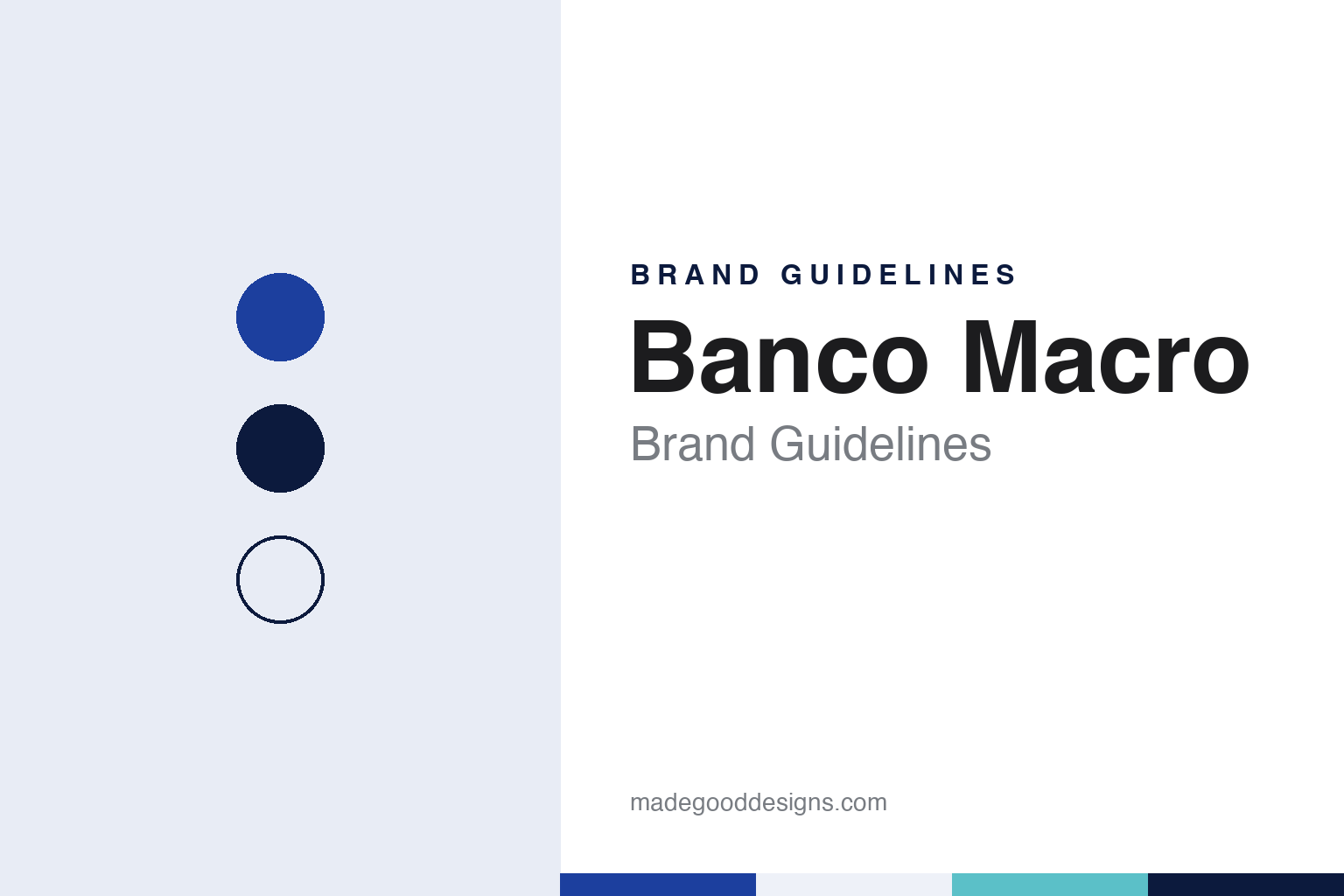
Banco Macro Brand Guidelines
From a 1976 financiera to a 2006 NYSE listing.
Aa
Two constants: a strong blue and navy palette and an open geometric sans register. Abstract homage — not a Banco Macro asset; no logo, card or sign is reproduced.
Financiera Macro
An arbitrage house that became a bank.
Banco Macro’s origins are told two ways. English Wikipedia says the business began as Financiera Macro, a brokerage specialising in arbitrage, founded in 1976 by Mario Brodersohn, José Dagnino Pastore and Alieto Guadagni, and bought in 1985 by a rival arbitrage trader, Jorge Brito. The bank’s own investor pages start the clock in 1985: Banco Macro says it began operating that year as a non-bank financial institution, founded by members of the Brito and Carballo families, who remain its majority shareholders. The bank’s head office is in Buenos Aires.
The banking licence came next. Spanish Wikipedia says the Central Bank of Argentina authorised Macro to work as a commercial bank and that the name Banco Macro S.A. was registered in February 1988. Until 1995, English Wikipedia says, it operated as a wholesale bank, trading government and corporate bonds, working in money markets and serving medium and large companies; it was an early participant in the Argentine corporate-bond market. Banco Macro says its shares have traded in Buenos Aires since November 1994.
The shift to a retail bank came through the provinces. In 1996, English Wikipedia says, citing the bank’s history, Macro bought control of the newly privatised provincial banks of Misiones, Salta and Jujuy, and later took part in restructuring a series of smaller private and cooperative banks in the north and centre of the country. In December 2001, during that year’s Argentine economic crisis, it bought about 60 percent of Banco Bansud, a bank with a large branch network in the south; it added branches of Scotiabank Quilmes in August 2002, and Macro and Bansud became one bank in 2003.
More purchases followed: Nuevo Banco Suquía in December 2004, Banco del Tucumán and Banco Empresario de Tucumán in 2005, and Nuevo Banco Bisel in 2006. In March 2006 the bank changed its corporate name from Macro Bansud to Macro and listed on the New York Stock Exchange, where its shares trade under the ticker BMA, the same code it uses in Buenos Aires.
Colour
A national bank built from regional ones.
Banco Macro describes itself as a universal bank focused on low- and middle-income individuals and small and medium-sized businesses, and says it acts as financial agent for four provinces in the north of Argentina. On its consumer site it calls itself the privately owned national bank with the largest branch network in the country, a claim that sits behind its slogan, “Tu banco cerca, siempre” (“Your bank close by, always”). Spanish Wikipedia says it has branches in 23 of Argentina’s 24 provinces, counting the City of Buenos Aires.
That geography shapes the brand. Many of Macro’s branches came from banks that once had their own names, from Misiones in the north-east to Tucumán in the north-west, and the bank has kept Banco del Tucumán as a separate entity within the group. A single Macro name over hundreds of branches, cards and screens is the device that holds those regional histories together under one national identity.
The most recent test came in 2023–2024. El Cronista reported in November 2024 that Macro had bought the Argentine operations of the Brazilian bank Itaú, run them for a transition period under the name Macro BMA, and planned to complete the merger on 19 November 2024, when everything would carry the Banco Macro name. A Macro manager told the paper that Itaú had wanted its own brand removed quickly, leaving the bank three months to change branch signs, reprint every credit and debit card and rebuild the app and websites, with about 1.3 million accounts moving across.
Advertising rounds out the picture. El Cronista reported in September 2018 on the campaign “Así de simple. Así de fácil,” starring the actor Darío Barassi, which promoted the bank’s Macro Premia rewards programme through everyday scenes. Infobae reported in May 2026 that Macro had launched “Soñá en grande” (“Dream big”) for the 2026 World Cup, renewing its partnership with Argentina’s national coach Lionel Scaloni, with a preview screening in his home town of Pujato and a plan to take customers and employees to the tournament. The bank’s site also follows Argentina’s national field-hockey teams, Las Leonas and Los Leones.
Typography
Design and documentation.
Latin American banks tend to present themselves through bold wordmarks and a small set of strong colours. Blues, reds, greens and yellows recur across the region’s banking brands, usually paired with a short name or acronym that has to work on a branch front, a debit card and an app icon alike. Many names are Spanish and carry a place, a nation or a founding purpose in them, and slogans are written for a home audience first.
Photography does much of the work. Bank websites and reports in the region often show branches, city streets and customers rather than abstract imagery, and some banks make a landmark headquarters building part of their public face. Financial-inclusion programmes — accounts for people new to banking, credit for small businesses, scholarships — are a recurring theme, presented alongside the core pages on accounts, cards, loans, remittances and mobile apps.
Sponsorship is another constant. Football leagues, stadiums and clubs carry bank names in several countries, and banks also run cultural foundations, art collections and exhibitions that put the brand in a setting far from the branch counter.
The paper trail matters too. Listed banks and the subsidiaries of international groups publish annual reports and sustainability reports, and these, together with dated press coverage and public histories, are what this guide draws on. Each entry sets out who founded the bank, who owns it now and how its name has changed, and marks what rests only on the bank’s own word. The colours and typefaces shown here are unofficial interpretations, not the banks’ own specifications.
Aa
An open geometric sans for a bank of many provinces. (Specimen set in Manrope, a sans STAND-IN; NOT the Banco Macro logo.)
Banco Macro
One short name over many provincial histories.
The name itself has stayed short. Spanish Wikipedia’s gallery records three versions of the logo, used from 2012 to 2019, from 2019 to 2025, and from 2025 onward. Through the Bansud years the bank traded as Macro Bansud, and the 2006 return to plain Macro coincided with its New York listing, giving one name for customers in the provinces and for investors abroad.
A listed bank of this kind also speaks through documents. Banco Macro publishes annual and quarterly results through Argentina’s securities regulator, the US Securities and Exchange Commission and its own investor-relations site, which makes reports, presentations and results releases a large part of its printed and digital identity alongside branches, cards and the app.
For a design guide, Banco Macro shows how one short name can unify provincial banks, an absorbed international brand and a national sponsorship programme. Compare the Itaú brand guidelines for the Brazilian bank whose Argentine branches became Macro in 2024 and the Santander brand guidelines for a contrast with a global bank group. For this guide we use a strong blue, a deep navy, a pale cloud and a teal accent with an open geometric sans, an unofficial interpretation; no product or logo is reproduced.
Explore & save
Keep Banco Macro’s identity on hand — save it to a board in the Made Good inspiration library.
Banco Macro identity set
Pin the Banco Macro strong blue and navy palette and the open geometric sans register to your own board.