Pacific Life Brand Guidelines
An 1868 Sacramento mutual that took a humpback whale as its symbol.
Aa
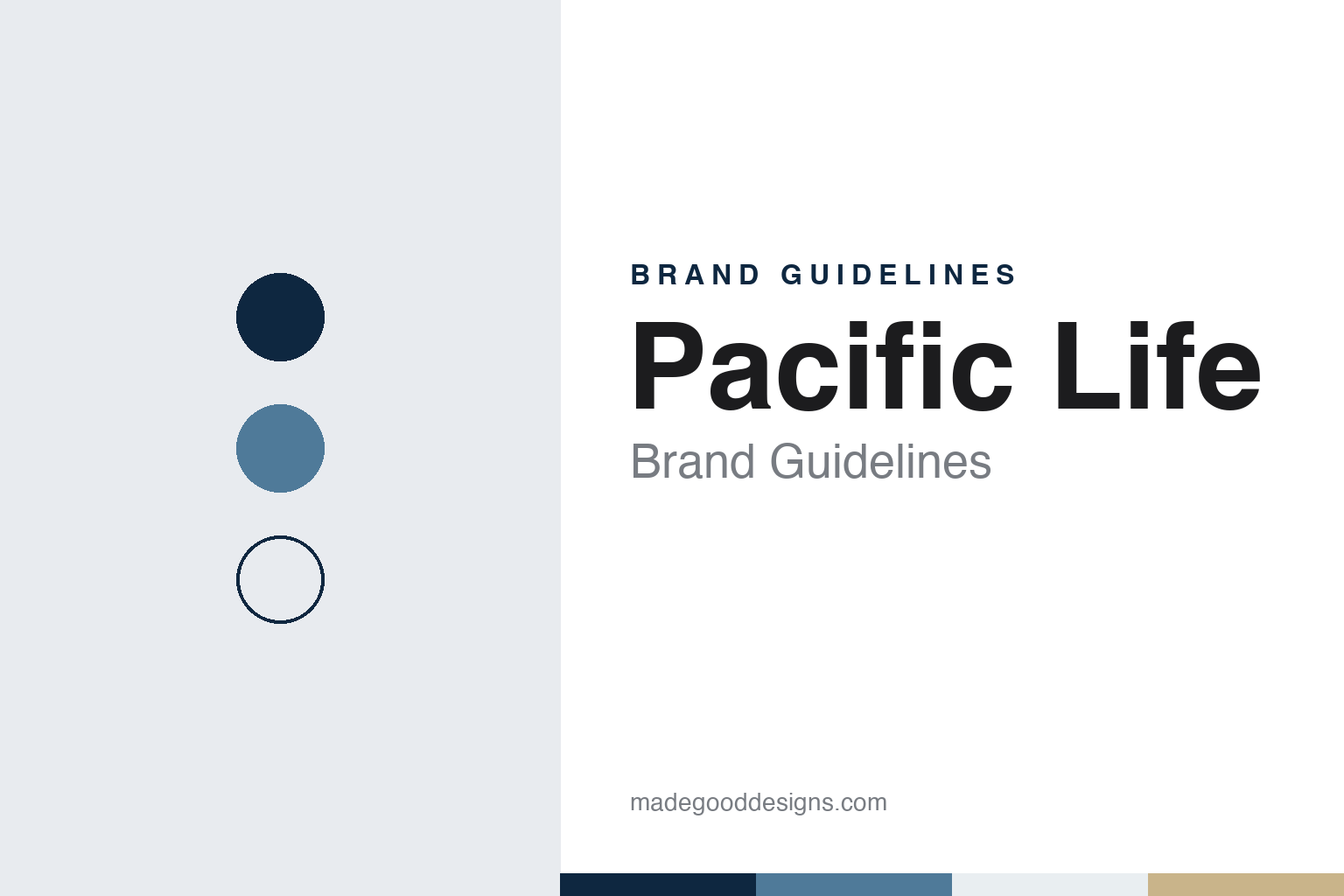
Two constants: a deep ocean blue, whale grey and sand palette and a steady serif register. Abstract homage — not a Pacific Life product or mark; no whale symbol, logo or wordmark is reproduced.
Pacific Mutual Life
A Sacramento start, a move south and a mutual structure.
Pacific Life began in Sacramento, California, in 1868 as Pacific Mutual Life. English Wikipedia names its founders as Simon Schreiber and Josiah Howell, and says the company followed state legislation passed in 1866 that allowed mutual insurance companies to be set up in California. Leland Stanford, president of the Central Pacific Railroad and a former governor of the state, was named the company’s president in 1868 and was also its first policyholder, Wikipedia says.
The business widened early. From 1885 Pacific Mutual also sold personal cover beyond life policies, a move Wikipedia describes as innovative for a life insurer at the time. Its offices were in San Francisco when the 1906 earthquake and the fires that followed struck the city; the building survived the earthquake but not the fires, and the company then moved to Los Angeles.
Hard times in the Great Depression changed its structure. In 1936, Wikipedia says, the state insurance commissioner encouraged policyholders to become part owners of the company through mutualisation, as a way to keep both the policyholders and the company going. In 1955 Pacific Mutual installed a Univac I computer, and in 1971 it started the investment firm PIMCO.
In 1972 the head office moved again, to Newport Beach in Orange County, where it remains. According to Wikipedia, management chose the city for the standard of living it offered employees’ families. The company has been domiciled in the state of Nebraska since 2005.
Colour
A new name and a whale, both in 1997.
The modern brand dates from 1997. That year the company dropped “Mutual” from its name and became the Pacific Life Insurance Company, reflecting a change from a mutual to a mutual holding company structure, English Wikipedia says. In the same year it adopted the humpback whale as its symbol; Wikipedia gives the reasons as the whale’s persistence, performance and strength.
Pacific Life’s own brand page says the humpback whale “has been at the heart of the Pacific Life brand since 1997,” representing stability and strength, and links the symbol to the Pacific Life Foundation, founded in 1984, which names whale conservation and ocean stewardship as a focus area. The company describes itself on its purpose page as a mutual company that takes “the long view,” with a stated purpose “to provide confidence for generations,” and says it serves over a million members.
The advertising line is about promises. Its television commercial is titled “The Power of a Promise,” and the brand page carries the line “We Keep Our Promises So You Can Keep Yours.” Sport carries the name too: Pacific Life says it is the Presenting Partner of the US Sailing Team in a partnership running through 2028, with branding on athletes, team gear and events, and the Official Life Insurance Sponsor of the PGA TOUR and PGA TOUR Champions. Its sailing page introduces athlete ambassadors across Olympic classes including Formula Kite, the mixed 470, ILCA 6 and Nacra 17, all aiming at the 2028 Games in Los Angeles.
The website splits its audiences into individuals, employers, institutions and financial professionals, with pages on life insurance, annuities, employee benefits and pension risk management. In May 2022, Wikipedia says, Pacific Life announced its intent to enter the workforce benefits market.
The purpose page sets out four goals: supporting customers through important financial moments, delivering long-term strength and resilience, operating with integrity, discipline and accountability, and investing in people, technology and capabilities. Its tone is that of a mutual: “We don’t manage for quarters, we manage for decades,” the page says. The company also lists outside recognition there, including a ninth consecutive year on the Ethisphere Institute’s ethics list and a fifth year as a Civic 50 honoree of Points of Light.
Typography
How US life insurers present themselves.
American life insurers and annuity firms sell promises that run for decades, and their identities tend to say so. Many lean on steady colours, most often blues, greens and navies, set against white, with wordmarks drawn to look calm rather than playful. Symbols carry much of the meaning: shields, lighthouses, arrows, letterforms built into monograms, and in Pacific Life’s case a humpback whale, which the company has used since 1997.
The photography follows a pattern too. Consumer pages show families, couples planning retirement and people at work, while a second set of pages speaks to the financial professionals, brokers and advisers who sell most of these products. Websites are usually divided by audience, into individuals, employers, institutions and financial professionals, with sections on life cover, annuities, retirement plans and workplace benefits.
Much of the visual language is regulatory as well as decorative. Product pages carry long disclosure notes naming the issuing company and the states where a contract is offered, and many companies give a page to financial-strength ratings from agencies such as S&P Global Ratings and Moody’s, each quoted as of a stated date. Annual reports, statutory filings and investor presentations sit alongside the consumer site, and for listed groups they are often where the corporate identity is most fully set out.
The companies in this guide come from different structures: mutuals owned by their policyholders, demutualised and listed groups, spin-offs from larger insurers and businesses owned by investment firms. This guide sets out what can be checked about each one, from its founding and ownership to the symbols and lines it uses today, and gives the company’s own statements as its claims.
Aa
A steady serif — a register for a company that talks about promises kept across generations. (Specimen set in Source Serif 4, a serif STAND-IN; NOT the Pacific Life logo or wordmark.)
Pacific Life
Subsidiaries bought, built and sold.
Around the insurer, Pacific Life has built and sold other businesses. In 2001 it became the majority shareholder of Aviation Capital Group, which owns, manages and leases commercial jet aircraft; in 2019 it agreed to sell the unit to the minority shareholder Tokyo Century, and the sale was completed on 5 December 2019, English Wikipedia says. Pacific Asset Management, a fixed-income manager created in May 2007, was sold to Aristotle Capital Management in a sale completed on 17 April 2023.
Not every venture lasted. Swell Investing, an impact-investing subsidiary launched in 2017, did not reach the scale it needed and was closed on 30 August 2019, according to Wikipedia. On 1 April 2022 Darryl Button became president and chief executive, which Wikipedia counts as the fifteenth in the company’s history, and on 28 October 2025 Pacific Life announced an expansion of its footprint to Charlotte, North Carolina. Wikipedia also records the Pacific Life Foundation, set up in 1984 and based in Newport Beach, which makes grants to organisations working on a broad range of social needs.
For a design guide, Pacific Life shows how one animal symbol, held since 1997, can carry a long-lived mutual through name changes, new head offices and sponsorships. Compare New York Life and MassMutual, two other American life insurers with mutual roots. For this guide we use a deep ocean blue, a whale grey and a dune sand with a serif, an unofficial interpretation; no product or logo is reproduced.
Explore & save
Keep Pacific Life’s identity on hand — save it to a board in the Made Good inspiration library.
Pacific Life identity set
Save the Pacific Life deep ocean blue, whale grey and sand palette and the steady serif register to your own board.