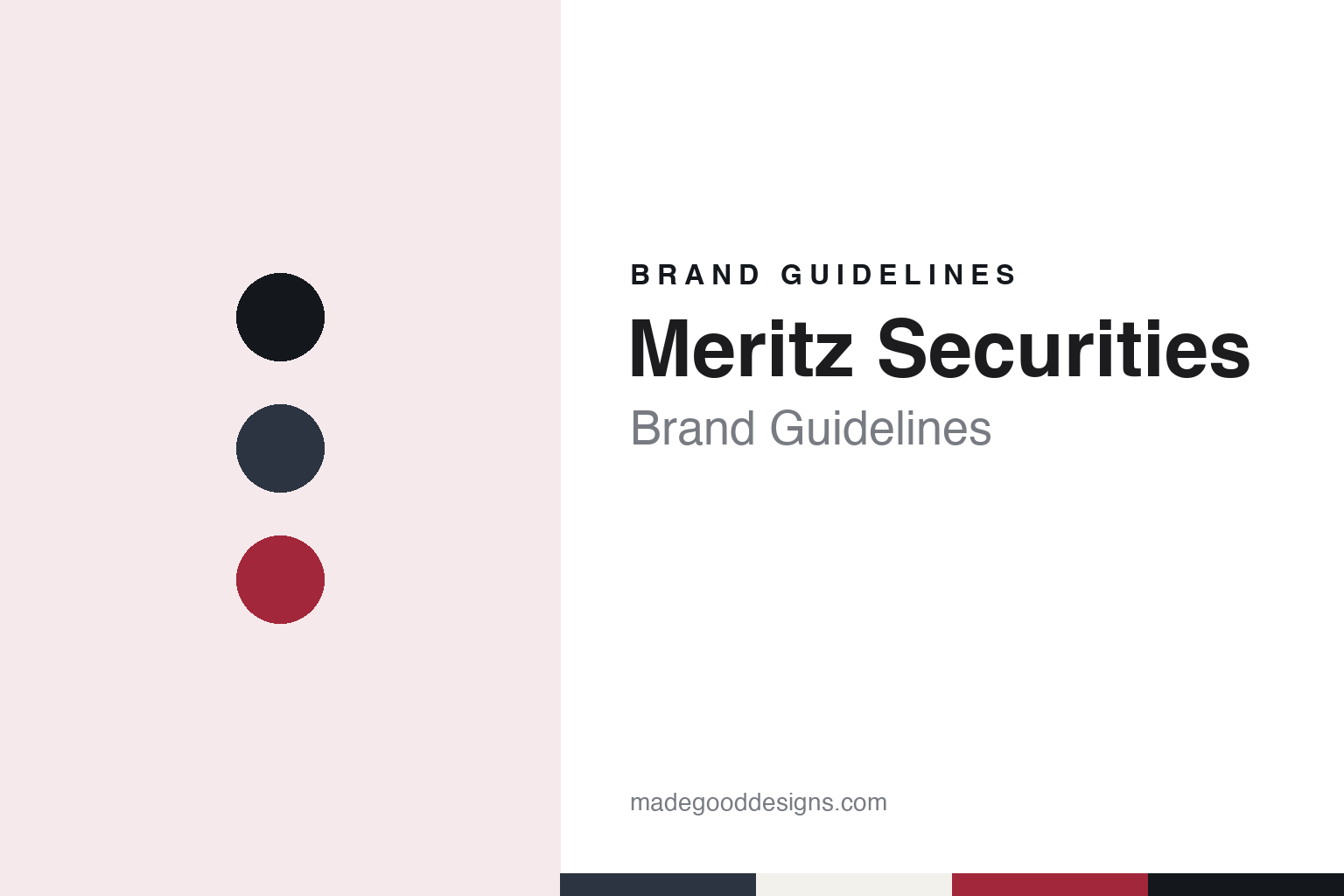
Meritz Securities Brand Guidelines
A 1973 Seoul brokerage that left the Hanjin group under a new name.
Aa
Two constants: a slate, paper and signal-red palette of our own and a geometric sans register. Abstract homage — not a Meritz Securities product or mark; no logo, app screen or document is reproduced.
Hanil Securities
A 1973 brokerage inside the Hanjin group.
Meritz Securities traces its corporate line to 24 February 1973, when it was founded in Seoul as Hanil Securities, according to Korean Wikipedia’s company history. In October 1990 it was renamed Hanjin Investment & Securities, the brokerage of the Hanjin group, and its shares were listed on the Korean stock market from 15 January 1992. In July 1996 it set up an investment trust manager, Seoul Investment Trust Management, the same history says.
The Meritz name arrived in March 2000. Korean Wikipedia’s article on Meritz Financial Group says that from 2000 the Hanjin group’s financial companies — the brokerage, the non-life insurer Dongyang Fire & Marine and the merchant bank Hanbul — began to separate from the group, and that the brokerage became a joint venture with Prudential Asset Management Asia and took the name Meritz Securities.
The separation took several years. On 14 May 2003 Korea JoongAng Daily reported that Hanjin Group had repeated a plan, first announced a year earlier, to spin off its financial arms into a separate financial group made up of three units: Oriental Fire and Marine Insurance, Korean French Banking and Meritz. The paper named Cho Jung-ho, then vice chairman of Meritz Securities, as the person who would take over the new group. It also reported that the companies had cut their cross-shareholdings in one another to below 3 per cent, one of the steps required under Korean law before the Fair Trade Commission could approve such a separation.
The final step came in 2005. According to Korean Wikipedia, citing Yonhap, Dongyang Fire & Marine left the Hanjin group in March 2005 and was renamed Meritz Fire & Marine Insurance; citing Segye Ilbo, it says the insurer acquired Meritz Securities on 14 October 2005 after the financial regulator approved the purchase. The Korea Times reported in October 2022 that Cho broke off the financial affiliates from Hanjin Group in 2005 and renamed them Meritz Financial Group.
Colour
A holding company and two renamings.
Meritz Securities widened its business in the years after the separation. On 20 September 2006 it acquired Hanbul, the merchant bank that had been the third part of the Hanjin financial arm, Korean Wikipedia says, citing Maeil Business. In April 2010 the company changed its name to Meritz Jonggeum Securities, and it used that name for ten years.
The group took its present shape on 28 March 2011. That day Meritz Fire & Marine Insurance said it had launched a financial holding company, Meritz Financial Group Inc., created through a split-up of the insurer, with six subsidiaries including Meritz Securities and Meritz Asset Management, Yonhap reported. English Wikipedia now lists five major subsidiaries: Meritz Fire & Marine Insurance, Meritz Securities, Meritz Asset Management, Meritz Alternative Investment Management and Meritz Capital.
Growth also came by merger. According to Korean Wikipedia, the brokerage absorbed IM Investment & Securities in June 2015, made Meritz Capital its subsidiary in April 2017, and in November 2017 was designated a comprehensive financial investment business operator under Korean capital-markets rules. In April 2020 it returned to the name Meritz Securities.
The last structural change came in April 2023, when Meritz Financial Group acquired all of the brokerage’s shares and made it a wholly owned subsidiary; Meritz Securities’ own stock-market listing ended on 25 April 2023, Korean Wikipedia records, and the group article says the insurer was taken fully into the holding company at the same time. The Korea Times described the group in October 2022 as run on a meritocracy, with Cho giving the chief executives of its affiliates full autonomy to act on their own judgement. Meritz Securities’ head office is in the Three IFC tower in Yeouido, Seoul, according to Korean Wikipedia.
Typography
Korean brokerages and their screens.
Korean securities firms present themselves in two languages at once. Their names usually appear in Hangul and in English side by side, on websites, in apps and on annual reports, and many of the larger houses carry the name of a wider financial group — Mirae Asset, Samsung, NH, KB or Hanwha — in front of the word for securities. Their wordmarks tend to rely on a single strong colour, and orange, blue, yellow and green all appear across the sector.
Most of a broker’s daily contact with customers now happens on screens. The industry has its own shorthand for them: an MTS, or mobile trading system, is the phone app, and an HTS, or home trading system, is the desktop program that came before it. The apps are named products in their own right. Samsung Securities calls its app mPOP, and Mirae Asset Securities renamed its M-STOCK app MAPS in 2026, describing the change as a shift from order-taking towards portfolio advice.
Beyond the trading screens, the websites follow a familiar pattern. Pages for overseas shares sit next to pages for retirement pensions; The Korea Herald noted in 2026 that Korean retail investors have expanded their investments in overseas markets. Each large house also runs a research centre whose analyst reports feed the apps, the websites and the firm’s institutional clients, and some now present that research with AI tools.
The formal record lives in reports. Listed brokers publish annual reports and, increasingly, sustainability or integrated reports in Korean and English, alongside disclosures to the Financial Supervisory Service. For a design reader these documents, more than any advertising, show how each firm sets its type, colour and tables when it speaks to shareholders and regulators.
Aa
A geometric sans for a group-wide name. (Specimen set in Manrope, a sans STAND-IN; NOT the Meritz Securities logo.)
Meritz Securities
MOUM, Super365 and a group-wide name.
In recent years the brokerage has turned more towards retail and private clients. In November 2024 it set up a dedicated family-office unit for wealthy clients, Korean Wikipedia records, citing Yonhap Infomax. On 1 September 2026 it launched MOUM, a platform that adds investment information, a global investor community and artificial-intelligence services to the stock-trading functions of its existing mobile trading system, ChosunBiz reported. The company said it had spent about a year and a half preparing the platform, which it presented at a launch event in Yeouido that morning.
According to ChosunBiz, users trading Korean and US shares on MOUM can read domestic and overseas news, disclosures and earnings information summarised and analysed by AI, and exchange views with investors abroad: Meritz linked the communities of the US social investing platform Stocktwits and the fintech company Webull to MOUM’s own stock communities. Major services work without a separate login; a social login gives associate membership, and linking the online-only investment account Super365 makes a user a full member who can see trading, holdings and AI analysis on a single screen. The platform also carries market and stock news as short videos of about a minute, and Meritz said it was built as a cloud-based open platform in collaboration with Amazon Web Services.
The Meritz name runs across the whole group, from the non-life insurer to the brokerage, the asset managers and the capital arm, so a single word carries companies with quite different businesses.
For a design guide, Meritz Securities shows how a brokerage’s name can follow its owners: Hanil, Hanjin, Meritz, Meritz Jonggeum and Meritz again. Compare Hanwha Investment & Securities, another Seoul brokerage shaped by a group and a merger, and Samsung Securities. For this guide we use slate, ink, warm paper and a signal red with a sans, an unofficial interpretation; no product or logo is reproduced.
Explore & save
Keep Meritz Securities’s identity on hand — save it to a board in the Made Good inspiration library.
Meritz Securities identity set
Pin the slate, paper and signal-red palette and the geometric sans register to your own board.