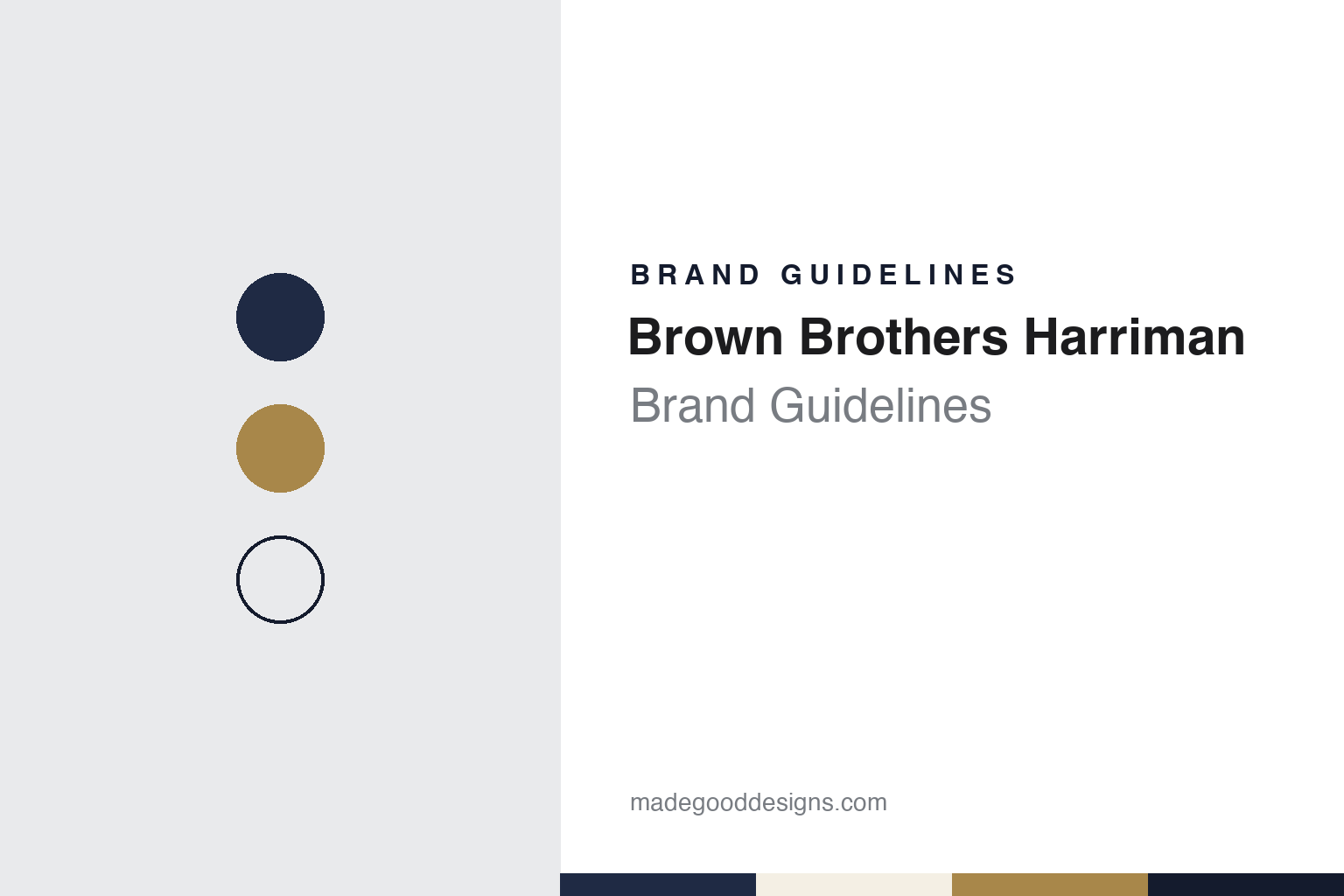
Brown Brothers Harriman Brand Guidelines
A private partnership that dates itself to 1818.
Aa
Two constants: a navy, cream and brass palette and a ledger serif register. Abstract homage — not a Brown Brothers Harriman product or mark; no logo, document or signage is reproduced.
Alexander Brown & Sons
A Baltimore linen business and four sons.
Brown Brothers Harriman traces itself to a linen business. The firm’s own timeline says Alexander Brown, born in Ballymena in 1764 and a linen merchant in Belfast, arrived in Baltimore in 1800 and set up a linen import business there under the name Alexander Brown & Co. Between 1805 and 1811 he took his four sons, William, George, John and James, into the business as partners, and the firm says it “has remained a private partnership ever since.”
The date on its pages is a later choice. In 1818 John Brown opened John A. Brown & Co. in Philadelphia, and, the firm says, “a century later, the partners of Brown Brothers & Co. would take 1818 for the founding date of the firm.” William had opened a Liverpool house in 1810; it was renamed Brown Shipley & Co. in 1839, after a junior partner, Joseph Shipley, secured loan guarantees from the Bank of England during the Panic of 1837, the firm and English Wikipedia say, and it became a separate company in 1918, according to English Wikipedia. James opened the New York office in October 1825, trading as Brown Brothers & Co., the name by which the American firm came to be known.
From the 1830s the brothers moved from trading goods to merchant banking: letters of credit, bills of exchange and foreign exchange. The firm’s timeline says it opened a Boston agency in 1844, began managing investments for private clients in 1857 and bought a seat on the New York Stock Exchange in 1882, where for 120 years it was known as “Broker 10.” In the late 1890s, it says, the sterling rates it posted in its New York lobby became the standard dollar-to-pound reference for two decades.
The present name dates from 2 January 1931, when Brown Brothers & Co. merged with Harriman Brothers & Company and W. A. Harriman & Co., according to English Wikipedia. The Harriman securities firm had been founded in 1919 by the brothers W. Averell and E. Roland Harriman, the firm says. After the Banking Act of 1933 the partners chose to remain a commercial bank and spun securities underwriting off into a separate firm, Harriman Ripley, English Wikipedia says.
Colour
From a fund ledger to global custody.
Custody grew out of a side service. In 1928, the firm says, its Boston office formed a fund accounting department to service Century Share Trust, a fund it sponsored; the processing and safekeeping of securities became a standalone business after the US banking and securities laws of 1933. In 1963 it took its first non-US securities into custody, the start of what it calls its global custody business, and in 1997 it merged its global and US custody operations into a single line called Investor Services.
Offices followed the funds: Zurich in 1968, London in 1974, Tokyo in 1984, Hong Kong and Luxembourg in 1989, Dublin in 1995, Kraków in 2012 and Grand Cayman in 2016, according to the firm’s timeline. It started a securities lending programme of its own in 1999 and its Infomediary data platform in 2001. In 1970 it gave its historical archive to the New-York Historical Society, where scholars can study it.
The firm’s history also runs through the cotton trade. Its own timeline says that in the early nineteenth century cotton became the largest commodity the Browns traded and financed, and that Brown Brothers, “like many other firms in the antebellum era,” were part of a system that helped perpetuate the Southern plantation economy and its use of slave labour, which it calls “a source of profound regret today.” Writing in the New York Almanack in February 2025, the historian Alan J. Singer said documents at the New-York Historical Society show that the firm lent to Southern planters, arranged the shipment and sale of slave-grown cotton and tobacco, and took possession of plantations through foreclosures after the Panic of 1837; he noted that the firm had amended its own account of this period on its website.
The firm’s own timeline describes many of its partners and staff entering public service and the armed forces during the war.
Typography
Design and documentation.
Post-trade institutions do the work that follows a trade: settlement, clearing, custody, collateral management and asset servicing. Central securities depositories, or CSDs, hold securities in book-entry form and settle transfers between accounts; international CSDs such as Euroclear Bank in Brussels and Clearstream Banking in Luxembourg do the same for bonds issued across borders; clearing houses stand between buyers and sellers; and custody banks hold assets for investors. Global Custodian noted in 2010 that this business is sometimes called the “plumbing of the financial system.”
The names can mislead. English Wikipedia points out that neither Euroclear nor Clearstream runs central counterparty clearing, despite the word in their names, which date from a time when clearing and settlement were treated as a single activity. For a designer, that makes plain service pages important: settlement, custody, collateral and fund services each tend to get their own section, written for banks, brokers and central banks rather than private investors.
Much of what these institutions publish is documentation. Clearstream’s website, for example, groups banking licences, articles of association, disclosure reports and regulatory information under the EU’s settlement and digital-resilience rules on one regulation page, alongside due-diligence questionnaires and factsheets. Rulebooks, operating manuals and annual reports sit beside those pages, so for a design system a clear type hierarchy and readable tables do much of the work.
The palettes in this guide lean on deep blue, teal and grey, set with a sans for long technical text, and the imagery stays abstract: networks, links and data rather than people or products. These are unofficial interpretations of our own, not brand colours; no logo, wordmark or document from any institution is reproduced.
Aa
A ledger serif for a firm that leads with its founding date. (Specimen set in Libre Caslon Text, a serif STAND-IN; NOT the Brown Brothers Harriman logo.)
Brown Brothers Harriman
Owner-managers, two businesses.
BBH has stayed private while most of its peers listed their shares. It calls itself “a privately owned and managed financial services firm,” free of outside shareholders, and says it is in its 14th generation of leadership, with 39 Partners and 63 Principals working as owner-managers. It runs two businesses: Capital Partners, covering wealth management, corporate advisory and banking, private equity and investment management, and Investor Services, which provides custody, fund accounting and administration, depositary services, foreign exchange, securities lending and data services to asset managers and financial institutions. As of 30 June 2026 the firm gave its figures as more than 6,000 employees in 18 offices and 6.2 trillion US dollars in assets under custody and administration.
The firm nearly sold part of that. In September 2021 State Street agreed to buy BBH’s Investor Services business; after prolonged regulatory review the two sides agreed in November 2022 to drop the deal, English Wikipedia’s State Street article says. Investor Services has since kept building links to market infrastructure: on 28 October 2026 BBH said it was a day-one participant in the DTCC Tokenization Service, run by The Depository Trust Company, a subsidiary of DTCC.
Leadership passes from within the partnership. On 17 September 2026 BBH announced that Kevin W. Stone, its chief financial officer and a partner who joined the firm in 1992, will become Managing Partner on 1 January 2027, succeeding William B. Tyree.
For a design guide, Brown Brothers Harriman shows how a firm can make its age and its ownership the message: “Founded in 1818” and the word “partnership” sit at the top of its own story pages. Compare State Street, a listed custodian that once agreed to buy BBH’s Investor Services arm, and Northern Trust. For this guide we use a deep navy, a warm cream and a muted brass with a serif, an unofficial interpretation; no product or logo is reproduced.
Explore & save
Keep Brown Brothers Harriman’s identity on hand — save it to a board in the Made Good inspiration library.
Brown Brothers Harriman identity set
Save the navy, cream and brass palette and the ledger serif register to your own board.