Northern Trust Brand Guidelines
A one-room office in the Rookery and a Chicago custody bank.
Aa
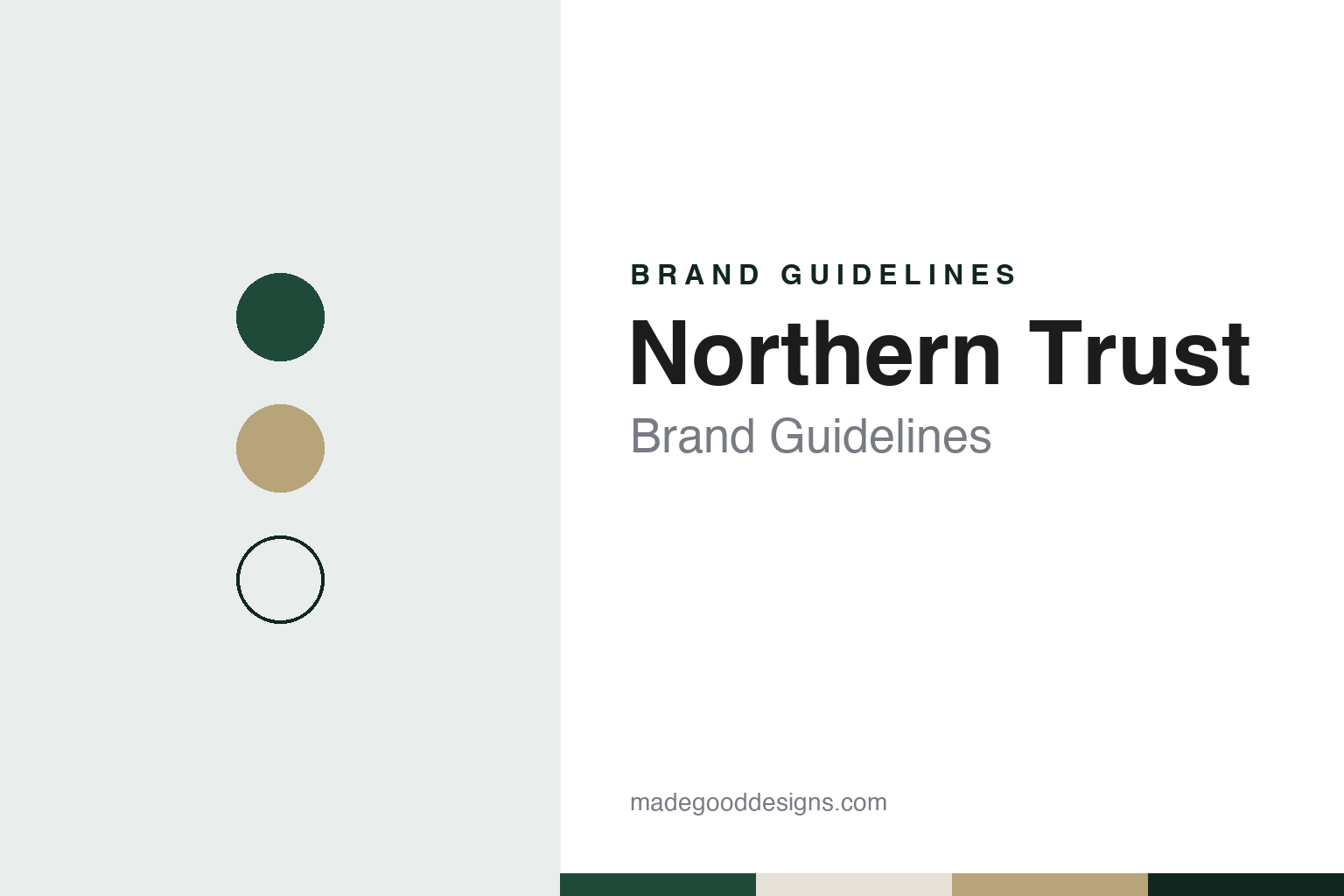
Two constants: a Northern Trust green, gold and stone palette and a bookish serif register. Abstract homage — not a Northern Trust mark; no logo or wordmark is reproduced.
The Rookery, 1889
A one-room trust office in the Loop.
Northern Trust opened in Chicago on 12 August 1889. English Wikipedia says it was founded by Byron Laflin Smith in a one-room office in the Rookery Building in the Loop, to offer trust and banking services to the city’s prosperous residents, and that its original 27 shareholders included the merchant Marshall Field, Martin A. Ryerson and the meatpacker Philip D. Armour. The company’s own boilerplate, in a release of June 2026, still opens with the same fact: founded in Chicago in 1889.
The bank soon had a building of its own. Its Chicago headquarters in the financial district dates from 1905 and was designed by the architects Frost and Granger; it opened with five storeys and was built to take more. When the bank needed space in 1965 it chose instead to add a 14-storey International Style building to the west, designed by Cesar Pelli, Wikipedia says. In 1914 Smith’s son, Solomon A. Smith, took charge of the bank, and members of the Smith family led it for decades afterwards; Edward Byron Smith stepped down as chief executive in 1979.
Wikipedia credits conservative policies for the bank’s steady record between the wars: its assets grew during the Great Depression, when many other banks failed. By 1941 nearly half of its commercial accounts came from outside the Chicago area. During the Second World War it took part in the government’s war-bond drives and made loans for the manufacture of war materials under special government programmes, and all sectors of its business expanded. In the 1950s it spent heavily on automated banking, including what Wikipedia calls the first fully automated financial statements for trust clients.
Colour
Custody, wealth and asset management.
The modern firm has three businesses. Asset Servicing is the custody and fund-administration arm: Wikipedia lists custody, fund administration, investment operations outsourcing, securities lending, foreign exchange, treasury and cash management for pension funds, foundations, endowments, fund managers, insurers and sovereign wealth funds. Wealth Management serves wealthy families, business owners and executives through offices across US states and in London, Guernsey and Abu Dhabi. Northern Trust Asset Management runs active and passive strategies in equities and fixed income, plus private equity, hedge-fund and multi-manager products.
Growth abroad came largely through funds servicing. A Northern Trust release of 15 June 2026 says it has served Irish clients since 1989, opened offices in Dublin in 2000 and Limerick in 2007, and serviced the first Irish UCITS fund. The same release announced that the Central Bank of Ireland had granted a licence for a new Ireland branch of The Northern Trust Company, to work alongside Northern Trust Global Services SE, the continental European bank it set up in Luxembourg in March 2019. In 2017 it acquired UBS Asset Management’s fund administration servicing units in Switzerland and Luxembourg, and in May 2020 it entered an alliance with BlackRock to work with shared clients on BlackRock’s Aladdin platform, Wikipedia says.
Operations technology remains part of the story, as it was in the 1950s. On 9 November 2026 CIO reported that the bank, which it called a venerable Chicago-based banking institution, had launched an AI client-onboarding agent built with Microsoft to convert years of client transaction data for its Front Office Solutions platform; the bank’s chief operating officer told the magazine that staff still review the output and handle the uncertain cases.
Typography
How custody institutions present themselves.
Post-trade institutions do the work that follows a trade: settlement, clearing, custody, collateral management and asset servicing. Central securities depositories, or CSDs, hold securities in book-entry form and settle transfers between accounts; international CSDs such as Euroclear Bank in Brussels and Clearstream Banking in Luxembourg do the same for bonds issued across borders; clearing houses stand between buyers and sellers; and custody banks hold assets for investors. Global Custodian noted in 2010 that this business is sometimes called the “plumbing of the financial system.”
The names can mislead. English Wikipedia points out that neither Euroclear nor Clearstream runs central counterparty clearing, despite the word in their names, which date from a time when clearing and settlement were treated as a single activity. For a designer, that makes plain service pages important: settlement, custody, collateral and fund services each tend to get their own section, written for banks, brokers and central banks rather than private investors.
Much of what these institutions publish is documentation. Clearstream’s website, for example, groups banking licences, articles of association, disclosure reports and regulatory information under the EU’s settlement and digital-resilience rules on one regulation page, alongside due-diligence questionnaires and factsheets. Rulebooks, operating manuals and annual reports sit beside those pages, so for a design system a clear type hierarchy and readable tables do much of the work.
The palettes in this guide lean on deep blue, teal and grey, set with a sans for long technical text, and the imagery stays abstract: networks, links and data rather than people or products. These are unofficial interpretations of our own, not brand colours; no logo, wordmark or document from any institution is reproduced.
Aa
A bookish serif — the register of a trust bank. (Specimen set in Libre Baskerville, a serif STAND-IN; NOT the Northern Trust logo.)
Northern Trust
One name, one city, since 1889.
Northern Trust has had difficult chapters, and Wikipedia records them plainly. In the early 1980s losses on loans to Latin American countries cut into profits until loan reserves and write-offs restored the bank’s asset quality. After the collapse of Enron, employees brought claims over the retirement plan Northern Trust had administered; a settlement reached in 2005 was revised a year later and approved by a federal court, with Northern Trust neither admitting nor denying wrongdoing. In November 2008 the US Treasury invested in the company under the Troubled Asset Relief Program, and the company repurchased that investment in June 2009.
The way the company describes itself has stayed close to its origins. Its June 2026 release calls Northern Trust Corporation a provider of wealth management, asset servicing, asset management and banking services to corporations, institutions, affluent families and individuals, and says it has offices in 24 US states and Washington, D.C., and in 22 locations across Canada, Europe, the Middle East and the Asia-Pacific region. The head office remains in Chicago, the shares trade on Nasdaq under the ticker NTRS, and the company, which Wikipedia says is incorporated in Delaware, still uses the name chosen in 1889. The release also says it has served clients for more than 135 years.
For a design guide, Northern Trust shows how a bank can keep one name and one home city for well over a century while its work moves from local trust accounts to global custody and fund administration. Compare BNY, a New York custody bank that cut its name to three letters in 2024, and State Street, a Boston custody bank. For this guide we use a deep green, a muted gold and a limestone grey with a serif, an unofficial interpretation; no product or logo is reproduced.
Explore & save
Keep Northern Trust’s identity on hand — save it to a board in the Made Good inspiration library.
Northern Trust identity set
Pin the Northern Trust green, gold and stone palette and the bookish serif register to your own board.