BNY Brand Guidelines
Hamilton’s 1784 bank, the 2007 Mellon merger and a three-letter name.
Aa
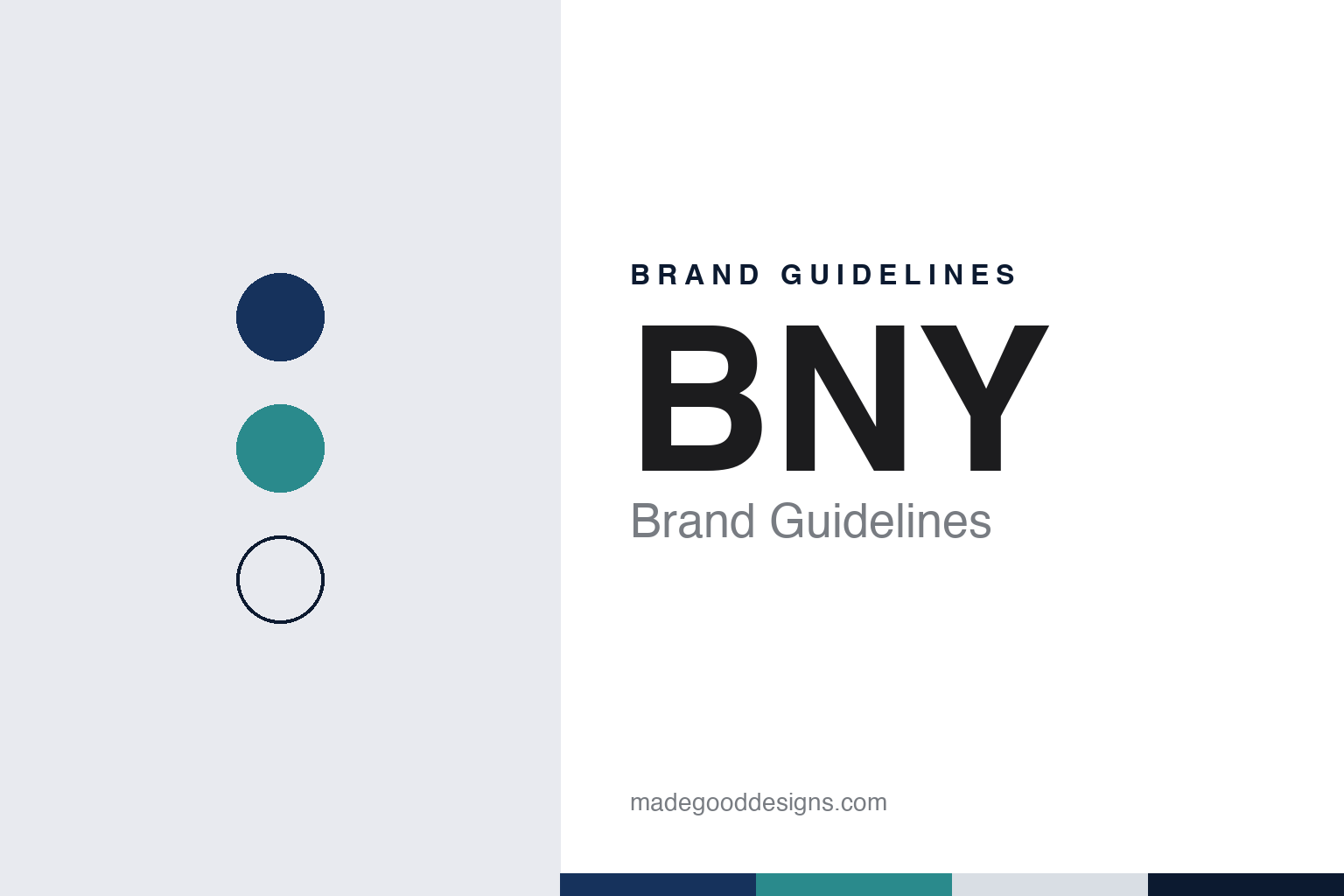
Two constants: a BNY navy, teal and grey palette and a geometric sans register. Abstract homage — not a BNY mark; no logo, arrow or wordmark is reproduced.
A coffee-house bank
New York merchants, Alexander Hamilton and 1784.
BNY is the corporate brand of The Bank of New York Mellon Corporation, a New York financial services company whose oldest line runs back to 1784. English Wikipedia describes months of discussion among New York merchants that ended in a June 1784 meeting at a coffee house, which led to the formation of the Bank of New York; the bank opened on 9 June 1784 and ran without a charter for seven years. The group behind it included Alexander Hamilton, later the first Secretary of the Treasury, and its first president was Alexander McDougall. The company’s own history page puts Hamilton at the centre of the story and says the bank was set up to help New York get back on its feet after the Revolutionary War.
The early milestones in Wikipedia’s account are civic as much as commercial. The bank made the federal government’s first loan in 1789, arranged by Hamilton as Treasury Secretary, and when the New York Stock Exchange opened in 1792 the Bank of New York was the first company traded on it. In 1796 it moved to the corner of Wall Street and William Street. Through the nineteenth century it was known for conservative lending; it helped fund the Erie and Morris canals and steamboat companies, helped finance the War of 1812 and the Union Army in the Civil War, and later lent to utilities, railroads and the New York City Subway, Wikipedia says.
The twentieth century was a run of mergers: the New York Life Insurance and Trust Company in 1922, the Fifth Avenue Bank in 1948 and the Empire Trust Company in 1966, with a holding company formed in 1969. In 1988, after a year-long takeover bid, it combined with Irving Bank and moved its headquarters to One Wall Street. The company says it automated its bookkeeping in 1958 and installed cash machines in its retail branches in the 1980s.
Colour
Pittsburgh’s Mellon and a custody business.
The second half of the name comes from Pittsburgh. Mellon began in 1869 as T. Mellon & Sons’ Bank, founded by Thomas Mellon, a retired judge, and his sons Andrew W. and Richard B. Mellon. It became Mellon National Bank in 1902, merged with the Union Trust Company in 1946, took the name Mellon Bank in 1972, merged with the fund group Dreyfus in 1994 and became Mellon Financial Corporation in 1999, according to English Wikipedia.
Meanwhile the Bank of New York was turning itself into a securities-services specialist. Wikipedia records 33 acquisitions between 1993 and 1998, including JP Morgan’s global custody business in 1995; the purchase of the clearing firm Pershing from Credit Suisse First Boston in 2003; and a 2006 exchange in which it passed its retail banking business to JPMorgan Chase in return for that bank’s corporate trust business, leaving retail banking behind. The company says it was the first to process securities over the internet, in 1996.
The two banks announced their merger on 4 December 2006 and completed it on 1 July 2007. The combined group took the legal name The Bank of New York Mellon Corporation and used BNY Mellon as the brand for most business lines. Wikipedia lists its services as asset servicing, custody, corporate trust, treasury services, depositary receipts, collateral services, foreign exchange and securities lending, alongside asset and wealth management. In October 2008 the US Treasury chose the bank, through a bidding process, as master custodian for the Troubled Asset Relief Program, and in November 2017 it carried out what Wikipedia calls the US banking industry’s first real-time payment on The Clearing House’s new system.
Not every chapter is a milestone. In October 2011 the US Justice Department and New York’s attorney general filed civil suits over the bank’s pricing of foreign-exchange trades for custody clients; in March 2015 the company admitted facts about how it had represented that pricing and settled the related cases, Wikipedia says.
Typography
How custody institutions present themselves.
Post-trade institutions do the work that follows a trade: settlement, clearing, custody, collateral management and asset servicing. Central securities depositories, or CSDs, hold securities in book-entry form and settle transfers between accounts; international CSDs such as Euroclear Bank in Brussels and Clearstream Banking in Luxembourg do the same for bonds issued across borders; clearing houses stand between buyers and sellers; and custody banks hold assets for investors. Global Custodian noted in 2010 that this business is sometimes called the “plumbing of the financial system.”
The names can mislead. English Wikipedia points out that neither Euroclear nor Clearstream runs central counterparty clearing, despite the word in their names, which date from a time when clearing and settlement were treated as a single activity. For a designer, that makes plain service pages important: settlement, custody, collateral and fund services each tend to get their own section, written for banks, brokers and central banks rather than private investors.
Much of what these institutions publish is documentation. Clearstream’s website, for example, groups banking licences, articles of association, disclosure reports and regulatory information under the EU’s settlement and digital-resilience rules on one regulation page, alongside due-diligence questionnaires and factsheets. Rulebooks, operating manuals and annual reports sit beside those pages, so for a design system a clear type hierarchy and readable tables do much of the work.
The palettes in this guide lean on deep blue, teal and grey, set with a sans for long technical text, and the imagery stays abstract: networks, links and data rather than people or products. These are unofficial interpretations of our own, not brand colours; no logo, wordmark or document from any institution is reproduced.
Aa
A geometric sans — the register of a custom wordmark. (Specimen set in Manrope, a sans STAND-IN; NOT the BNY logo.)
BNY
From BNY Mellon to three letters.
The identity was rebuilt in June 2024, the year of the Bank of New York’s 240th anniversary. Funds Society reported on 12 June 2024 that the company had simplified its corporate brand to BNY and updated its logo, while keeping The Bank of New York Mellon Corporation as its legal name. The company described the logo changes as a more modern custom typeface, a simpler structure and a distinctive teal for the arrow, and said the new name and mark would be applied at once, with updates continuing over the following twelve months.
The business names were shortened at the same time: BNY Mellon Investment Management became BNY Investments, BNY Mellon Wealth Management became BNY Wealth, and Pershing became BNY Pershing, a change the company said would keep a unified visual identity. The footer of bny.com now states that BNY is the corporate brand of The Bank of New York Mellon Corporation and may refer to the group as a whole or to its subsidiaries. A further step came in May 2026, when the company changed its New York Stock Exchange ticker from BK to BNY, according to English Wikipedia. Wikipedia also records an earlier refresh, a 2013 marketing campaign with a new slogan and logo, and two headquarters moves: from One Wall Street to Brookfield Place in 2014, then to a building in Tribeca the bank already owned in 2018.
For a design guide, BNY shows how a long institutional name can be cut to three letters without dropping its history: the legal entity keeps every word, while the brand, the business lines and finally the ticker share one short mark. Compare State Street, another custody bank with eighteenth-century roots, and Northern Trust, a Chicago trust bank in the same business. For this guide we use a deep navy, a teal and a cool grey with a sans, an unofficial interpretation; no product or logo is reproduced.
Explore & save
Keep BNY’s identity on hand — save it to a board in the Made Good inspiration library.
BNY identity set
Pin the BNY navy, teal and grey palette and the geometric sans register to your own board.