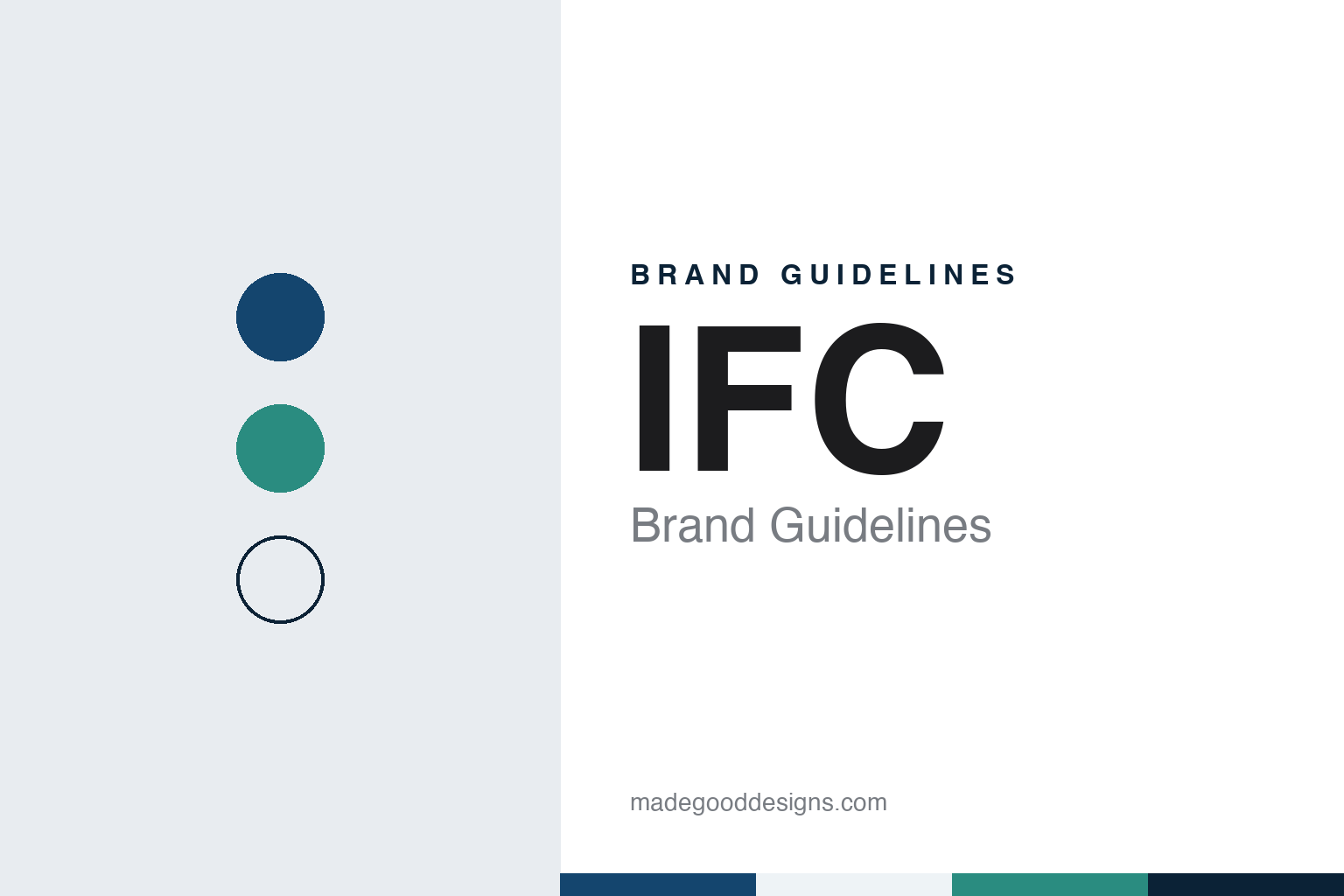
IFC Brand Guidelines
The World Bank Group’s 1956 private-sector arm in Washington.
Aa
Two constants: an IFC blue, teal and mist palette and a measured serif register. Abstract homage — not an IFC product or mark; no logo, emblem or seal is reproduced.
Washington, 1956
A private-sector arm for the World Bank.
The International Finance Corporation is the member of the World Bank Group that invests in private companies rather than lending to governments. English Wikipedia traces the idea to the 1944 Bretton Woods conference, which created the International Monetary Fund and the International Bank for Reconstruction and Development but left the role of private capital open. Robert L. Garner, who joined the World Bank in 1947, became the main advocate of a separate affiliate that could invest in private firms without government guarantees, something the bank’s own articles did not allow; in 1952 he put the proposal to the bank’s president, Eugene Black, in a memorandum.
In 1954 the United Nations General Assembly passed a resolution urging the World Bank to study the idea, and IFC’s Articles of Agreement came into force on 20 July 1956, English Wikipedia says. Garner became its first president. IFC was set up as a legally separate institution with its own articles, share capital, management and staff; the World Bank Group president is also IFC’s president, while a managing director runs it day to day. Membership is open only to countries that belong to the International Bank for Reconstruction and Development.
The early charter allowed loans only. IFC’s first investment, in 1957, was a loan to a Brazilian affiliate of Siemens, and in 1959 it arranged its first syndication, bringing in a group of commercial banks for a Brazilian pulp and paper company. The Articles of Agreement were amended in 1961 to allow investment in shares, and the first equity investment followed in 1962, in the Spanish firm FEMSA, according to English Wikipedia. In 1961, as the post became subordinate to the World Bank president, the title of IFC’s head was changed from president to executive vice president, by the same account.
Colour
Loans, equity and standards.
Over the following decades IFC widened its range. English Wikipedia says it moved into financial markets, capital-market development and tourism by the 1970s; added partial credit guarantees, risk-management instruments and local-currency financing in the 1980s; and in 1986 created the Emerging Markets Growth Fund, by that account one of the first private equity funds dedicated to developing countries. From the early 1990s it invested in Central and Eastern Europe, the former Soviet republics and China. The Asian financial crisis of 1997–98 and the Russian debt default tested its balance sheet and forced write-downs on its equity portfolio, English Wikipedia says. It set up a Global Trade Finance Program in 2005 and the IFC Asset Management Company in 2009, which invests money from sovereign funds, pension funds and insurers alongside IFC.
Its environmental and social rules travelled furthest. IFC issued its first Performance Standards in 2006 — eight standards its clients must apply — and English Wikipedia says they formed the basis of the 2006 revision of the Equator Principles used in project finance. A revised Sustainability Framework took effect on 1 January 2012, adding formal recognition of free, prior and informed consent for indigenous peoples in defined circumstances, and supply-chain checks covering child and forced labour.
Its legal standing has also been settled in court. In 2019 the US Supreme Court ruled, by seven votes to one, that international organisations such as IFC can be sued in US federal courts over their commercial activities, in a case brought in 2015 by fishing and farming communities in the Kutch district of Gujarat, India, over a power plant that IFC had financed, English Wikipedia says. The ruling concerned immunity from suit and reversed lower-court decisions that had dismissed the case.
Typography
Development banks and their identities.
Development banks are owned by their member countries and economies rather than by private shareholders, and their websites put that ownership up front. The Asian Development Bank lists its 69 members with the year each one joined; the Asian Infrastructure Investment Bank publishes a register of regional, non-regional and prospective members with their subscriptions and voting power. For these institutions the shareholder list is part of the brand, set out as openly as a logo.
Names travel in several languages. ADB’s website runs in English, Japanese and Chinese, with some country pages in other languages, and most of these lenders are known by short sets of initials that have to read the same on a loan document in one country and a project sign in another. The palettes in this group of guides lean on deep blues, greens and teals, chosen here as our own unofficial interpretations rather than official colours.
Their websites are organised around what they finance and where. ADB’s menus divide its work by region and subregional programme and separate public- from private-sector financing, which can take the form of loans, guarantees or equity; the AIIB sorts its project list by status, from proposed to approved, on hold or cancelled, and by sovereign-backed and nonsovereign-backed financing. These project databases are where a reader can follow a single road, power line or water scheme from proposal onward.
Accountability is presented as part of the same identity. ADB lists an Accountability Mechanism and Independent Evaluation among its pages; the AIIB has its Project-affected People’s Mechanism, approved in 2018. Alongside annual reports and financial statements, these evaluation pages and complaint routes are where the banks set out, in their own words, how their projects are reviewed.
Aa
A measured, bookish serif. (Specimen set in Source Serif 4, a serif STAND-IN; NOT the IFC logo.)
IFC
A member of the World Bank Group.
IFC sits alongside the International Bank for Reconstruction and Development, the International Development Association, the Multilateral Investment Guarantee Agency and the International Centre for Settlement of Investment Disputes in the World Bank Group, and its website, offered in English, Japanese, French and Arabic, links to each. IFC says it is owned by 186 member countries, is consistently rated AAA/Aaa and is the largest global development institution focused on the private sector in developing countries; MyJoyOnline, reporting in September 2026, said it operates in more than 100 countries.
In December 2016 its board endorsed a strategy known as IFC 3.0, which aimed to create markets through upstream advisory work, blended finance and dialogue with governments, and in April 2018 the World Bank Group’s Development Committee endorsed a capital increase that included IFC, its first in 26 years, English Wikipedia says. Makhtar Diop became managing director on 1 March 2021, the first African to lead the institution by English Wikipedia’s account, and was still in the post in September 2026, when MyJoyOnline reported his planned visit to Ghana from 15 to 17 September to meet government and business leaders.
For a design guide, IFC shows how an institution inside a larger group keeps its own initials, mandate and record while sharing a family of names. Compare the World Bank, its sister institution within the group, and the IMF, the other institution born at Bretton Woods. For this guide we use a deep harbour blue, a teal and a mist white with a serif, an unofficial interpretation; no product or logo is reproduced.
Explore & save
Keep IFC’s identity on hand — save it to a board in the Made Good inspiration library.
IFC identity set
Pin the IFC blue, teal and mist palette and the measured serif register to your own board.