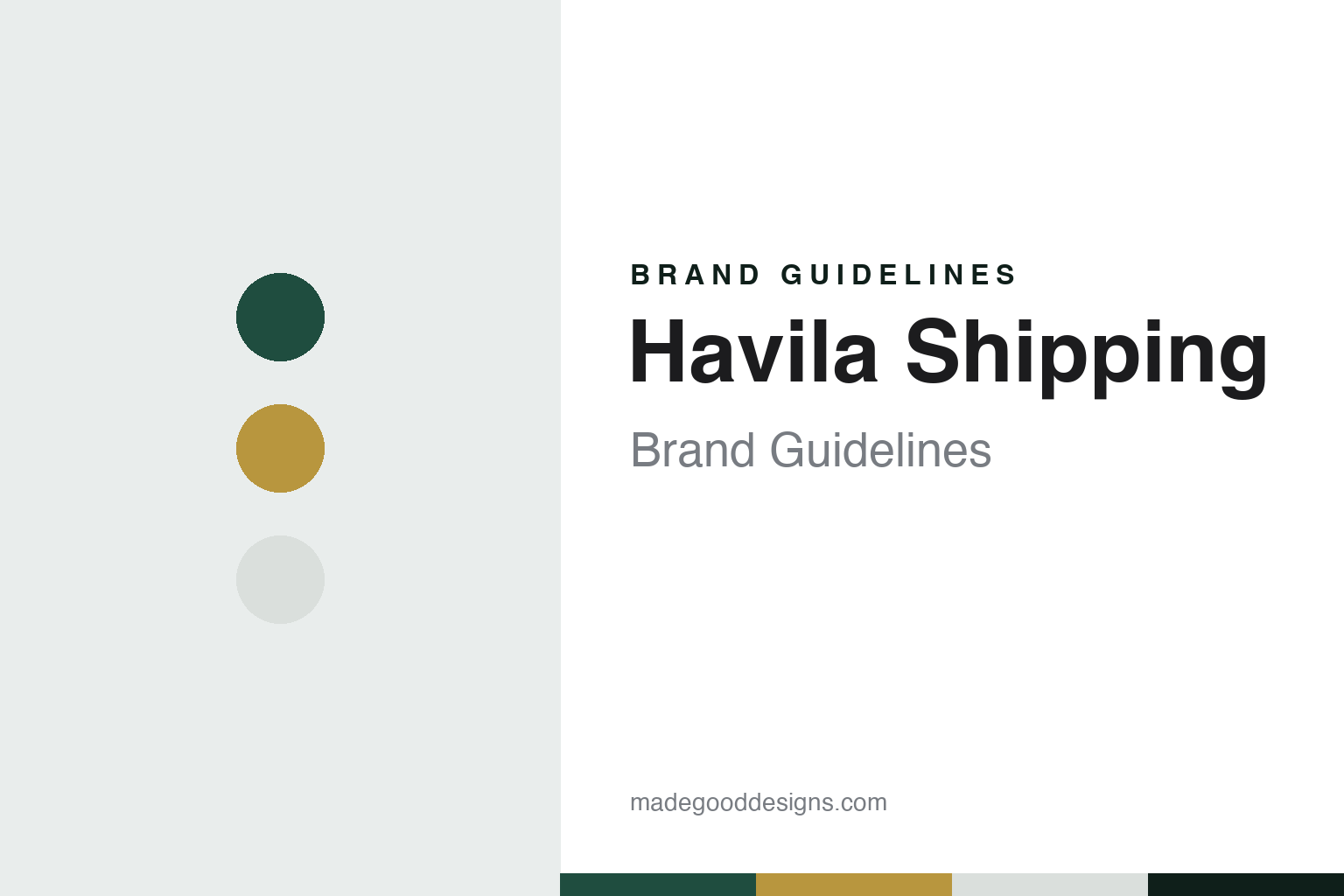
Havila Shipping Brand Guidelines
The Fosnavåg shipowner named after a land of good gold.
Aa
Two constants: a sea green, gold and fog grey palette and a maritime sans register. Abstract homage — not a Havila vessel or mark; no logo, bollard or livery is reproduced.
Sævik Supply
From herring boats to offshore supply.
Havila Shipping is a Norwegian offshore shipowner based in Fosnavåg, in Herøy on the Sunnmøre coast. The company in its present form was registered on 31 July 2003, according to English Wikipedia and to Havila Holding, the family investment company behind it, and it was listed on the Oslo Stock Exchange in 2005, Norwegian Wikipedia says, citing Euronext.
Its roots are older. Havila Holding says the family’s fishing, and the rich herring fishery of the 1950s, gave it the capital to build a shipping business, and that in 1981 the founder, Per Sævik, moved into the oil industry with Sævik Supply. Both companies say Sævik Supply grew into Norway’s second-largest offshore shipowner before the American company Trico Marine bought it in 1997. That year a new company, Havila Supply, was started, and Havila Holding was founded; from the turn of 1997–98 the Sævik name disappeared from the group’s companies. Havila Supply was bought in turn by France’s Groupe Bourbon in May 2003, and Havila Shipping was registered about two months later to build a new fleet.
The name comes from the Book of Genesis, which mentions a land called Havila near the Garden of Eden, the land “where the gold is good,” the company says. Havila Holding says the name stands for an aim to create good gold, and that the group’s logo is a mooring bollard with gold at its centre, a sign of being anchored and also of casting off. Since 2008, Havila Holding says, the Havila companies have worked from the Havila building in Fosnavåg, a glass building that reflects the sea and the boats passing by, with corners that lean out like a bow.
Colour
Newbuilds, a downturn and a smaller fleet.
After its listing, the company says, Havila Shipping took delivery of 17 newbuilds over five years, and by 2013 it had 27 vessels and 840 employees, with branches in Aberdeen, Brazil, Singapore and Malaysia as well as its head office in Fosnavåg. Norwegian Wikipedia says the company has slowly repositioned itself since its start, away from rescue vessels and toward platform supply and anchor-handling work and, more recently, the subsea market.
The fall in oil prices from 2014 changed course. The company says it sold ships, restructured and reached agreements with its creditors, and in 2017 it entered Volstad Maritime to keep working with offshore vessels; Havila Holding says it took over all the shares in Volstad Maritime in 2024. Havila Shipping says that in 2020 it became the first of the larger offshore companies to agree long-term refinancing deals.
At the end of 2024 Havila Shipping owned or operated 14 ships, Norwegian Wikipedia says, citing the annual report. Its website sorts the current fleet into four groups: an offshore patrol vessel; platform supply vessels such as Havila Charisma and Havila Foresight; subsea vessels such as Havila Harmony; and the rescue and recovery vessel Havila Troll. It also manages six ships for others, the company says. Beyond oil and gas, it says it has worked for the renewable energy industry with walk-to-work services, trenching and ploughing, and that it uses battery packs on board and shore power in port.
The website’s own wording is plain. It uses the line “Service at Sea,” says the company is “committed to what we do, which is run ships,” and lists the fleet under four short headings, OPV, PSV, Subsea and RRV, with each vessel named with the Havila prefix.
Typography
Design and documentation.
Offshore support vessel operators present themselves first through their ships. A fleet is usually painted in one house scheme, with a strong hull colour such as red, blue or orange, a mark on the funnel and a shared naming prefix, so that a client, a port or another crew can tell whose vessel is working a field. In Norway the prefix habit is easy to see: DOF’s ships sail as Skandi vessels and Solstad’s as Normand vessels.
On the web, the core of most operator sites is the fleet list. Vessels are sorted by type — platform supply vessels that carry cargo, fuel and water out to installations, anchor handling tug supply vessels that tow rigs and set moorings, and construction support vessels with cranes, large decks and remotely operated vehicles — and each ship usually has its own specification sheet listing deck area, crane capacity, berths and equipment, often as a downloadable file.
Beside the fleet sit pages on services. Many operators now describe work for offshore wind as well as for oil and gas, and many offer subsea services such as inspection, repair and maintenance, survey and ROV work, sometimes through a sister company or a subsidiary with its own name. Contract announcements, usually naming the vessel, the client region and the length of the charter, keep those pages moving.
Because many of these companies are listed, the annual report and the quarterly results presentation are part of the identity too, and in a sector shaped by mergers, restructurings and fleet sales, the company story page often carries the history. For a designer, the useful material is consistent: hull colours, funnel marks, vessel names, clear fleet tables and sober corporate typography.
Aa
A maritime sans for fleet lists and vessel names. (Specimen set in Barlow, a sans STAND-IN; NOT the Havila logo.)
Havila Shipping
One prefix and a family group.
The fleet is listed by type on the company’s website. In November 2026 it named an offshore patrol vessel, Polarsyssel; platform supply vessels including Havila Clipper, Havila Charisma, Havila Borg, Havila Fanø, Havila Foresight and Havila Herøy; the subsea vessels Havila Harmony, Havila Subsea and Havila Phoenix; and a rescue and recovery vessel, Havila Troll. The shared prefix does the branding work on every hull.
Havila Shipping is one company in a wider family group, and the names are easy to mix up. Havila Holding, founded in 1997, is the Sævik family’s investment company, and Norwegian Wikipedia names Havila AS, part-owned by the Sævik family, as Havila Shipping’s largest shareholder. Havila Kystruten, which sails the coastal route between Bergen and Kirkenes under a contract Havila Holding won from Norway’s transport ministry in 2018, is a separate business in the group, as are its hotels. Havila Shipping’s chief executive is Njål Sævik, the founder’s son.
The design notes come from the group as much as from the shipowner. Havila Holding says Morse code, with its dots and dashes, is used in graphic elements for companies in the Havila group, and Havila Shipping says its vessels “will justify the colour green.” For a design guide, Havila Shipping shows how a family shipowner can carry one name, a bollard mark and a story of fishing roots across several companies. Compare Bourbon, which bought Havila Supply in 2003, and Solstad, another Norwegian offshore shipowner. For this guide we use a deep sea green, a muted gold and a fog grey with a sans, an unofficial interpretation; no product or logo is reproduced.
Explore & save
Keep Havila Shipping’s identity on hand — save it to a board in the Made Good inspiration library.
Havila Shipping identity set
Pin the Havila Shipping sea green, gold and fog grey palette and the maritime sans register to your own board.