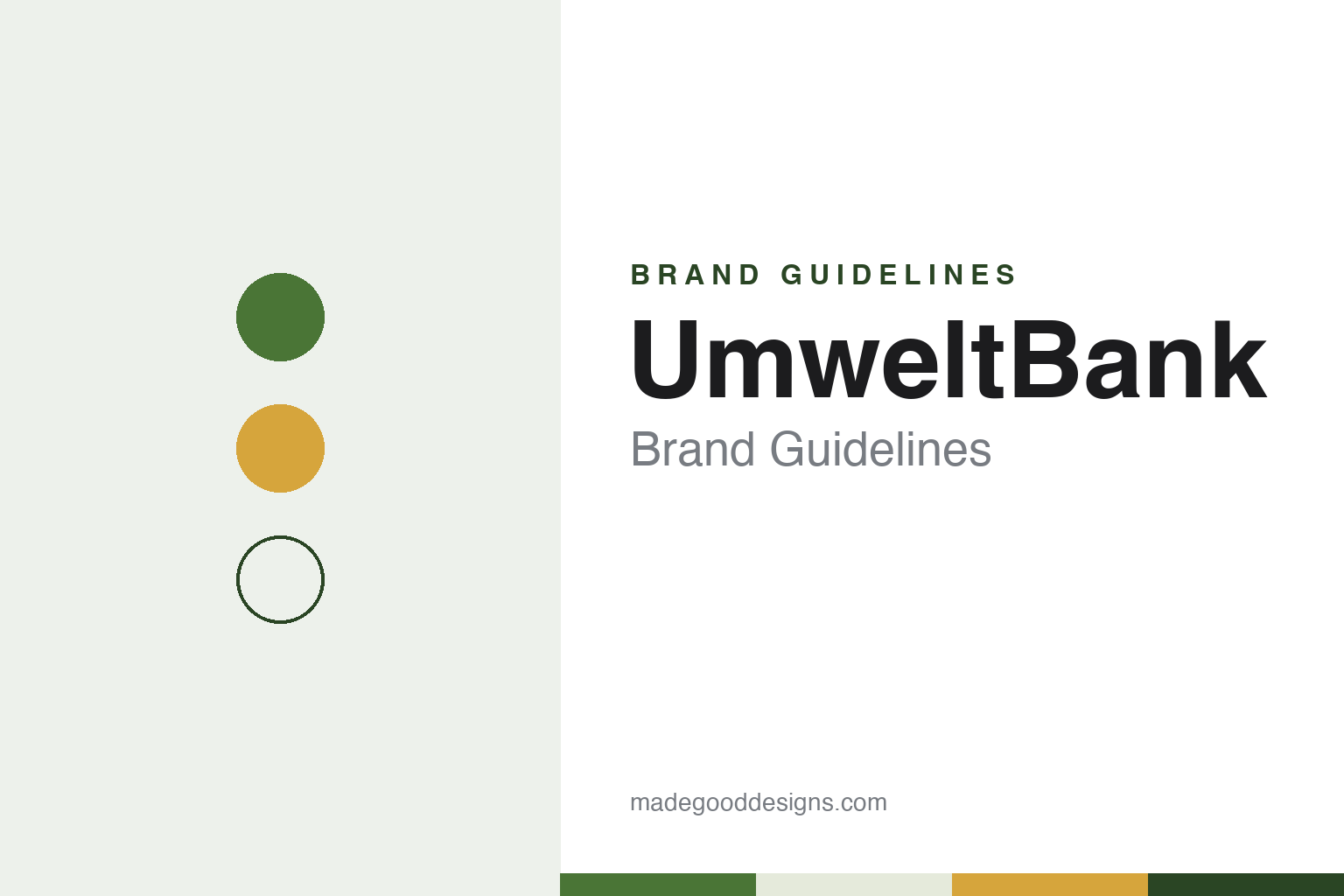
UmweltBank Brand Guidelines
The Nuremberg direct bank that says it lends its customers’ deposits only to environmental projects.
Aa
Two constants: a meadow green, forest and sunflower palette and an open sans-serif register. Abstract homage — not an UmweltBank asset or mark; no logo, card or app screen is reproduced.
The environment bank
A Nuremberg bank with one rule for its deposits.
UmweltBank, whose name means “environment bank,” is a German direct bank based in Nuremberg. German Wikipedia says it was founded in 1994 by Horst P. Popp and began business at the start of 1997, when its full banking licence was entered in the commercial register. The bank itself dates its founding to 1997 in its press releases and says it has financed projects under strict selection criteria for 29 years. Its shares went to market in mid-2001, German Wikipedia says, and the founder left the management board in April 2015.
German Wikipedia says the bank uses its customer deposits only for ecological lending projects and that the aim of helping the environment through all of its business is written into its articles of association. Its lending, the same source says, has covered solar power, ecological and social housing, wind and hydro schemes, biomass and organic farming; in 2020 solar energy and housing were the two largest parts of the loan book. The bank publishes this breakdown each year as its credit portfolio, so that customers can see what kinds of projects their money has gone into. Its press releases now describe the focus as renewable energy and sustainable real estate, including social and ecological housing.
Since the bank began, it says, an expert body called the Umweltrat (environmental council) has sat beside the supervisory board that German law requires. German Wikipedia describes the council as the bank’s ecological control body, checking that lending meets its environmental criteria. The bank describes its members as advisers on how its lending and the investments it issues meet its sustainability requirements, and says the council’s yearly report forms part of its company report.
Colour
No branches, a long list of exclusions and a listed share.
The bank works without branches. Its website explains that, as a direct bank, it serves customers across Germany by phone and online and offers no local service; its English page adds that only adults living in Germany can open an account. For most of its history customers came for savings: instant-access and fixed-term deposit accounts, securities and the bank’s own funds. In July 2025 it added a current account, the UmweltGiro. mobiFlip reported on 7 July 2025 that it had launched as announced in January, run through the UmweltBanking app, with cards offered in recycled plastic or in a wooden version. In its third-quarter release of October 2026 the bank said current accounts had passed 10,000 and that it had about 194,000 customers; the same release said three Europe ETFs had been listed at the end of July 2026, with a pension depot planned from January 2027 and asset management from spring 2027.
Its lending rules are written as lists. The bank says it does not finance nuclear energy, fossil fuels, military goods or animal testing, among other exclusions, and that it does finance solar systems, community wind farms, affordable housing and kindergartens. It says it uses the United Nations Sustainable Development Goals as a guide when refining these criteria, and that its climate targets were validated by the Science Based Targets initiative in March 2026. German Wikipedia adds that it introduced an environmental management system validated under EMAS in 2017 and reports to the Global Reporting Initiative standard, and quotes the German Sustainable Building Council (DGNB) as saying UmweltBank was the first bank to complete its recognition process, with the UmweltRating system for building loans that the bank introduced in early 2019.
UmweltBank is a public company, not a cooperative. German Wikipedia says most of its shares are in free float, held mainly by customers and staff, and that GLS Bank held just under 17 per cent at the end of 2025. Its investor-relations page lists the shares in the m:access segment of the Munich stock exchange and in Scale, the Deutsche Börse segment for small and mid-sized companies; on 20 August 2025 the bank announced that it had applied to join Scale, aiming for a listing that month.
Typography
Cooperative and ethical banking.
Cooperative and ethical banks sit in a corner of finance where the ownership model is part of the message. A cooperative bank is owned by its members, who usually buy shares and vote at a general meeting; an ethical bank sets out which sectors it will and will not lend to. Many institutions do both, and their identities tend to say so plainly, with wordmarks in strong single colours — orange, green and red among them — and names that point to a place, a farming root or a founding idea.
Their websites follow a recognisable pattern. Beside pages on current accounts, savings, mortgages and business lending, they usually carry a section on membership: how to join, how many shares a member needs, and how voting works. GLS Bank in Bochum, for example, gives each member one vote at its annual general assembly regardless of how many shares they hold, according to German Wikipedia.
Imagery tends towards the local and the collective: branch fronts, regional offices, member meetings and the projects a bank has financed, from housing to renewable energy and schools. Statements of values and sustainability policies are given prominent space, and they are presented as the bank’s own commitments rather than as independent findings. GLS Bank goes further than most by publishing its business loans in its customer magazine, Der Bankspiegel, German Wikipedia says.
The paper trail matters as much as the logo. These banks publish annual reports, and many add impact or sustainability reports that set out where deposits went. This guide uses those documents, encyclopaedias and dated press reports to record when each bank was founded, how its local banks and central institutions merged, and how it describes its own structure, keeping the bank’s claims attributed to the bank.
Aa
An open sans-serif for a green direct bank. (Specimen set in Work Sans, a sans STAND-IN; NOT the UmweltBank logo.)
Supervision and a reset
A regulator’s monitor, then a new current account.
The bank’s recent history includes a period under close supervision. In March 2024 the dpa news agency, in a report carried by the Süddeutsche Zeitung, said BaFin, Germany’s financial regulator, had appointed a special representative to monitor the bank’s business organisation, after a 2022 special audit had found that it was not in order in all the areas examined, mainly lending processes and internal audit; the bank named the audit firm PwC as the appointee. In July 2025 the bank announced that the special representative’s work was ending because of the progress it had made, while BaFin’s capital requirements for the bank stayed in place. A new chief executive had taken over at the turn of 2024, dpa reported.
The public identity rests on the name and on what the money does. The about page opens with the line that impact and profitability belong together and shows projects from a timber house to a solar park, and the English page features a community wind farm in Fuchstal, Bavaria, financed with citizen participation. German Wikipedia lists awards including the Goldener Bulle for sustainability in 2009, the B.A.U.M. environmental prize in 2010, the German CSR Prize in 2013 and the environmental prize of the Bavarian Landesstiftung in 2019.
For a design guide, UmweltBank shows how a bank can make what it will and will not finance the centre of its message. Compare Triodos Bank and Banca Etica, two other banks in this series of guides to ethical banking. For this guide we use a meadow green, a deep forest green and a sunflower yellow with a sans, an unofficial interpretation; no product or logo is reproduced.
Explore & save
Keep UmweltBank’s identity on hand — save it to a board in the Made Good inspiration library.
UmweltBank identity set
Pin the UmweltBank meadow green, forest and sunflower palette and the open sans-serif register to your own board.