Zip Brand Guidelines
The Australian payments company that fought to keep its name.
Aa
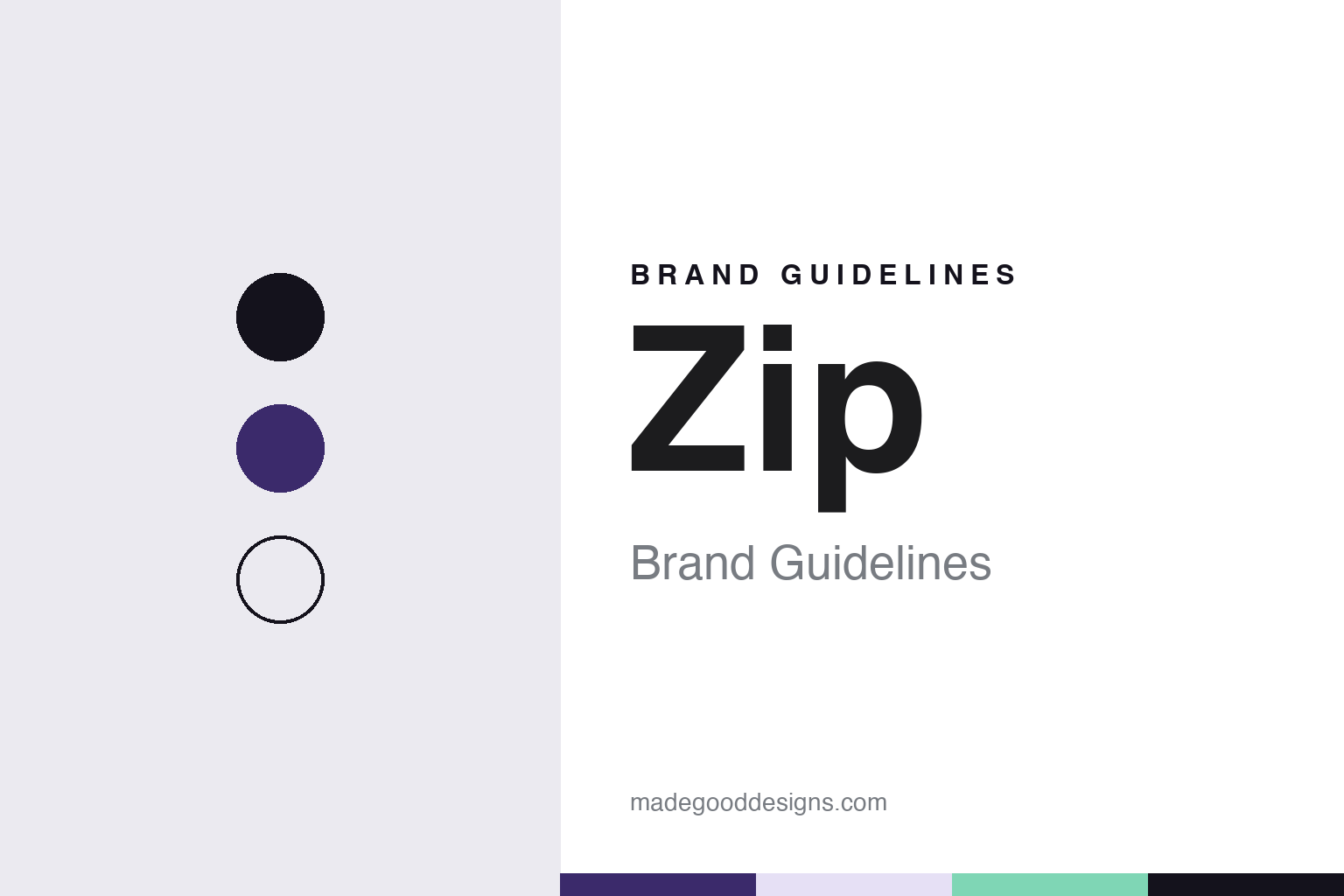
Two constants: a Zip violet, lavender and mint palette and a Friendly sans register. Abstract homage — not a Zip product or mark; no card, app screen or logo is reproduced.
Zip Money
An Australian credit account from 2013.
Zip began in Australia in 2013. English Wikipedia names its founders as Larry Diamond and Peter Gray and gives its first name as Zip Money, a digital credit account; a second product, Zip Pay, followed for everyday purchases. The company’s own about page says simply that Zip was “founded in Australia in 2013,” and English Wikipedia gives its headquarters as Sydney and New York.
The business went public early. It listed on the Australian Securities Exchange in 2015 as zipMoney Limited, and in December 2017 it changed its name to Zip Co Limited, English Wikipedia records; since then it has called itself simply Zip. In 2016 it bought Pocketbook, a budgeting app launched in 2012, which it closed in 2022. The Zip app reached the Google Play Store in August 2018 and Apple’s App Store later that year.
Expansion came largely by acquisition. In August 2019 Zip bought PartPay, a New Zealand buy now, pay later company with early operations in the UK, and in September 2019 SpotCap ANZ, a business lender. In June 2020 it bought the remaining shares in Quadpay, a New York buy now, pay later company in which it already held a stake through the PartPay deal, English Wikipedia says. In late 2021 it added Spotii, in the Middle East, and Twisto, in Europe. According to the company’s FY24 results, as cited by English Wikipedia, the group had 6.0 million active customers.
Colour
Two core markets.
Several of those markets did not last. Zip ceased operations in Singapore in July 2022 and began winding down its UK business in October 2022, English Wikipedia records. Its small-business lending went too: Zip Business Trade accounts stopped working for transactions at the end of August 2022, Zip Business Capital closed to new customers in May 2023, and in January 2024 the lender Prospa acquired that loan book. A larger plan also fell away: in February 2022 Zip agreed to buy the Minneapolis provider Sezzle, and in July 2022 the two companies ended the agreement by mutual consent, English Wikipedia’s article on Sezzle records.
New Zealand followed in 2026. In July 2026 Zip told the ASX that, after a strategic review of its business portfolio, it would stop its Zip Pay in 4 product there; from mid-August customers’ account limits would drop to zero, while amounts already being repaid were unaffected, RNZ reported on 17 July 2026. The company said the decision reflected its focus on its Australian and US businesses; English Wikipedia gives the effective date as 16 August 2026.
Those are the two markets Zip now names. Its about page, read in November 2026, describes two core markets, “Australia and New Zealand (ANZ) and the US (previously Quadpay),” and describes Zip as a digital financial services company offering “point-of-sale credit and digital payment services.” The US business, in other words, now trades under the Zip name rather than as Quadpay.
In Australia the range is a set of named accounts. Its website lists Zip Pay, described as a starter account; Zip Plus, an everyday account; and Zip Money, for bigger purchases. Alongside them sit a Zip Personal Loan, a Zip Visa Card and ZMobile prepaid eSIM plans. Each product page sets out its own fees, limits and credit terms, and the site footer names the Zip company that provides the credit, gives its Australian Credit Licence and links to the industry’s BNPL Code of Practice and to pages on financial hardship.
Typography
How buy now, pay later brands present themselves.
Buy now, pay later providers sell a way of paying rather than a product, so most of their design work happens on other companies’ pages. A shopper meets the brand as a small wordmark beside a price, a badge in a row of card logos, or a button at the end of a checkout. Many of these marks are short, rounded names set in bright mint, pink, purple or plain black, and several providers publish kits for merchants with approved logos, lockups and banners in light and dark versions.
The second surface is the app. Providers show purchases as instalment schedules: a row of dates and amounts, a progress marker for payments made, and reminders of what is due next. Many also run shopping directories of participating merchants, with categories, deals and store pages, which turn the payment brand into a place to browse.
The third surface is explanation. Providers typically keep a page on how payments work, usually a sequence of three or four steps, and most carry dense small print: who the lender is, which licences apply, what fees and rates can be charged and where to go for help with hardship. In several markets these disclosures are set by regulators, and merchant kits often spell out which phrases need a full disclaimer and which claims may not be made at all.
The last surface is the investor page. Several providers are listed companies, in Sydney, New York or both, and publish results, presentations and announcements alongside their consumer sites. This guide sets out what can be checked about each provider — who founded it, who owns it, where it operates and how regulators have treated it — and gives company statements as the company’s own.
Aa
A friendly sans — a three-letter name. (Specimen set in Manrope, a sans STAND-IN; NOT the Zip logo.)
Zip
A name it went to court over.
The name itself went to court. Firstmac, a privately owned Australian non-bank lender, had registered “Zip” as a trademark for a loan product in 2004 and brought proceedings against Zip Co. In May 2026 the High Court of Australia upheld a Federal Court finding that Zip had infringed that mark, rejecting its defence of honest concurrent use, English Wikipedia records; the ruling meant Zip would have to stop calling itself Zip in Australia, The Motley Fool Australia reported.
Days later the company settled. On 21 May 2026 Zip announced a settlement with Firstmac under which, it said, it will acquire the registered ZIP trademark and keep using the Zip name for its Australian products and services; its branding in the US and New Zealand was unaffected, and the terms were confidential, according to the company update reported by TipRanks and The Motley Fool Australia.
The rest of the identity is set out in plain words on its about page. Its values are Customer First, Own It, Stronger Together and Change the Game; its stated purpose is “unlocking financial potential, together”; and it calls its staff “Zipsters.”
For a design guide, Zip shows how much a short, generic name can carry — and how much can rest on owning it. Compare Sezzle, the US provider Zip agreed to buy in 2022 before the two companies ended the deal, and Afterpay, another buy now, pay later brand with Australian roots. For this guide we use a deep violet, lavender and a soft mint with a sans, an unofficial interpretation; no product or logo is reproduced.
Explore & save
Keep Zip’s identity on hand — save it to a board in the Made Good inspiration library.
Zip identity set
Pin the Zip violet, lavender and mint palette and the Friendly sans register to your own board.