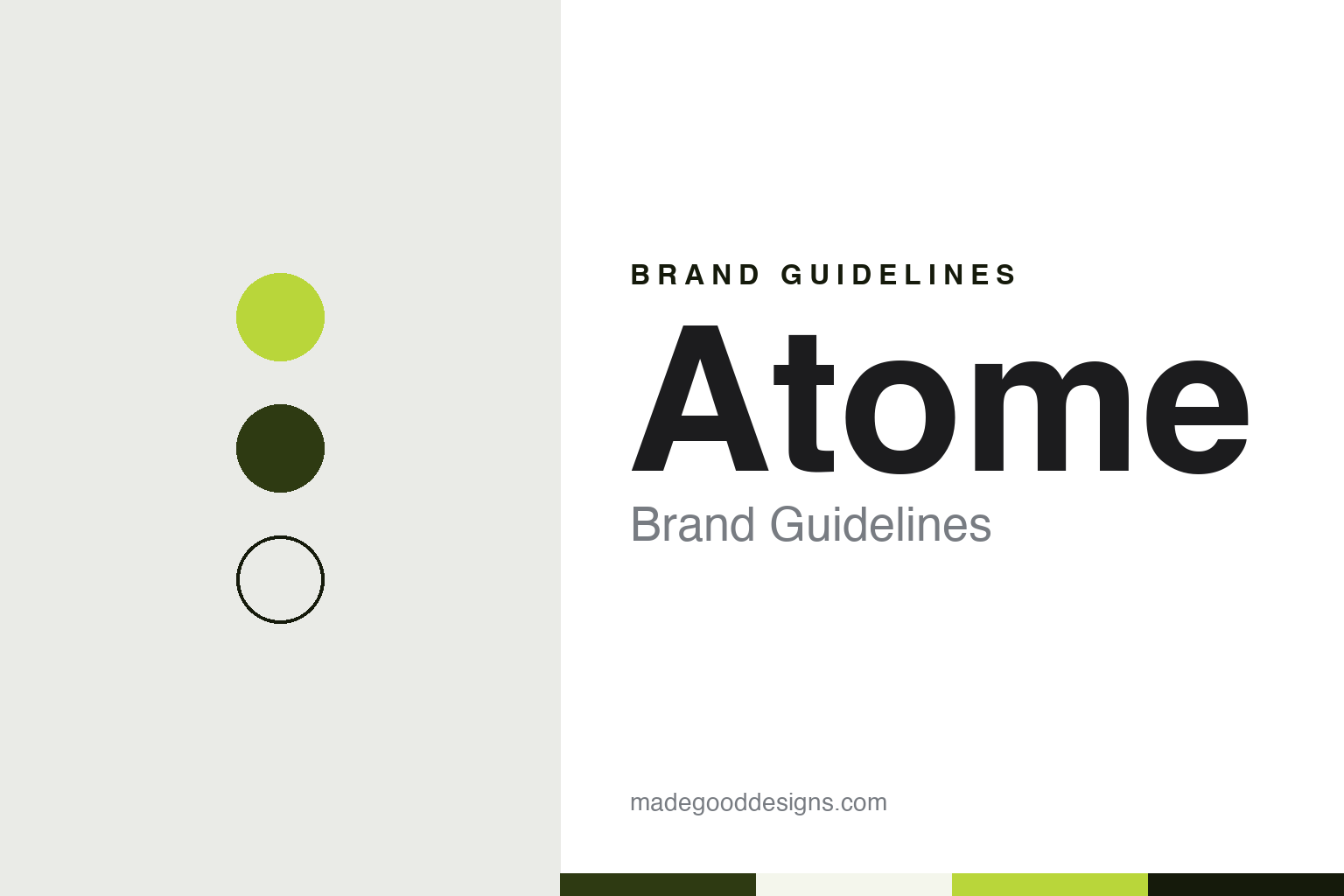
Atome Brand Guidelines
The Singapore pay-later app with a colour called Spriteburst.
Aa
Two constants: a yellow-green and olive palette and a geometric sans register. Abstract homage — not an Atome product or mark; no app screen, card or logo is reproduced.
Available to Me
A Singapore app inside a larger technology group.
Atome is a buy now, pay later service based in Singapore. It launched in 2019, The Straits Times reported in September 2026, and it now operates in five markets: Singapore, Malaysia, the Philippines, Indonesia and Thailand. The name is short for “Available to Me”, according to the company’s “Our Story” page, which describes Atome as a service for “a new generation of digital-savvy, mobile-first consumers.”
The service sits inside a larger structure. Atome is part of Atome Financial, the consumer-finance business, and Atome Financial is part of Advance Intelligence Group, a Singapore technology group that says it was founded in 2016 and has a presence across South and Southeast Asia and Greater China. The group’s other units include ADVANCE.AI, according to its own website. In Singapore, the Atome site names its operating company as Apaylater Financials Pte. Ltd. and says the service is compliant with the industry’s buy now, pay later standards.
Its scale is set out in figures attached to the 2026 Grab announcement. Atome Financial has a network of more than 30,000 brands and 25 million cumulative transacting users across its five markets, The Business Times reported on 15 September 2026. Its products, as listed in that coverage and in CNA’s report of the same day, are buy now, pay later loans, consumer cash loans, buy now, pay later cards and digital lending.
Colour
Spriteburst, three pillars and “Time to Own It”.
Atome names its brand colour in public. The “Our Story” page calls it Spriteburst, “a yellow-green tennis ball hue,” and says it stands for energy, progress, positivity and brilliance. No colour code is given there, and the tones used in this guide are chosen independently rather than taken from the company.
The same page sets out the tagline “Time to Own It”, also used as the hashtag #TimeToOwnIt. The company says the line plays on the idea of time: shoppers paying for products and services over time, and, at a deeper level, a call to act now. It lists three brand pillars — Aspiration, Access and Advice — glossed as enabling “one’s deepest passions,” the affordability and availability of quality products and services, and customisable features for shopping.
The product is presented in plain steps. The Singapore homepage tells shoppers they can split a purchase into three or more payments at partner brands; the company describes three payments as carrying no interest and longer plans as carrying a small fee. Payments are tracked in the mobile app, which the site says works online and in shops. A loyalty layer, Atome+, offers points, cashback and in-app games, according to the same page.
The shop directory is organised by category, from fashion, beauty and lifestyle to travel, fitness and homeware, with headings for electronics, home and living and in-store partners. For retailers, the site has separate sections for businesses and developers under the heading “Sell with Atome.”
The written voice is short and direct: “Get it today,” “Some things in life shouldn’t have to wait,” and a promise that shoppers are “in control.”
Typography
Design and documentation.
Buy now, pay later providers sell a way of paying rather than a product, so most of their design work happens on other companies’ pages. A shopper meets the brand as a small wordmark beside a price, a badge in a row of card logos, or a button at the end of a checkout. Many of these marks are short, rounded names set in bright mint, pink, purple or plain black, and several providers publish kits for merchants with approved logos, lockups and banners in light and dark versions.
The second surface is the app. Providers show purchases as instalment schedules: a row of dates and amounts, a progress marker for payments made, and reminders of what is due next. Many also run shopping directories of participating merchants, with categories, deals and store pages, which turn the payment brand into a place to browse.
The third surface is explanation. Providers typically keep a page on how payments work, usually a sequence of three or four steps, and most carry dense small print: who the lender is, which licences apply, what fees and rates can be charged and where to go for help with hardship. In several markets these disclosures are set by regulators, and merchant kits often spell out which phrases need a full disclaimer and which claims may not be made at all.
The last surface is the investor page. Several providers are listed companies, in Sydney, New York or both, and publish results, presentations and announcements alongside their consumer sites. This guide sets out what can be checked about each provider — who founded it, who owns it, where it operates and how regulators have treated it — and gives company statements as the company’s own.
Aa
A geometric sans for a pay-later app. (Specimen set in Outfit, a sans STAND-IN; NOT the Atome logo.)
Atome and Grab
A majority sale, announced in 2026 and still pending.
On 15 September 2026 Grab, the Singapore ride-hailing, delivery and financial services company, announced that it would buy a 60 per cent stake in Atome Financial from Advance Intelligence Group, The Business Times and CNA reported. Grab also agreed to buy the remaining 40 per cent about two years after the first stage closes, under a performance-linked framework tied to Atome’s earnings and revenue, CNA reported. The first stage was expected to complete by the third quarter of 2027, subject to regulatory approvals: the deal was agreed in September 2026 and not completed at the time of writing.
Grab presented the purchase as a fast route into consumer lending. Its chief operating officer told The Business Times that it would let Grab “leapfrog the 10 years of learning across multiple products and markets” that Atome Financial had already been through. Grab’s own announcement described a proposed transaction covering five markets that would combine Atome Financial’s lending systems with Grab’s financial services. The Straits Times called it the latest step in turning Grab’s platform into a wider financial and lifestyle app for Southeast Asia, while reporting that some analysts questioned the premium.
The figures given for the deal show what each side was buying. Atome would gain access to some 54 million monthly transacting users on Grab, and Grab could offer its services to Atome Financial’s merchant network, The Business Times reported. Grab’s chief operating officer told the paper that only about 1 per cent of Grab’s 138 million annual transacting users had so far taken a loan from it. Grab also estimates that more than 70 per cent of adults in Southeast Asia are unbanked or underbanked, The Straits Times reported, and pitched the deal as a way to extend formal credit to people without conventional credit histories.
Atome works in a crowded regional field. A 2023 TechCrunch report on the Indonesian credit app Kredivo listed “Advance.ai’s Atome BNPL service” among Kredivo’s competitors, alongside Akulaku’s pay-later service.
For a design guide, Atome shows how a pay-later brand can build its identity around one named colour and a short tagline. Compare Grab, the company that agreed to buy a majority of Atome Financial, and Kredivo, another Southeast Asian credit app. For this guide we use a yellow-green, a deep olive and an off-white with a sans, an unofficial interpretation; no product or logo is reproduced.
Explore & save
Keep Atome’s identity on hand — save it to a board in the Made Good inspiration library.
Atome identity set
Pin the yellow-green and olive palette and the geometric sans register to your own board.