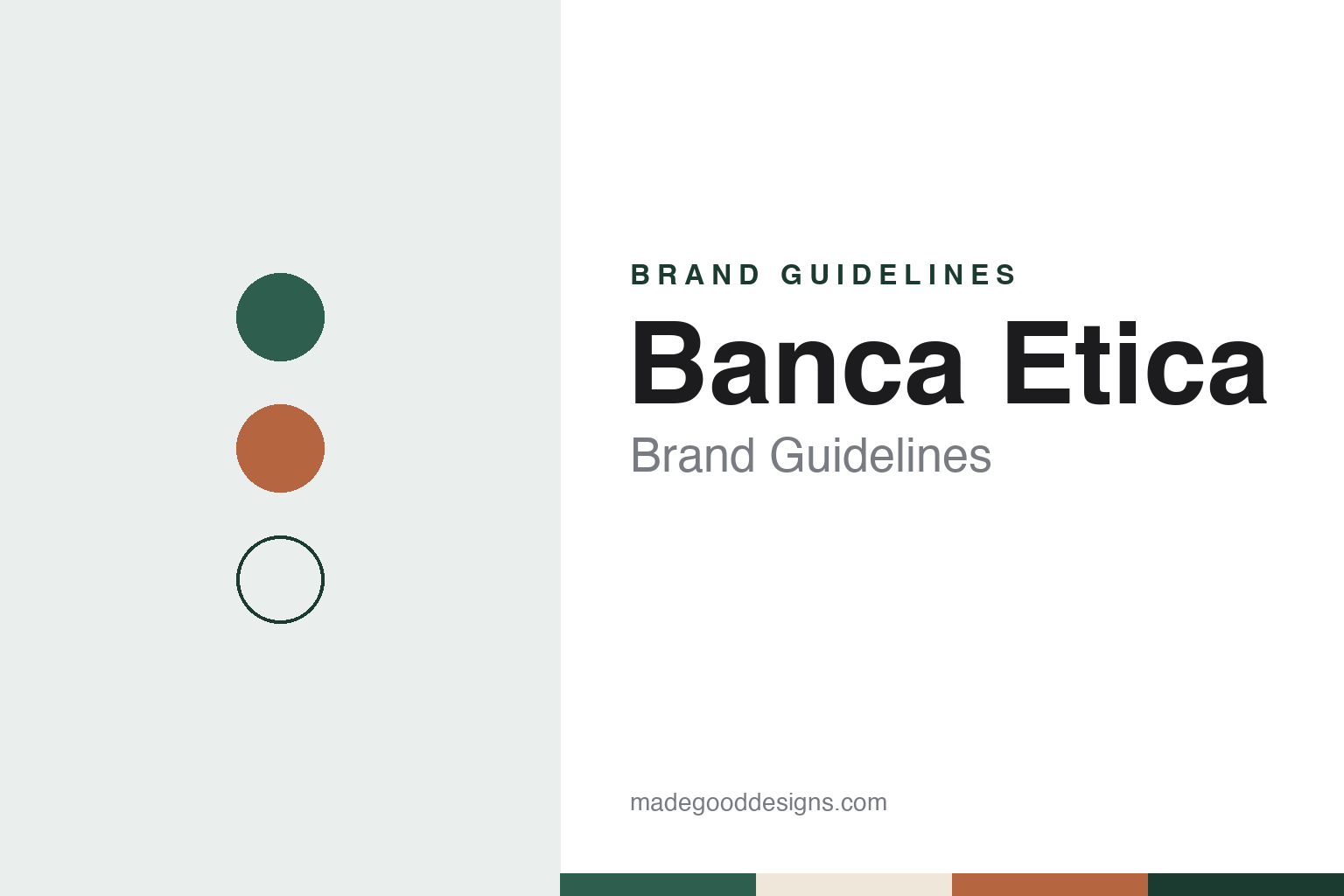
Banca Etica Brand Guidelines
The Padua cooperative bank built by its members around one rule: say what the money does.
Aa
Two constants: a green, terracotta and linen palette and a humanist sans register. Abstract homage — not a Banca Etica asset or mark; no logo, card or branch sign is reproduced.
Verso la Banca Etica
A savings drive that became a bank.
Banca Etica began as a savings drive rather than a bank. In December 1994 a group of organisations set up the Cooperativa Verso la Banca Etica (“towards the ethical bank”), whose task was to raise the minimum share capital that Italian law required for a banca popolare, a cooperative bank, according to the bank’s own history and its Spanish website. The bank says the project drew on volunteers, aid workers, pacifists and environmentalists from secular and religious groups, most of them in Italy’s third sector of non-profits and social cooperatives, and that thousands of people and 18 founding member organisations took part.
Italian Wikipedia, citing a 2010 book by Fabio Salviato, the bank’s first chairman, names ACLI, ARCI and AGESCI among the larger founding organisations. The bank traces the idea further back, to the MAG cooperatives (Mutue per l’Autogestione), small self-managed credit groups which, its Spanish site says, first found social enterprises that needed money and then found people willing to lend part of it. In the 1990s the MAGs approached the worlds of social cooperation, volunteering and associations to build a financial offer for those sectors.
The bank gives three founding dates. On 30 May 1998 the members’ meeting approved the change from cooperative to banca popolare, according to the bank and Italian Wikipedia. On 8 March 1999, after authorisation from the Bank of Italy, the first branch opened in Padua, which remains the head office. la Repubblica treated that date as the bank’s birthday in a March 2019 article on its first 20 years. The legal name is Banca Popolare Etica, a cooperative company limited by shares; it trades as Banca Etica, and it marked 25 years of operation in 2024.
Italian Wikipedia lists its presidents as Fabio Salviato from 1999 to 2010, Ugo Biggeri to 2019, Anna Fasano to 2025 and Aldo Soldi since 2025.
Colour
One head, one vote, and a public loan list.
Banca Etica describes itself as a cooperative bank run on the principle of “one head, one vote”: every member has the same vote at the general meeting, whatever the number of shares held. Its website gives 51,332 members in Italy and 4,105 in Spain, in figures dated 31 October 2026. In 2019 la Repubblica reported about 42,500 members, 83 per cent of them individuals and the rest organisations such as public bodies, parishes and cooperatives. The bank says about ninety local groups of volunteer members promote its work in their areas.
Its lending rules are its main statement of identity. The bank says its credit policy refuses to finance sectors it considers harmful to ecosystems and communities, naming weapons, fossil fuels and intensive farming, and that it lends to welfare and social enterprises, renewable energy and energy efficiency, organic farming, fair trade, international cooperation and microfinance, culture, and organisations that manage assets confiscated from the mafia. It says it publishes the list of its loans online and reports each year on the social and environmental impact of its lending, with guidance from an Ethics Committee. la Repubblica reported in 2019 that the bank caps its highest salary at six times the lowest and limits the terms of board members.
The products themselves are familiar ones: current accounts, cards, loans, savings, investment and pension products for households, businesses and non-profit organisations, sold through branches, financial advisers and online and mobile banking. In 2019 la Repubblica counted 17 branches in Italy, from Padua, Milan and Turin to Naples, Bari and Palermo, plus some 30 travelling advisers for areas without a branch.
The bank heads the Banca Etica Group. Etica Sgr, which manages ethical mutual funds, was formed in 2000 and began operating in 2003, Italian Wikipedia says. In January 2025 Il Giornale d’Italia reported that Banca Etica had completed the purchase of 70 per cent of IMPact SGR, an impact-investing fund manager, in order to bring the management of Etica Sgr’s funds inside the group after its mandate with Anima SGR ended. The bank names Cresud, which supports microfinance organisations, fair-trade producers and NGOs in Latin America, Africa and Asia, as the other group company, with Fondazione Finanza Etica and the Spanish Fundación Finanzas Éticas in its wider network.
Typography
Cooperative and ethical banking.
Cooperative and ethical banks sit in a corner of finance where the ownership model is part of the message. A cooperative bank is owned by its members, who usually buy shares and vote at a general meeting; an ethical bank sets out which sectors it will and will not lend to. Many institutions do both, and their identities tend to say so plainly, with wordmarks in strong single colours — orange, green and red among them — and names that point to a place, a farming root or a founding idea.
Their websites follow a recognisable pattern. Beside pages on current accounts, savings, mortgages and business lending, they usually carry a section on membership: how to join, how many shares a member needs, and how voting works. GLS Bank in Bochum, for example, gives each member one vote at its annual general assembly regardless of how many shares they hold, according to German Wikipedia.
Imagery tends towards the local and the collective: branch fronts, regional offices, member meetings and the projects a bank has financed, from housing to renewable energy and schools. Statements of values and sustainability policies are given prominent space, and they are presented as the bank’s own commitments rather than as independent findings. GLS Bank goes further than most by publishing its business loans in its customer magazine, Der Bankspiegel, German Wikipedia says.
The paper trail matters as much as the logo. These banks publish annual reports, and many add impact or sustainability reports that set out where deposits went. This guide uses those documents, encyclopaedias and dated press reports to record when each bank was founded, how its local banks and central institutions merged, and how it describes its own structure, keeping the bank’s claims attributed to the bank.
Aa
A humanist sans for a members’ bank. (Specimen set in Source Sans 3, a sans STAND-IN; NOT the Banca Etica logo.)
Fiare Banca Etica
A Basque foundation that became a Spanish branch.
Spain is the bank’s second country. According to Fiare’s own history, groups interested in ethical finance set up the Fundación Fiare in the Basque Country in 2003. In 2005 it signed an agreement with Banca Popolare Etica and began offering its services in Spain; in 2011 the two proposed to integrate, a step approved by members’ meetings in both countries, and in 2013 a Fiare area was created inside the Italian bank. In autumn 2014 the Spanish business started as Fiare Banca Etica, licensed by the Bank of Spain. Italian Wikipedia dates the first branch outside Italy, in Bilbao, to October 2014, followed by branches in Madrid and Barcelona; in 2019 la Repubblica described a branch in Bilbao and offices in Madrid and Barcelona. Fiare is a name used by the Italian cooperative rather than a separate bank: its Spanish site refers to the Spanish branch of Banca Popolare Etica.
Outside its two countries the bank works through networks. It was among the founders of FEBEA, the European Federation of Ethical and Alternative Banks, and in 2009 among the founders of the Global Alliance for Banking on Values, la Repubblica reported; Italian Wikipedia adds that in 2001 it helped found the European Microfinance Network with Crédit Coopératif and other lenders. la Repubblica also reported that at the end of 2016 Italy’s Parliament added a recognition of ethical finance to the country’s consolidated banking law.
Italian Wikipedia gives the bank’s slogan as “L’interesse più alto è quello di tutti,” roughly “the highest interest is everyone’s.” Its website gives as much room to members, local groups and the yearly members’ meeting as to accounts and loans, and it publishes annual reports and impact reports alongside its product pages.
For a design guide, Banca Etica shows how a cooperative bank can make its members and its lending rules the centre of its identity. Compare Triodos Bank, another bank that describes itself as ethical, and Iccrea, another Italian cooperative banking name. For this guide we use a deep green, a warm terracotta and linen with a sans, an unofficial interpretation; no product or logo is reproduced.
Explore & save
Keep Banca Etica’s identity on hand — save it to a board in the Made Good inspiration library.
Banca Etica identity set
Pin the Banca Etica green, terracotta and linen palette and the humanist sans register to your own board.