Amalgamated Bank Brand Guidelines
The New York bank a clothing workers’ union opened in 1923, now a listed public benefit company.
Aa
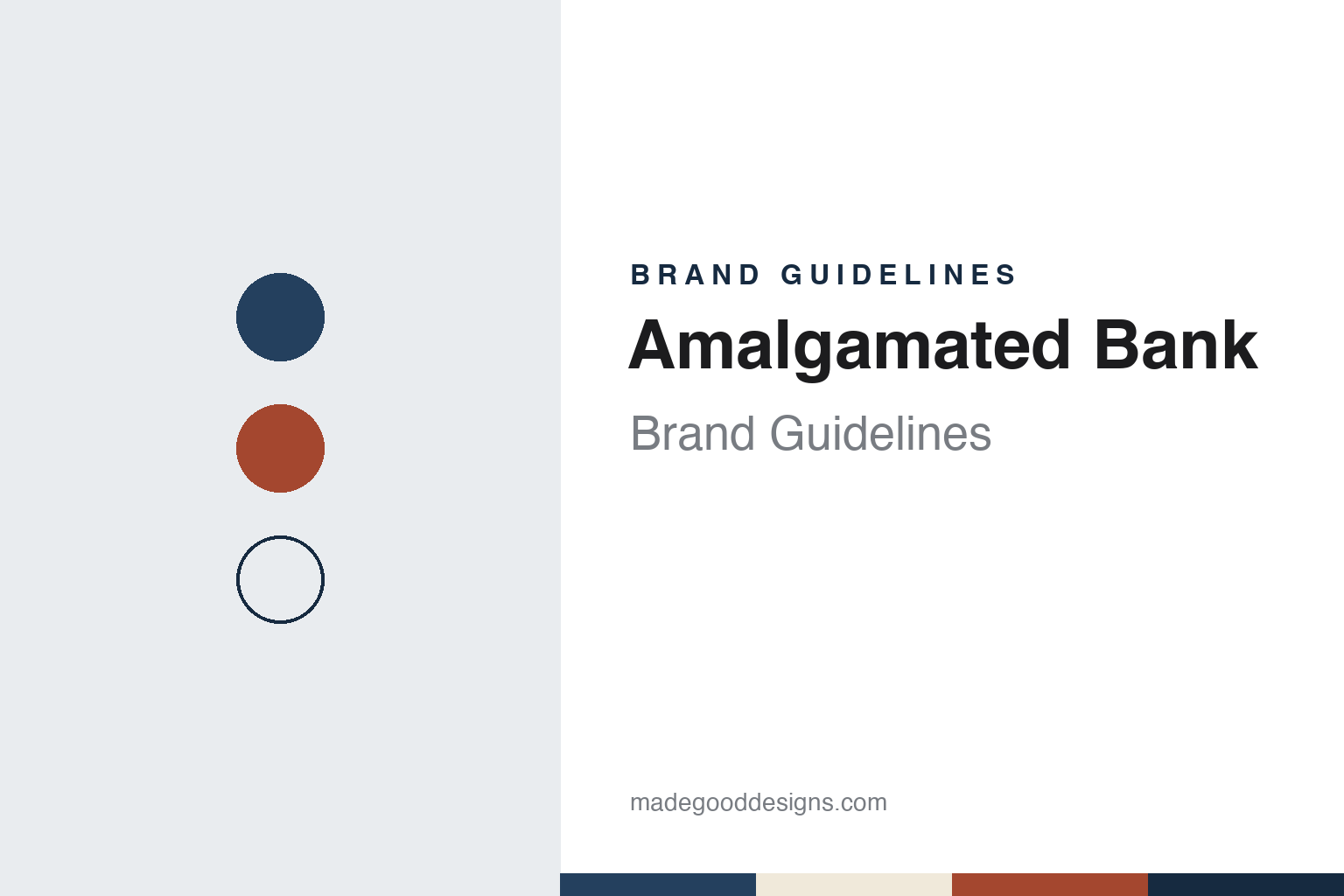
Two constants: a navy, brick red and cream palette and a plain sans register. Abstract homage — not an Amalgamated Bank asset or mark; no logo, card or branch sign is reproduced.
A union’s bank
Garment workers, East 14th Street and Union Square.
Amalgamated Bank was started by a trade union. In February 1923 the Jewish Telegraphic Agency reported that notice of intention to organise the Amalgamated Bank of New York had been filed with the New York State banking authorities, with its shares limited to members of the Amalgamated Clothing Workers of America, the clothing workers’ union; the incorporators included the union’s general president, Sidney Hillman. English Wikipedia says the union chartered the bank on 16 March 1923 and that it opened to the public on 14 April 1923 on East 14th Street in Manhattan. The International Directory of Company Histories (2004) calls it the first labour bank in New York, and notes that the union had already set up a separate sister bank in Chicago, the Amalgamated Trust and Savings Bank.
The bank says it opened to serve working-class immigrant women who had been rejected by established banks. The 2004 company history describes services shaped around the union’s members: low-interest loans to workers, a foreign-exchange transfer service for sending money to relatives in Europe, and a travel agency. In 1925 the bank took a lease on the former Tiffany Building beside Union Square, which remained its head office into the 2000s. In 1927, English Wikipedia says, it financed the Amalgamated Housing Cooperative in the Bronx, described there as the first union-supported housing development in the United States; in 1957 it financed the Park Reservoir Housing Cooperative under New York State’s Mitchell-Lama programme.
The same company history says the bank was among the first allowed to reopen after the national bank holiday of March 1933, and that by its 40th anniversary in 1963 it was one of only three fully union-owned banks from the 1920s still operating. In 1973 it began offering checking accounts and set up a trust and investment division for employee benefit plans, work it still does for union pension and welfare funds. Ownership followed the union through its mergers, which the directory traces from the clothing workers to the textile and clothing workers’ union and then to UNITE. The bank shortened its name from Amalgamated Bank of New York to Amalgamated Bank in 2000.
Colour
A merger, a listing and a benefit charter.
For most of the 20th century the bank had no outside shareholders. That changed in 2018. In May 2018 it completed a merger with New Resource Bank of San Francisco; the bank’s announcement of 21 May 2018 said the combination linked New York and Washington, D.C. to the San Francisco Bay Area and Boulder, Colorado. In August 2018, English Wikipedia says, it went public on the Nasdaq under the ticker AMAL. Its shares are now held through Amalgamated Financial Corp., which a company announcement of September 2024 describes as a Delaware public benefit corporation and a bank holding company, with Amalgamated Bank as its wholly owned subsidiary. English Wikipedia dates the move to public-benefit status to March 2021 and calls the bank the first publicly traded financial services company to take that form.
The same 2024 announcement describes Amalgamated Bank as a New York-based commercial bank and chartered trust company, with five branches across New York City, Washington, D.C. and San Francisco and a commercial office in Boston. It offers personal and small-business banking, commercial lending, and institutional investment, custody and trust services, and its website has separate pages for nonprofits, unions, philanthropic and sustainable organisations. The bank says it has been a certified B Corporation since 2017 and a member of the Global Alliance for Banking on Values since 2016; the 2024 announcement reported that it was recertified as a B Corp in 2023. On its own site it describes itself as the largest B Corp bank in the United States.
Its policies are a large part of how it presents itself. The bank says it committed in 2018 to align its business with the Paris climate agreement, that it formed a corporate social responsibility committee in October 2019, and that it publishes yearly CSR and climate impact reports and its B Corp score card. English Wikipedia describes a purchasing policy that favours goods made by union workers, union contractors for building work and outside printing that carries the union label. The 2004 company history records a long run of shareholder action on corporate governance, including a 2002 case in which, the directory says, Amalgamated was the first plaintiff to take legal action against Enron’s managers.
Typography
Cooperative and ethical banking.
Cooperative and ethical banks sit in a corner of finance where the ownership model is part of the message. A cooperative bank is owned by its members, who usually buy shares and vote at a general meeting; an ethical bank sets out which sectors it will and will not lend to. Many institutions do both, and their identities tend to say so plainly, with wordmarks in strong single colours — orange, green and red among them — and names that point to a place, a farming root or a founding idea.
Their websites follow a recognisable pattern. Beside pages on current accounts, savings, mortgages and business lending, they usually carry a section on membership: how to join, how many shares a member needs, and how voting works. GLS Bank in Bochum, for example, gives each member one vote at its annual general assembly regardless of how many shares they hold, according to German Wikipedia.
Imagery tends towards the local and the collective: branch fronts, regional offices, member meetings and the projects a bank has financed, from housing to renewable energy and schools. Statements of values and sustainability policies are given prominent space, and they are presented as the bank’s own commitments rather than as independent findings. GLS Bank goes further than most by publishing its business loans in its customer magazine, Der Bankspiegel, German Wikipedia says.
The paper trail matters as much as the logo. These banks publish annual reports, and many add impact or sustainability reports that set out where deposits went. This guide uses those documents, encyclopaedias and dated press reports to record when each bank was founded, how its local banks and central institutions merged, and how it describes its own structure, keeping the bank’s claims attributed to the bank.
Aa
A plain sans for a union-founded bank. (Specimen set in Libre Franklin, a sans STAND-IN; NOT the Amalgamated Bank logo.)
America’s socially responsible bank
A mission line, four values and a century.
The bank’s mission statement is “to be America’s socially responsible bank,” and its website lists four values that all begin with C: courage, conviction, consistency and collective action. The line “Helping those who do good, do better” heads its mission page, and its May 2018 merger announcement already called it “America’s socially responsible bank.” Its about page puts the story first, with the century-old bank set up for immigrant workers, then the B Corp certification, then a list of clients and partners among nonprofits, unions and social-impact enterprises.
In September 2024 a Forbes contributor’s piece on the bank entering its second century quoted its chief executive on a book about its first 100 years, prepared with a historian. Its product pages carry the same vocabulary, with impact checking accounts, social impact lending, a fossil-fuel-free portfolio and C-PACE lending for clean-energy building work.
For a design guide, Amalgamated Bank shows how a bank founded by a union can carry that origin into a mission line, a B Corp certification and a public benefit charter. Compare The Co-operative Bank, a British bank with a published ethical policy, and Triodos Bank in the Netherlands. For this guide we use a deep navy, a brick red and cream with a sans, an unofficial interpretation; no product or logo is reproduced.
Explore & save
Keep Amalgamated Bank’s identity on hand — save it to a board in the Made Good inspiration library.
Amalgamated Bank identity set
Pin the Amalgamated Bank navy, brick red and cream palette and the plain sans register to your own board.