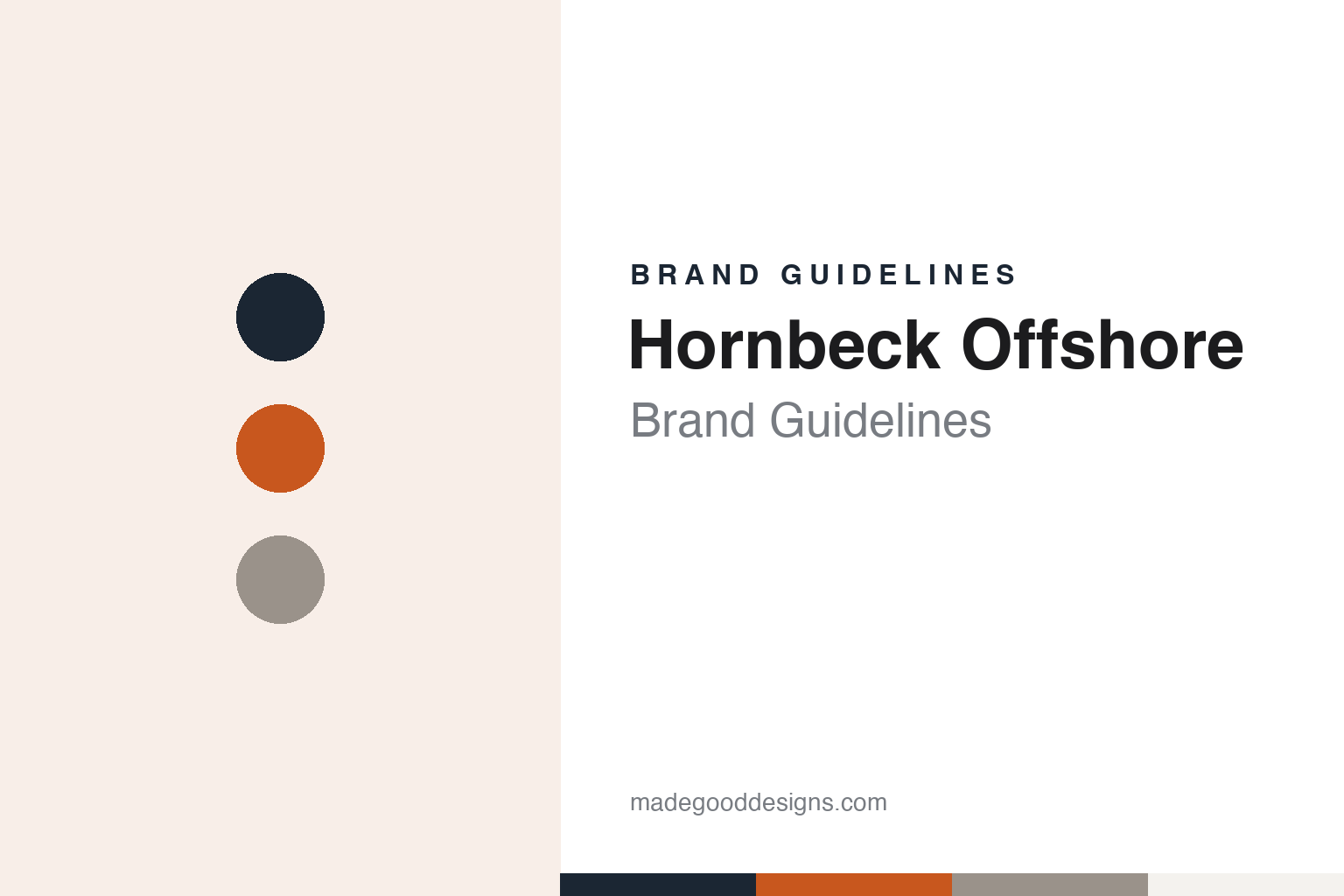
Hornbeck Offshore Brand Guidelines
The Louisiana fleet whose name survived a Chapter 11 case and a merger.
Aa
Two constants: a navy, burnt orange and warm grey palette and a sturdy grotesque register. Abstract homage — not a Hornbeck Offshore vessel or mark; no horse-head emblem, logo or hull livery is reproduced.
Covington
A Louisiana fleet built for deep water.
Hornbeck Offshore Services is based in Covington, Louisiana. English Wikipedia lists it among companies established in Louisiana in 1997 and describes a business that operates offshore supply vessels (OSVs), multi-purpose support vessels (MPSVs) and a shore-base facility, serving oil and gas exploration and production mainly in the US Gulf, along with oilfield service, offshore construction and military customers. Its fleets are US-flagged, Wikipedia says, and its MPSVs carry DP-2 and DP-3 dynamic positioning. The company’s long-time leader is Todd M. Hornbeck, named as chairman, president and chief executive by gCaptain in 2020.
Wikipedia also notes that Hornbeck sold its ocean-going tugs and product barges to Genesis Energy to concentrate on OSVs, and that it ordered further new-generation vessels from VT Halter Marine of Pascagoula, Mississippi, and Eastern Shipbuilding of Panama City, Florida.
For years the shares traded on the New York Stock Exchange under the ticker HOS. On 20 December 2019 the exchange delisted the stock because the company had not kept the minimum average market capitalisation the exchange requires, and trading moved to the OTC Pink marketplace on 23 December, MarineLink reported. In April 2020, as oil prices fell sharply, Hornbeck agreed a pre-packaged restructuring with most of its secured lenders and unsecured noteholders, to be carried out through a voluntary Chapter 11 case in the US Bankruptcy Court for the Southern District of Texas, gCaptain reported. It filed on 19 May 2020, according to Wikipedia, and emerged from Chapter 11 in September 2020, MarineLink reported in 2023.
Colour
An HOS prefix and a horse.
Hornbeck names its ships with an HOS prefix. English Wikipedia’s fleet list groups them by class, from 240 Class OSVs through the 280, 300, 310 and 320 Classes to the larger HOSFLEX 370 vessels HOS Centerline and HOS Strongline, alongside MPSVs such as HOS Achiever, HOS Warhorse and HOS Iron Horse. Horses recur in the names and in the mark: the icon on the company’s website shows a white horse’s head, drawn like a chess knight, above a base lettered HOS, on an orange ground.
The fleet has been adapted for new markets. In July 2023 Hornbeck said it had contracted Eastern Shipbuilding Group to convert one of its recently acquired 280-foot OSVs, built by Eastern in 2014, into a service operation vessel for US offshore wind and for accommodation work in oil and gas. The design, called the HOSSOV 300E, was drawn up with VARD, the vessel’s original designer, and the conversion was planned at Eastern’s Allanton yard in Panama City, MarineLink reported. Hornbeck said the vessel would house up to 90 or more people and carry a 30-metre motion-compensated gangway, a helideck and an enclosed warehouse. Wikipedia’s fleet list includes one 300E Class vessel, HOS Rocinante.
Government work is part of the mix. In July 2024 the US Navy’s Office of Small Business Programs approved a Mentor Protégé Agreement between Hornbeck and Next Generation Logistics, a New Orleans marine transportation firm, MarineLink reported, and the company’s website describes Jones Act-compliant vessels for submarine fleet logistics. In December 2023 Hornbeck made public its paperwork for a New York stock-market listing, again under HOS, MarineLink reported, citing Reuters.
Typography
Design and documentation.
Offshore support vessel operators present themselves first through their ships. A fleet is usually painted in one house scheme, with a strong hull colour such as red, blue or orange, a mark on the funnel and a shared naming prefix, so that a client, a port or another crew can tell whose vessel is working a field. In Norway the prefix habit is easy to see: DOF’s ships sail as Skandi vessels and Solstad’s as Normand vessels.
On the web, the core of most operator sites is the fleet list. Vessels are sorted by type — platform supply vessels that carry cargo, fuel and water out to installations, anchor handling tug supply vessels that tow rigs and set moorings, and construction support vessels with cranes, large decks and remotely operated vehicles — and each ship usually has its own specification sheet listing deck area, crane capacity, berths and equipment, often as a downloadable file.
Beside the fleet sit pages on services. Many operators now describe work for offshore wind as well as for oil and gas, and many offer subsea services such as inspection, repair and maintenance, survey and ROV work, sometimes through a sister company or a subsidiary with its own name. Contract announcements, usually naming the vessel, the client region and the length of the charter, keep those pages moving.
Because many of these companies are listed, the annual report and the quarterly results presentation are part of the identity too, and in a sector shaped by mergers, restructurings and fleet sales, the company story page often carries the history. For a designer, the useful material is consistent: hull colours, funnel marks, vessel names, clear fleet tables and sober corporate typography.
Aa
A sturdy grotesque for a working fleet. (Specimen set in Barlow, a sans STAND-IN; NOT the Hornbeck Offshore logo.)
Hornbeck and Helix
A merger that kept the Hornbeck name.
On 23 April 2026 Hornbeck and Helix Energy Solutions of Houston announced an all-stock combination, with Hornbeck shareholders to own about 55 percent of the merged company and Helix shareholders about 45 percent, according to their joint announcement. Helix would bring its well intervention vessels and subsea robotics, Hornbeck its specialty offshore support vessels. The deal was completed on 1 September 2026: the combined company took the Hornbeck Offshore Services name and began trading on the New York Stock Exchange under HOS on 2 September, with headquarters in Houston and Covington, the companies said, and Helix’s own shares stopped trading. The Maritime Executive placed the deal in a wider wave of consolidation among offshore vessel companies, noting Helix’s presence in West Africa, Asia Pacific and the North Sea and Hornbeck’s concentration in the Americas, including Brazil and Mexico. Funds managed by Ares Management, which held a large part of Hornbeck, gave written consent to the deal when it was announced.
Today the website describes three business segments — Marine Transportation, Subsea Services and Well Intervention — serving oilfield, defense, renewables and emerging-technology customers, and it writes the name in capitals, HORNBECK OFFSHORE, with a registered-trademark sign. In November 2026 the company signed agreements with Shell for riser-based and riserless well intervention and marine support in the deepwater US Gulf, with the main vessels contracted for five years from 2027, MarineLink reported. The plan pairs a riser-based well intervention vessel, fitted with an intervention riser system and ROVs, with a multi-purpose support vessel, backed by Jones Act-compliant supply vessels.
For a design guide, Hornbeck Offshore shows a fleet identity built on a three-letter prefix and a single animal emblem, carried through a delisting, a Chapter 11 case and a 2026 merger in which its name was the one that stayed. Compare Tidewater, another offshore vessel operator with Louisiana roots, and Helix, now part of the combined company. For this guide we use a deep navy, a burnt orange and a warm grey with a sans, an unofficial interpretation; no product or logo is reproduced.
Explore & save
Keep Hornbeck Offshore’s identity on hand — save it to a board in the Made Good inspiration library.
Hornbeck Offshore identity set
Pin the Hornbeck Offshore navy, burnt orange and warm grey palette and the sturdy grotesque register to your own board.