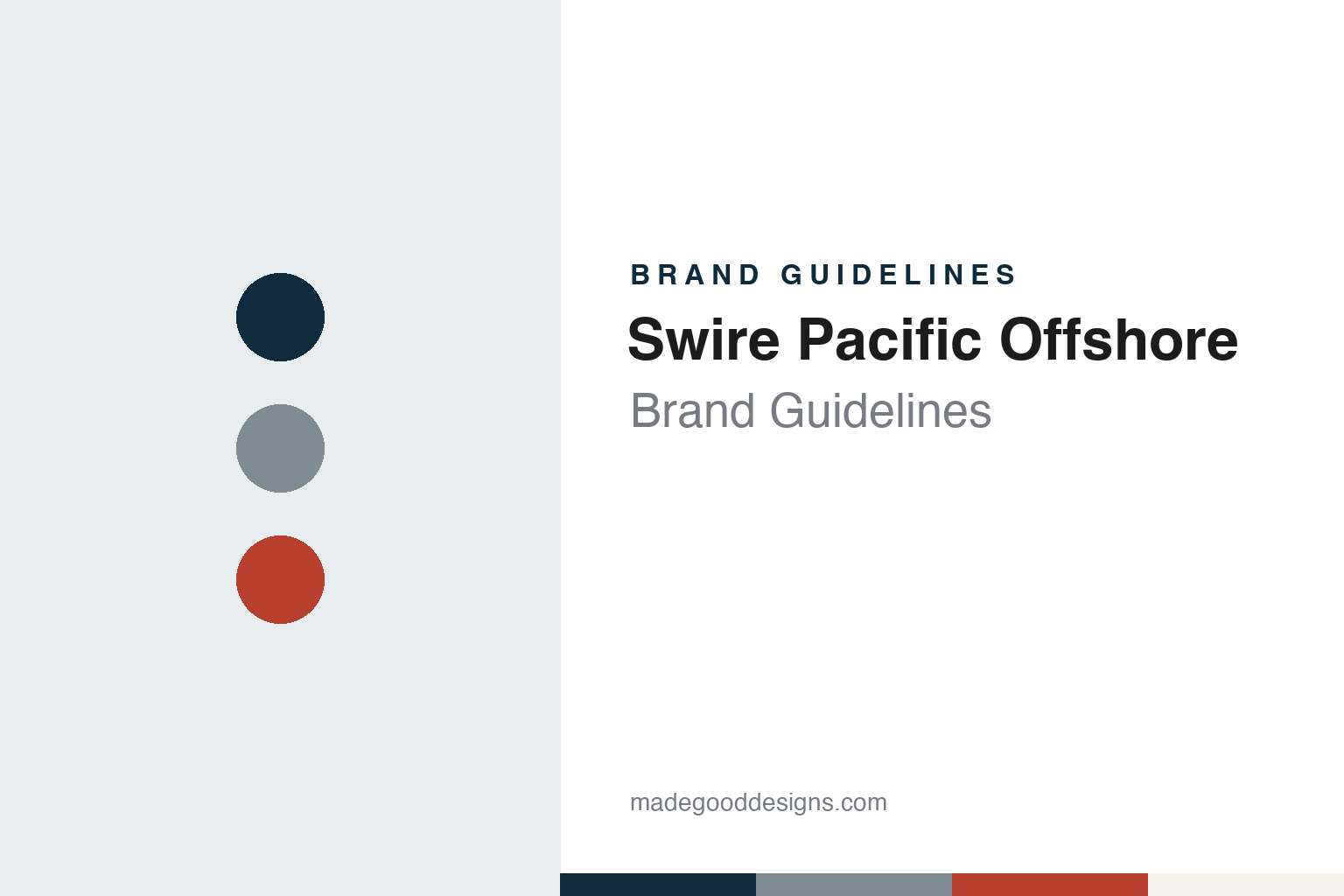
Swire Pacific Offshore Brand Guidelines
A Singapore fleet that put “Pacific” in front of every name.
Aa
Two constants: a blue, grey and red palette and a maritime serif register. Abstract homage — not a Swire Pacific Offshore vessel, livery or mark; no logo or funnel mark is reproduced.
Swire Pacific Offshore
A Swire group shipping business in Singapore.
Swire Pacific Offshore, usually shortened to SPO, was a Singapore-based operator of specialised offshore support vessels serving the energy industry, as The Maritime Executive described it in March 2022. A company profile published by Energy, Oil & Gas magazine in 2012 says it was established in 1975. English Wikipedia describes Swire Pacific Offshore Holdings Limited as a wholly owned subsidiary of Swire Pacific that supplied chartered vessels to the offshore oil and gas industry worldwide.
The parent group is far older than the offshore business. Wikipedia traces the Swire group to a Liverpool import-export company that John Swire started in 1816, trading mainly in textiles; its privately owned parent is the London-based John Swire & Sons Limited, and its Asian businesses come under Swire Pacific, which is listed in Hong Kong. The 2012 profile quoted SPO as saying that the Swire family had owned ships for more than 150 years.
At the time of that profile, in April 2012, SPO owned and operated more than 75 offshore support vessels — a mix of anchor handling tug supply vessels, platform supply vessels, icebreakers, tugs and seismic survey vessels — with an average age of about ten years, the magazine reported. A large share of the fleet used dynamic positioning, and the company described an investment programme aimed at a fleet of 100 vessels by 2016, with new platform supply vessels on order from shipyards in Brazil and Japan. Its general manager told the magazine that the vessels had to work like Swiss Army knives, carrying liquid mud, bulk cargo and chemicals and offering firefighting, fast rescue craft and large deck areas, often all in one hull.
Colour
Pacific Hawk, Pacific Harrier, Pacific Orca.
SPO’s vessels carried the word “Pacific” at the front of their names. The 2012 profile names Pacific Hawk, delivered in August 2011, and her sister Pacific Harrier, delivered in March 2012, as the company’s largest platform supply vessels at the time, each able to carry about 4,700 tonnes of cargo. Pacific Hawk was then working with a deepwater rig off Malaysia, and Pacific Harrier had won work with a dynamically positioned drillship in Asia. The same profile described two accommodation barges due later in 2012 from the Boustead shipyard in Penang, Malaysia, each with a 200-tonne crane and room for 300 people in one- and two-person cabins.
The company also moved into offshore wind. According to the profile, its first wind turbine installation vessel, Pacific Orca, was due in 2012 from Samsung Heavy Industries in Korea: a six-legged, dynamically positioned jack-up with a 1,500-tonne crane, built to lift turbines into place in up to 60 metres of water for renewable projects in the North Sea, and the first of two such vessels ordered for SPO. The company expected it to become the largest and most technically complex ship in its fleet.
In anchor handling, SPO’s largest vessels formed its “D class”, which Rob Day, head of offshore at the ship-valuation firm VesselsValue, called well respected in a March 2022 analysis republished by MarineLink. He noted that SPO had gone on taking delivery of large Japanese-built platform supply vessels through the offshore downturn, which brought its average fleet age down to about ten years, and he counted 18 large platform supply vessels of 4,000 deadweight tonnes or more, with an average age of 6.7 years, and 10 very large anchor handlers of 16,000 brake horsepower or more. The same analysis described several hard years for the company, with mounting operating losses and the closure of its Swire Subsea division.
Typography
How offshore vessel operators present themselves.
Offshore support vessel operators present themselves first through their ships. A fleet is usually painted in one house scheme, with a strong hull colour such as red, blue or orange, a mark on the funnel and a shared naming prefix, so that a client, a port or another crew can tell whose vessel is working a field. In Norway the prefix habit is easy to see: DOF’s ships sail as Skandi vessels and Solstad’s as Normand vessels.
On the web, the core of most operator sites is the fleet list. Vessels are sorted by type — platform supply vessels that carry cargo, fuel and water out to installations, anchor handling tug supply vessels that tow rigs and set moorings, and construction support vessels with cranes, large decks and remotely operated vehicles — and each ship usually has its own specification sheet listing deck area, crane capacity, berths and equipment, often as a downloadable file.
Beside the fleet sit pages on services. Many operators now describe work for offshore wind as well as for oil and gas, and many offer subsea services such as inspection, repair and maintenance, survey and ROV work, sometimes through a sister company or a subsidiary with its own name. Contract announcements, usually naming the vessel, the client region and the length of the charter, keep those pages moving.
Because many of these companies are listed, the annual report and the quarterly results presentation are part of the identity too, and in a sector shaped by mergers, restructurings and fleet sales, the company story page often carries the history. For a designer, the useful material is consistent: hull colours, funnel marks, vessel names, clear fleet tables and sober corporate typography.
Aa
A maritime serif for a fleet with one shared prefix. (Specimen set in Source Serif 4, a serif STAND-IN; NOT the Swire Pacific Offshore logo.)
Sale to Tidewater
Agreed in March 2022, completed on 22 April 2022.
The business left the Swire group in 2022. In March 2022 Tidewater, the Houston-based offshore support vessel operator, entered into a definitive agreement to acquire Swire Pacific Offshore from Swire Pacific, The Maritime Executive reported on 9 March. The deal covered a fleet of 50 vessels — 29 anchor handling tug supply vessels and 21 platform supply vessels, all then active — with about half of them working in West Africa and the rest mainly in Southeast Asia and the Middle East. Part of the payment to Swire Pacific took the form of warrants for Tidewater shares, structured to fit the foreign-ownership limits of the U.S. Jones Act, the magazine said.
Tidewater completed the purchase on 22 April 2022, The Maritime Executive and gCaptain reported, taking its own fleet to 203 vessels, including crew boats, tugs and maintenance vessels. On its page about the acquisition, Tidewater says the purchase placed it as the largest offshore support vessel fleet in the world. Since that date SPO has been part of Tidewater rather than a Swire business, and its 50 vessels joined the Tidewater fleet.
For a design guide, Swire Pacific Offshore shows how a single shared word can hold a fleet together: from Pacific Hawk to Pacific Orca, the shared prefix ties the fleet together. Compare Tidewater, the operator that bought SPO, and Bourbon, which The Maritime Executive named in 2022, with Edison Chouest, as owners of fleets of about 140 vessels each. For this guide we use a deep ocean blue, a harbour grey and a signal red with a serif, an unofficial interpretation; no product or logo is reproduced.
Explore & save
Keep Swire Pacific Offshore’s identity on hand — save it to a board in the Made Good inspiration library.
Swire Pacific Offshore identity set
Pin the Swire Pacific Offshore blue, grey and red palette and the maritime serif register to your own board.