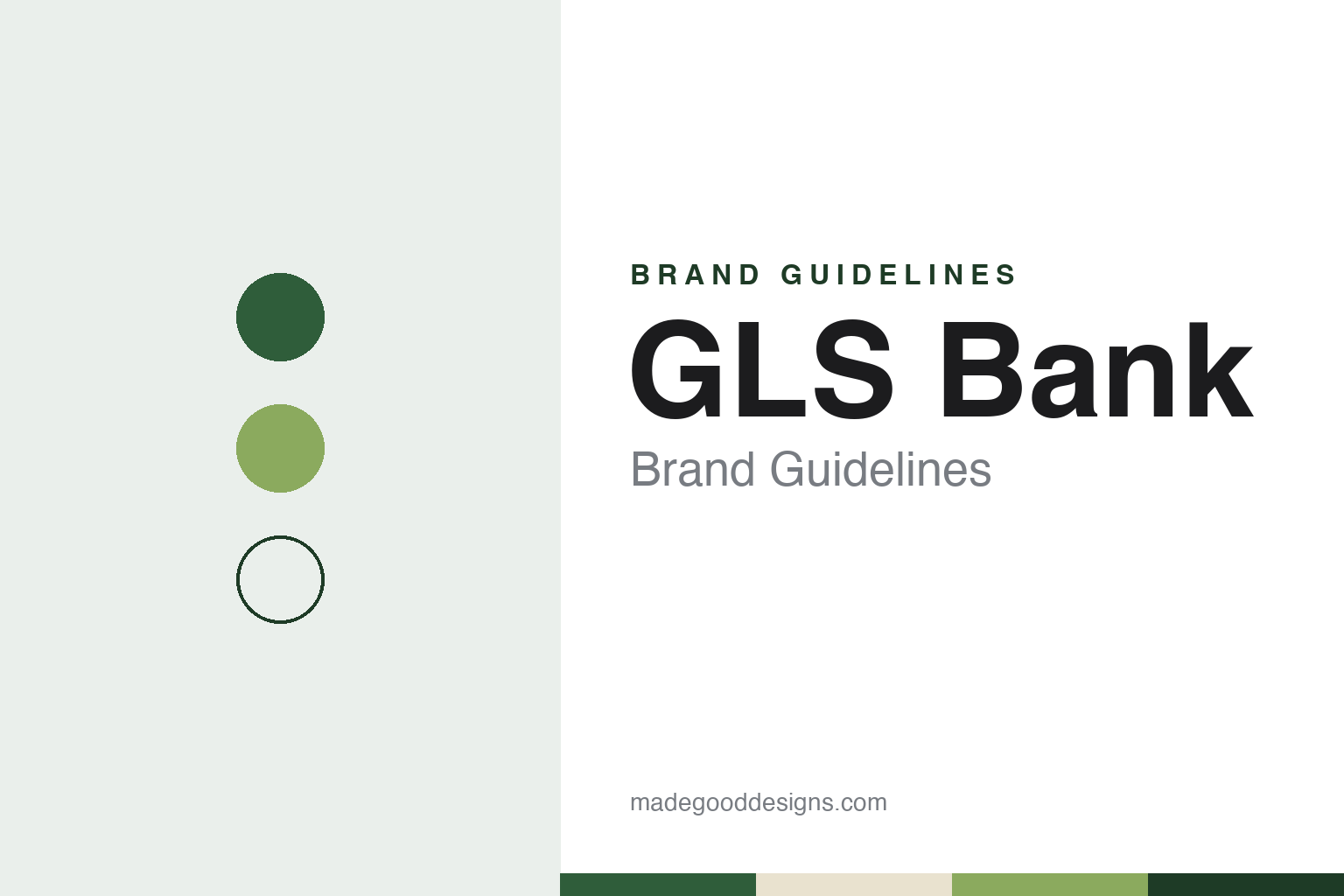
GLS Bank Brand Guidelines
The Bochum cooperative bank built on lending and giving.
Aa
Two constants: a forest green, meadow and oat palette and a Plain humanist sans register. Abstract homage — not a GLS Bank product or mark; no card, logo or sign is reproduced.
Lending and giving
A Waldorf school that needed a loan.
GLS Bank began with a school. Its full name is GLS Gemeinschaftsbank eG, and the three letters stand for Gemeinschaftsbank für Leihen und Schenken — roughly, “community bank for lending and giving.” German Wikipedia dates its founding to 11 March 1974 in Bochum, in the Ruhr, and names its founders as Gisela Reuther, Wilhelm Ernst Barkhoff, Albert Fink and Rolf Kerler, all anthroposophists — followers of the ideas of Rudolf Steiner — who set it up to finance a Waldorf school. The same date appears in a dpa report carried by Die Welt in March 2024.
Deutsche Welle told the founding story in May 2024, for the bank’s fiftieth year. About sixty parents needed money to build a Waldorf school, Fink recalled, and no bank would lend it to them. The Bochum lawyer Barkhoff advised them to form a lending community and take joint responsibility for the loan, with guarantors backing the borrower. “That was the blueprint for the bank,” Fink told the broadcaster; he was one of its founding board members in 1974. According to DW, the new bank opened with nine employees and 101 members.
The anthroposophical link has loosened but not gone. German Wikipedia says the bank no longer sees itself as an anthroposophical company, while its statutes still refer to Steiner’s approaches, and it continues to finance anthroposophical projects and institutions. English Wikipedia describes it as an ethical bank founded as an anthroposophical initiative. English Wikipedia also points to Triodos Bank as another ethical bank founded on anthroposophical principles.
Colour
Mergers, members and a published loan book.
The bank grew partly by absorbing others, German Wikipedia records. In 1997 it merged with the Gemeinnützige Kredit-Garantiegenossenschaft, a guarantee cooperative also based in Bochum. Early in 2003 it took over the business of Ökobank, a Frankfurt cooperative bank that had come out of the environmental movement and had run into financial difficulty. In 2008 it took over IntegraBank of Munich, a bank from the church sector, and in 2012 it merged with the Bürgschaftsbank für Sozialwirtschaft of Cologne. In 2018 it took a stake in UmweltBank of Nuremberg, and in 2021 it set up GLS Investment Management as an asset manager.
Its structure is cooperative. Customers can become members by buying shares, and each member has one vote at the annual general assembly, however many shares they hold, German Wikipedia says. Members use that vote: at the assembly of December 2016, English Wikipedia records, about 80 per cent of some 1,200 people present voted for the GLS-Beitrag, an annual contribution from each customer meant to make the bank less dependent on interest. The bank belongs to the German federation of Volksbanken and Raiffeisenbanken and works with partners in that cooperative network, including DZ Bank and Union Investment.
Its numbers come from dated reports. Membership rose by about 12,000 in 2023 to 130,000, and the customer count reached 366,000, dpa reported in March 2024; the group then employed 939 people. Alongside the Bochum head office, DW listed branches in Berlin, Frankfurt, Stuttgart, Munich, Freiburg and Hamburg.
Its signature practice is disclosure. German Wikipedia says the bank publishes all of its loans to businesses in its customer magazine, Der Bankspiegel, and that customers opening an account can choose the sectors their money should go to: renewable energy, food, sustainable business, housing, education and culture, and social services. It does not finance sectors including nuclear power, arms and tobacco, the encyclopaedia says.
Typography
Design and documentation.
Cooperative and ethical banks sit in a corner of finance where the ownership model is part of the message. A cooperative bank is owned by its members, who usually buy shares and vote at a general meeting; an ethical bank sets out which sectors it will and will not lend to. Many institutions do both, and their identities tend to say so plainly, with wordmarks in strong single colours — orange, green and red among them — and names that point to a place, a farming root or a founding idea.
Their websites follow a recognisable pattern. Beside pages on current accounts, savings, mortgages and business lending, they usually carry a section on membership: how to join, how many shares a member needs, and how voting works. GLS Bank in Bochum, for example, gives each member one vote at its annual general assembly regardless of how many shares they hold, according to German Wikipedia.
Imagery tends towards the local and the collective: branch fronts, regional offices, member meetings and the projects a bank has financed, from housing to renewable energy and schools. Statements of values and sustainability policies are given prominent space, and they are presented as the bank’s own commitments rather than as independent findings. GLS Bank goes further than most by publishing its business loans in its customer magazine, Der Bankspiegel, German Wikipedia says.
The paper trail matters as much as the logo. These banks publish annual reports, and many add impact or sustainability reports that set out where deposits went. This guide uses those documents, encyclopaedias and dated press reports to record when each bank was founded, how its local banks and central institutions merged, and how it describes its own structure, keeping the bank’s claims attributed to the bank.
Aa
A plain humanist sans — “Dein Geld gestaltet die Welt.” (Specimen set in Work Sans, a sans STAND-IN; NOT the GLS Bank logo.)
GLS Bank
“Your money shapes the world.”
The bank’s slogan, quoted by DW in 2024, is “Dein Geld gestaltet die Welt” — “your money shapes the world.” DW described GLS as Germany’s largest social-ethical and ecologically run bank; by its own account, dpa reported, it is the country’s oldest social-ecological bank. Thomas Jorberg was its long-time spokesman of the board, and Aysel Osmanoglu has led the board as spokeswoman since 2023, DW said.
The lending-community idea survives as a product. German Wikipedia describes the Leih- und Schenkgemeinschaft, a group of up to 25 supporters who each commit to monthly payments towards a loan for a non-profit project. The bank also made microloans to very small businesses from 2000, a programme that ended in 2014, and in 2018 it introduced giro-e, a payment system for charging points; that business was spun off in September 2023 as GLS Mobility. German Wikipedia lists the German Sustainability Award among its prizes, in 2012, 2019 and 2023, and says it was a founding member of the Global Alliance for Banking on Values in 2009.
Its newest physical object is small. Since 2023, DW reported, customers can have a giro card made mostly of wood rather than plastic, and the dpa report of March 2024 also mentioned the new wooden cards. For its fiftieth year, dpa reported, the bank planned a sustainability fair in Bochum’s Jahrhunderthalle in June 2024.
For a design guide, GLS Bank shows a brand built on a founding story and a habit of publishing what it does with deposits. Compare Triodos Bank, another ethical bank with anthroposophical roots, and The Co-operative Bank, a British bank with a long-standing ethical policy. For this guide we use a forest green, a meadow green and an oat with a sans, an unofficial interpretation; no product or logo is reproduced.
Explore & save
Keep GLS Bank’s identity on hand — save it to a board in the Made Good inspiration library.
GLS Bank identity set
Pin the GLS Bank forest green, meadow and oat palette and the Plain humanist sans register to your own board.