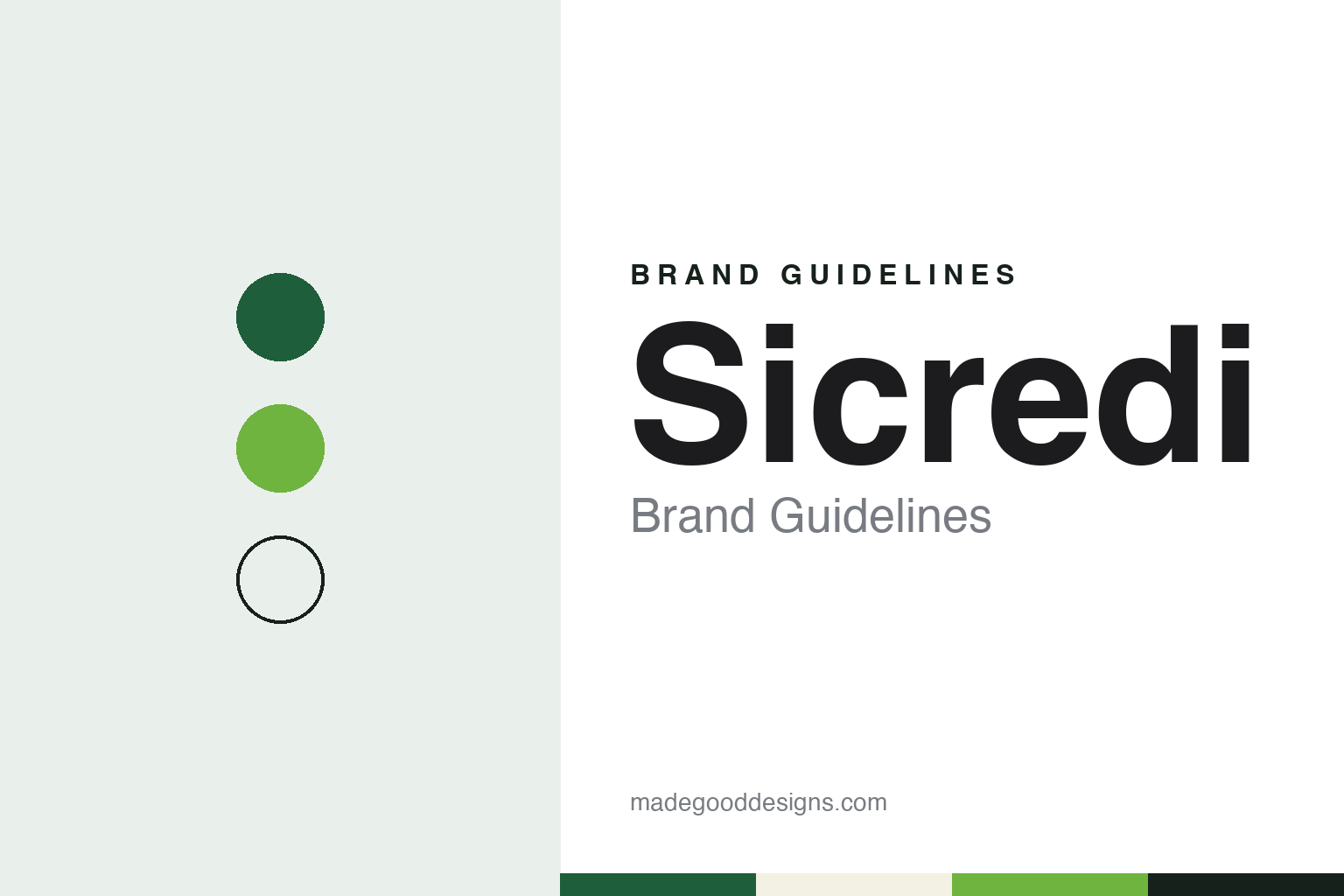
Sicredi Brand Guidelines
A 1902 Nova Petrópolis cooperative grown into a national system.
Aa
Two constants: a Sicredi green and cream palette and a Rounded sans register. Abstract homage — not a Sicredi product or mark; no logo, card or branch sign is reproduced.
Nova Petrópolis, 1902
A Swiss priest and a Raiffeisen-style savings bank.
Sicredi — short for Sistema de Crédito Cooperativo — is a Brazilian system of credit cooperatives rather than a single bank. Its roots are in the German-speaking farming colonies of Rio Grande do Sul. On 28 December 1902, at Linha Imperial in Nova Petrópolis, the Swiss Jesuit priest Theodor Amstad and 19 local leaders and smallholders founded the Sociedade Cooperativa Caixa de Economia e Empréstimos de Nova Petrópolis, modelled on the system created in Germany by Friedrich Wilhelm Raiffeisen, Portuguese Wikipedia says. That cooperative still operates today as Sicredi Pioneira RS.
Sicredi describes the 1902 cooperative as the first credit cooperative in Brazil and in Latin America, and Portuguese Wikipedia says Sicredi is considered the first cooperative financial institution in Latin America. Amstad had arrived in Rio Grande do Sul in 1885 and spent years as a priest travelling among the German colonies, Portuguese Wikipedia says; after Nova Petrópolis he helped found similar cooperatives, including one in Santa Cruz do Sul in 1904. A federal law of December 2019, Lei 13.926, named him patron of Brazilian cooperativism.
The movement grew in the following decades. In 1925, Sicredi says, 20 of the 22 credit cooperatives then in the state met in Santa Maria and founded the Central das Caixas Rurais da União Popular do Rio Grande do Sul, today Sicredi Origens. The 1964 reform of the national financial system, Lei 4.595, imposed restrictions on how credit cooperatives could operate, and the 1971 cooperatives law, Lei 5.764, set out the legal regime of cooperative societies. On 27 October 1980 nine surviving cooperatives formed the central cooperative Cocecrer/RS, which Portuguese Wikipedia treats as the official restart of the institution. Sicredi adds that the 1988 Constitution gave credit cooperatives the operating autonomy the movement had sought since its origins.
Colour
From a state central to a national system.
The name came in 1992. On 10 July that year an extraordinary general assembly made Sicredi the standard brand for every cooperative in Cocecrer/RS, the system’s own history says; the centrals of Paraná, Mato Grosso and Mato Grosso do Sul unified their identities under the same brand in 1996, according to Portuguese Wikipedia. In 1995 the cooperatives founded Bansicredi, now Banco Cooperativo Sicredi, which Sicredi calls the first private cooperative bank in Brazil.
A layered structure followed. Sicredi lists the Confederação Sicredi, a shared-services and processing centre for the system, in 2000; the Fundação Sicredi for education and culture in 2005; the holding company Sicredi Participações, or SicrediPar, on 10 October 2008; and Sicredi Fundos Garantidores in 2009. On its investor-relations site Sicredi sets out the chain of control: every cooperative is linked to one of the centrals, the centrals control SicrediPar, and SicrediPar controls Banco Cooperativo Sicredi and coordinates the system’s strategic decisions. The Confederação Sicredi is based in Porto Alegre.
Membership is the core of the model. When customers join, Sicredi says, they buy a small share in their local cooperative, become owners with a voice in its decisions and take part in its results; a programme called Pertencer encourages members to attend meetings and assemblies. Sicredi gives its size as more than 10.6 million members, more than 3,100 branches and more than 90 cooperatives as of September 2026, and says it is the only financial institution present in more than 200 municipalities. On 10 November 2026 the regional news site DRD reported a nationwide figure of 10.5 million members.
Growth beyond the south came later. Portuguese Wikipedia says the system expanded from 2002 into São Paulo, Santa Catarina, Goiás, Tocantins and Rondônia, and reached Manaus in 2020, making it present in every Brazilian state. In 2010 it formed a partnership with the development arm of the Dutch cooperative group Rabobank, which took a minority stake in Banco Cooperativo Sicredi, Portuguese Wikipedia says. Sicredi still names Rabo Development as its international partner, and it lists a 2011 partnership with the International Finance Corporation, part of the World Bank Group.
Typography
Cooperative and ethical banks.
Cooperative and ethical banks sit in a corner of finance where the ownership model is part of the message. A cooperative bank is owned by its members, who usually buy shares and vote at a general meeting; an ethical bank sets out which sectors it will and will not lend to. Many institutions do both, and their identities tend to say so plainly, with wordmarks in strong single colours — orange, green and red among them — and names that point to a place, a farming root or a founding idea.
Their websites follow a recognisable pattern. Beside pages on current accounts, savings, mortgages and business lending, they usually carry a section on membership: how to join, how many shares a member needs, and how voting works. GLS Bank in Bochum, for example, gives each member one vote at its annual general assembly regardless of how many shares they hold, according to German Wikipedia.
Imagery tends towards the local and the collective: branch fronts, regional offices, member meetings and the projects a bank has financed, from housing to renewable energy and schools. Statements of values and sustainability policies are given prominent space, and they are presented as the bank’s own commitments rather than as independent findings. GLS Bank goes further than most by publishing its business loans in its customer magazine, Der Bankspiegel, German Wikipedia says.
The paper trail matters as much as the logo. These banks publish annual reports, and many add impact or sustainability reports that set out where deposits went. This guide uses those documents, encyclopaedias and dated press reports to record when each bank was founded, how its local banks and central institutions merged, and how it describes its own structure, keeping the bank’s claims attributed to the bank.
Aa
An open, rounded sans for a system that calls itself “yours, mine and ours.” (Specimen set in Nunito Sans, a sans STAND-IN; NOT the Sicredi logo.)
Sicredi
A shared name and a new identity in 2016.
Sicredi’s own timeline marks 2016 as the year of a new visual identity, alongside the creation of its asset manager, Gestora de Recursos Sicredi. On its website it presents itself as the first cooperative financial institution in Brazil and frames the brand around shared ownership, with the line that Sicredi is “seu, meu e nosso” — yours, mine and ours.
Its stated mission is to be a cooperative system that values people and promotes local development in a sustainable way, and its listed values run from cooperation and people at the centre to ethics and transparency. Its main social-responsibility programme, A União Faz a Vida, works through education on cooperation and citizenship, Sicredi says, and the programme Crescer trains staff, members and council members in cooperative culture. Sicredi says its holding board, cooperatives and centrals voted in December 2019 to join the United Nations Global Compact, and that its first sustainability policy dates from 2011.
The brand also appears in public space. On 9 November 2026 the city of Gramado confirmed the result of a public tender won by the cooperative Sicredi Pioneira for the renovation of the town’s Rua Coberta, a covered street, in return for 20 years of naming rights, Gramado Magazine reported. Under the draft contract the space will be called “Rua Coberta” followed by the brand, and the historic name cannot be dropped; the works were planned to take about five months from the start order, and the naming rights begin only once the finished works are handed over.
For a design guide, Sicredi shows how a name agreed by one state central in 1992 became the shared brand of a national system of cooperatives. Compare Sicoob, another Brazilian cooperative system, and Rabobank, the Dutch cooperative group whose development arm is Sicredi’s international partner. For this guide we use a deep green, a fresh leaf green and a warm cream with a sans, an unofficial interpretation; no product or logo is reproduced.
Explore & save
Keep Sicredi’s identity on hand — save it to a board in the Made Good inspiration library.
Sicredi identity set
Save the Sicredi green and cream palette and the Rounded sans register to your own board.