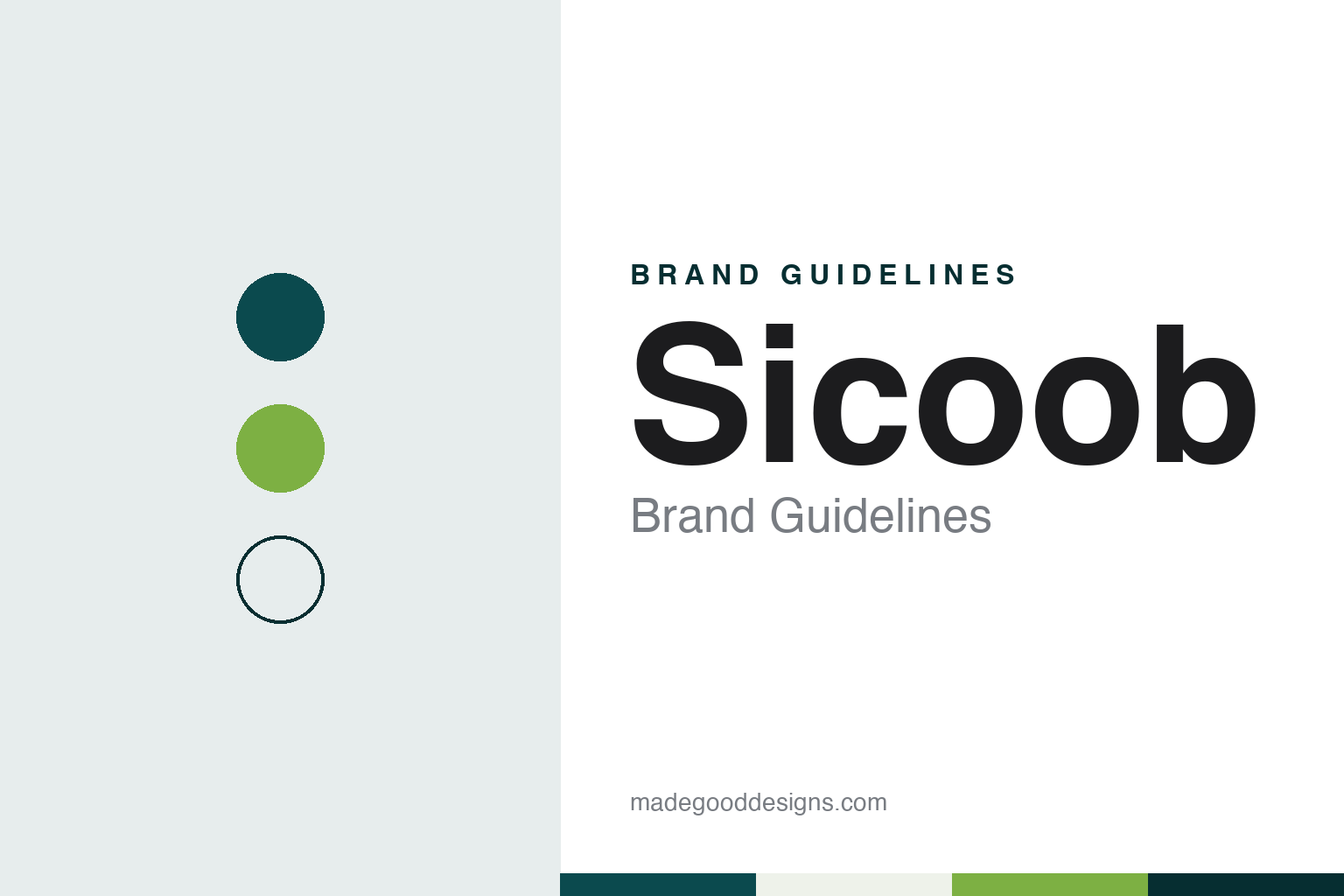
Sicoob Brand Guidelines
A national name for hundreds of local cooperatives.
Aa
Two constants: a teal, green and mist palette and a rounded sans register. Abstract homage — not a Sicoob asset or mark; no logo, card or app screen is reproduced.
Sicoob
A bank founded by cooperatives, for cooperatives.
Sicoob is not a single bank but a system. The name stands for Sistema de Cooperativas Financeiras do Brasil, and Portuguese Wikipedia describes it as financial cooperatives and support companies that together offer members current accounts, credit, investments, cards, private pensions, consórcio purchasing pools, insurance, bank collection and card acquiring. The people it serves are called cooperados, members rather than customers. In a 2025 interview with the cooperative trade magazine MundoCoop, a Sicoob strategy executive put the idea simply: the member is at once a client and an owner of the business.
Its central bank came first. According to Portuguese Wikipedia, regional central cooperatives founded the Banco Cooperativo do Brasil S.A., known as Bancoob, on 4 November 1996, and it began operating in 1997 as the financial and operational arm of a system of regional cooperatives. In 2021 Bancoob was renamed Banco Sicoob, so that the bank now carries the same name as the system it serves.
The system is organised on three levels, Portuguese Wikipedia says. Local cooperatives, the singulares, deal directly with members and are present in every state and in the Federal District. Regional central cooperatives, the centrais, coordinate and support the local cooperatives affiliated to them; there are 14. At the top, the Centro Cooperativo Sicoob (CCS) represents the system and is responsible for its rules, policies, processes, technology, products, services and brands. In September 2026 the Portal do Cooperativismo Financeiro counted 315 local cooperatives and 14 centrals, with the CCS made up of a confederation and a cooperative bank, alongside a card processor and card scheme, a consórcio administrator, a pension entity, an insurer and a social-investment institute.
Colour
Branches, towns and an app.
Sicoob’s scale is usually described through its network. In November 2025 MundoCoop, drawing on InfoMoney, reported more than 9.3 million members and more than 4,600 service points, and said Sicoob ranked first among Brazilian financial institutions by number of agencies and was the only financial institution present in more than 415 municipalities. By June 2026 the system had reached 10 million members, the Portal do Cooperativismo Financeiro reported that September.
In November 2026 the chair of the CCS board for the 2026–2029 term told MundoCoop that Sicoob was present in about 45 per cent of Brazil’s municipalities with 4,756 service points, which he described as the largest physical financial-service network in the country. Twelve of the board’s 14 members continued from the previous term, he said, and he set out how the work is divided across the three levels: local cooperatives strengthen their own governance, controls and risk management; the centrals supervise, guide and support them; and the CCS sets strategy, develops shared solutions and runs centralised services. MundoCoop wrote that the system aims to grow especially in the northeast of Brazil.
The digital side has grown alongside the branches. MundoCoop reported in May 2026 that more than 94 per cent of Sicoob’s transactions take place in digital channels, while its physical units remain part of the strategy. From 1 September 2026 Sicoob began rolling out a new generation of its SuperApp, with Open Finance features that show accounts members hold at other institutions, and a generative-AI assistant, the Assistente Inteligente Sicoob, built on the system’s own Sisbr IA platform, according to the Portal do Cooperativismo Financeiro.
Typography
Cooperative and ethical banks.
Cooperative and ethical banks sit in a corner of finance where the ownership model is part of the message. A cooperative bank is owned by its members, who usually buy shares and vote at a general meeting; an ethical bank sets out which sectors it will and will not lend to. Many institutions do both, and their identities tend to say so plainly, with wordmarks in strong single colours — orange, green and red among them — and names that point to a place, a farming root or a founding idea.
Their websites follow a recognisable pattern. Beside pages on current accounts, savings, mortgages and business lending, they usually carry a section on membership: how to join, how many shares a member needs, and how voting works. GLS Bank in Bochum, for example, gives each member one vote at its annual general assembly regardless of how many shares they hold, according to German Wikipedia.
Imagery tends towards the local and the collective: branch fronts, regional offices, member meetings and the projects a bank has financed, from housing to renewable energy and schools. Statements of values and sustainability policies are given prominent space, and they are presented as the bank’s own commitments rather than as independent findings. GLS Bank goes further than most by publishing its business loans in its customer magazine, Der Bankspiegel, German Wikipedia says.
The paper trail matters as much as the logo. These banks publish annual reports, and many add impact or sustainability reports that set out where deposits went. This guide uses those documents, encyclopaedias and dated press reports to record when each bank was founded, how its local banks and central institutions merged, and how it describes its own structure, keeping the bank’s claims attributed to the bank.
Aa
A rounded, friendly sans for a member-owned system. (Specimen set in Nunito Sans, a sans STAND-IN; NOT the Sicoob logo.)
Telenovelas and football
Explaining cooperative finance through stories.
Sicoob builds its brand in popular culture as much as in banking advertising. In 2023 it began product placement in TV Globo telenovelas, written into the plots to explain cooperative finance through stories about credit, consórcio and small business, MundoCoop reported in May 2026, citing Meio & Mensagem. The placements began in Terra e Paixão in 2023 and continued in No Rancho Fundo in 2024 and Coração Acelerado in 2026. The same executive explained that cooperative finance is still little understood in Brazil, so the system looked for closer, more explanatory ways to describe the model to the public.
Sport and music carry the same message. Sicoob sponsors Série A and Série B of the Campeonato Brasileiro and several state championships; its ambassadors include the footballers Zico and Endrick and the canoeist Ana Sátila; and it sponsored the 20th-anniversary tour of the duo Jorge & Mateus. From July 2026 it took on a three-year sponsorship of the Campeonato Brasileiro Feminino, the Copa do Brasil Feminina and the Supercopa Feminina, MundoCoop reported, noting that more than 44 per cent of Sicoob’s members are women. Sicoob says, from its own internal data, that its brand strength has risen by about 95 per cent since the new communication cycle began in 2023.
Outside rankings have taken note. In the 2025 edition of InfoMoney’s list of the most valuable Brazilian brands, prepared with the consultancy TM20 Branding, Sicoob placed 13th of 50 and was the highest-placed cooperative brand, MundoCoop reported in November 2025. MundoCoop has described the system’s purpose as promoting financial fairness and prosperity.
For a design guide, Sicoob shows how hundreds of local cooperatives can share one national name, with the work of explaining what a cooperative is handed to storytelling, sport and song. Compare Sicredi, another Brazilian cooperative system, and Desjardins, the cooperative group of Quebec. For this guide we use a deep teal, a fresh green and a pale mist with a rounded sans, an unofficial interpretation; no product or logo is reproduced.
Explore & save
Keep Sicoob’s identity on hand — save it to a board in the Made Good inspiration library.
Sicoob identity set
Pin the teal, green and mist palette and the rounded sans register to your own board.