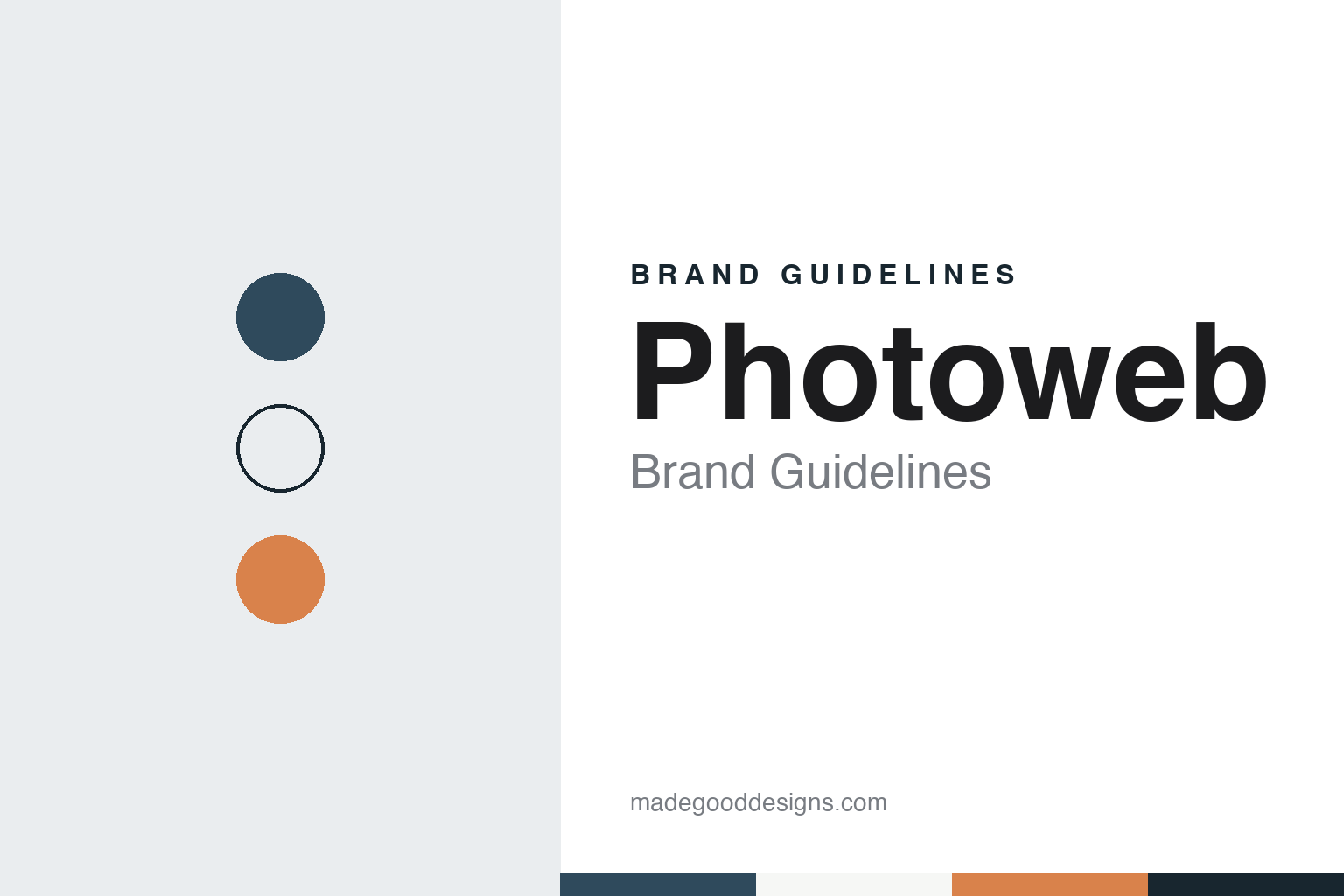
Photoweb Brand Guidelines
The Grenoble student project that became an Alpine photo lab.
Aa
Two constants: an Alpine slate, snow white and print orange palette and a rounded geometric sans register. Abstract homage — not a Photoweb product or mark; no print, logo or packaging is reproduced.
A living-room lab
An end-of-studies project in Grenoble.
Photoweb is an online photo-printing company based in Saint-Égrève, just north of Grenoble in the Isère department of France. It began as a student project. During a visit to the lab in December 2008, the technology site Clubic reported that the company was launched in 2000 by two friends, one of them its chief executive Étienne Descure, then freshly graduated from the Grenoble business school, and that it grew out of an end-of-studies project. At the time, Clubic noted, few French homes had a digital camera or a broadband connection, and the young business ran from the living room of an apartment.
The early equipment was modest. Clubic reported that the first printer, an Agfa DPU, turned out only 170 photos an hour, too few to make the business pay, and that by 2008 it had been replaced by a fleet of 15 Fujifilm printers running on Fujifilm paper. By then Photoweb had 45 staff on two sites, rising to about 70 in the holiday season, in-house software that sent each order to the right machine, and a second workshop given over to new products such as calendars, cards, photo books and photo mosaics.
Ownership changed in 2014. Clubic, in a review published in November 2025, says Photoweb became a subsidiary of the Exacompta Clairefontaine group, the French paper and stationery maker, in 2014. Le Journal des Entreprises reported in March 2024 that the group was still its shareholder, and quoted the managing director, Laurent Boidi, describing it as a family shareholder with a long-term view. The same paper reported in February 2016 that Photoweb had moved into a new head office of 7,000 square metres in April 2014.
In early 2016 Photoweb made its first acquisition, Le Journal des Entreprises reported: Lalalab, a four-person company from Nancy whose mobile app for ordering prints had passed three million downloads in Europe. Lalalab moved into the Exacompta-Clairefontaine group’s offices in Paris and handed part of its production to Photoweb’s plant at Saint-Égrève. The paper put Photoweb’s staff at about 156 in 2016 and about 220 in 2024.
Colour
Silver halide, inkjet and the photo book.
Prints remain at the centre of the range. Le Journal des Entreprises reported in March 2024 that silver-halide printing made up about 35 percent of Photoweb’s activity, that the company produced around 70 million prints a year, and that it had about 650,000 customers. In its 2008 visit, Clubic explained that even a fully digital lab still prints on light-sensitive paper, exposed by lasers rather than through a negative, and that Photoweb kept a separate Italian machine for enlargements above 50 centimetres.
The 2024 report also said Photoweb had partnered with a French industrial company to co-develop an inkjet printing machine. Clubic’s 2025 review describes the two kinds of print now on offer: silver-halide prints on Fujifilm paper, in matt or gloss, and prints the company calls “éco-conçus,” made on a heavier digital paper with water-based ink. The same review lists mini prints, retro prints, square prints, photo-booth strips and enlargements.
Beyond prints, Photoweb’s site groups its products into photo books, wall decoration, cards and announcements, personalised objects and calendars. Clubic describes books in S, M and XL formats, with standard or lay-flat opening, soft or hard covers, and themed layouts for travel, the year and new babies. Le Journal des Entreprises reported in 2016 that personalised mugs were then its top-selling product. Newer services on the site include Photoweb Studio, in which a designer lays out a photo book from a customer’s pictures, and a Collection Héritage of books meant to be passed down, alongside online photo storage for members.
Where things are made matters to the brand. Clubic’s 2025 review says 99.75 percent of items are printed in France at Saint-Égrève, with the remainder printed in Spain, and that the company holds the Imprim’Vert label. Photoweb’s homepage says its customer advisers work directly above the workshop, and the 2025 review describes ordering through a web editor and a mobile app.
Typography
How professional labs present themselves.
Professional photo labs and film-processing labs sit between the photographer and the finished object. Most present themselves chiefly through the print: the paper it is made on, the process that made it and the size it comes in. Lab websites typically sort their catalogues by paper surface — glossy, lustre, matt, pearl or metallic — and separate photographic prints exposed on light-sensitive paper from inkjet or giclée prints made for fine-art work.
Around the print sit albums, photo books, cards and wall pieces. Labs name these ranges plainly, usually by material and construction: lay-flat books, hard and soft covers, mounted prints, framed prints, acrylic, metal and wood. Film labs add a second vocabulary of development and scanning, listing film formats, scan resolutions and turnaround times so that a photographer can compare one service with another before sending a roll.
Ordering is part of the brand. Many labs describe their software in practical terms: a web editor for families, a mobile app for quick prints, and downloadable ordering programs or proofing tools for professionals who send large batches. Service promises — remakes, colour correction, shipping deadlines and guarantees — are usually written as short named policies rather than long explanations.
Corporate pages tend to carry the history. Labs that began as a single printer or a small darkroom often tell that story in their About pages, alongside the names of their owners, the towns where their production sits and any group they now belong to. For a design reader, the category is a study in restraint: the identity frames the customer’s pictures and names the materials, and it rarely competes with the images it prints.
Aa
A rounded geometric sans. (Specimen set in Outfit, a sans STAND-IN; NOT the Photoweb logo.)
Photoweb
A workshop at the foot of the Alps.
Photoweb speaks French to a mainly French audience, and its tone is warm and domestic. The corporate site opens with the line “Imaginons nos futurs souvenirs” — let us imagine our future memories — and describes an optimistic company that has sat at the heart of the Alps for nearly 25 years. The shop’s homepage leans on the same setting: a workshop at the foot of the Alps, a savoir-faire claimed over 25 years, and an emphasis on care for every detail of a finished book or print.
Three labels recur on the corporate site: an innovative company, a French company and a committed company. Together they tie the brand to its local plant, its printing projects and its group shareholder, a paper producer. The product names stay plain and descriptive in French — tirages, livres photo, déco murale, calendriers — with named services such as Photoweb Studio and the Collection Héritage layered on top. The customer-service promise is framed in the same personal register, with advisers who, the company says, sit just above the workshop and follow an order from creation to delivery.
The company’s growth story is told the same way. Clubic traced it in 2008 from a living-room start and a single slow printer to a lab with fifteen machines, and Descure told Le Journal des Entreprises in 2016 that the company had begun with prints alone in 2000 before adding new products as broadband and online editors improved. The Lalalab purchase brought a mobile app and customers outside France into the group.
For a design guide, Photoweb shows how an online lab can build a brand on place and process, naming its workshop and its printing methods while keeping the product names simple. Compare it with Photobox, another European online photo service, and Fujifilm, whose paper Photoweb used in 2008 and still offers for its silver-halide prints, according to Clubic. For this guide we use an Alpine slate, a snow white and a print orange with a rounded geometric sans, an unofficial interpretation; no product or logo is reproduced.
Explore & save
Keep Photoweb’s identity on hand — save it to a board in the Made Good inspiration library.
Photoweb identity set
Save the Photoweb Alpine slate, snow white and print orange palette and the rounded geometric sans register to your own board.