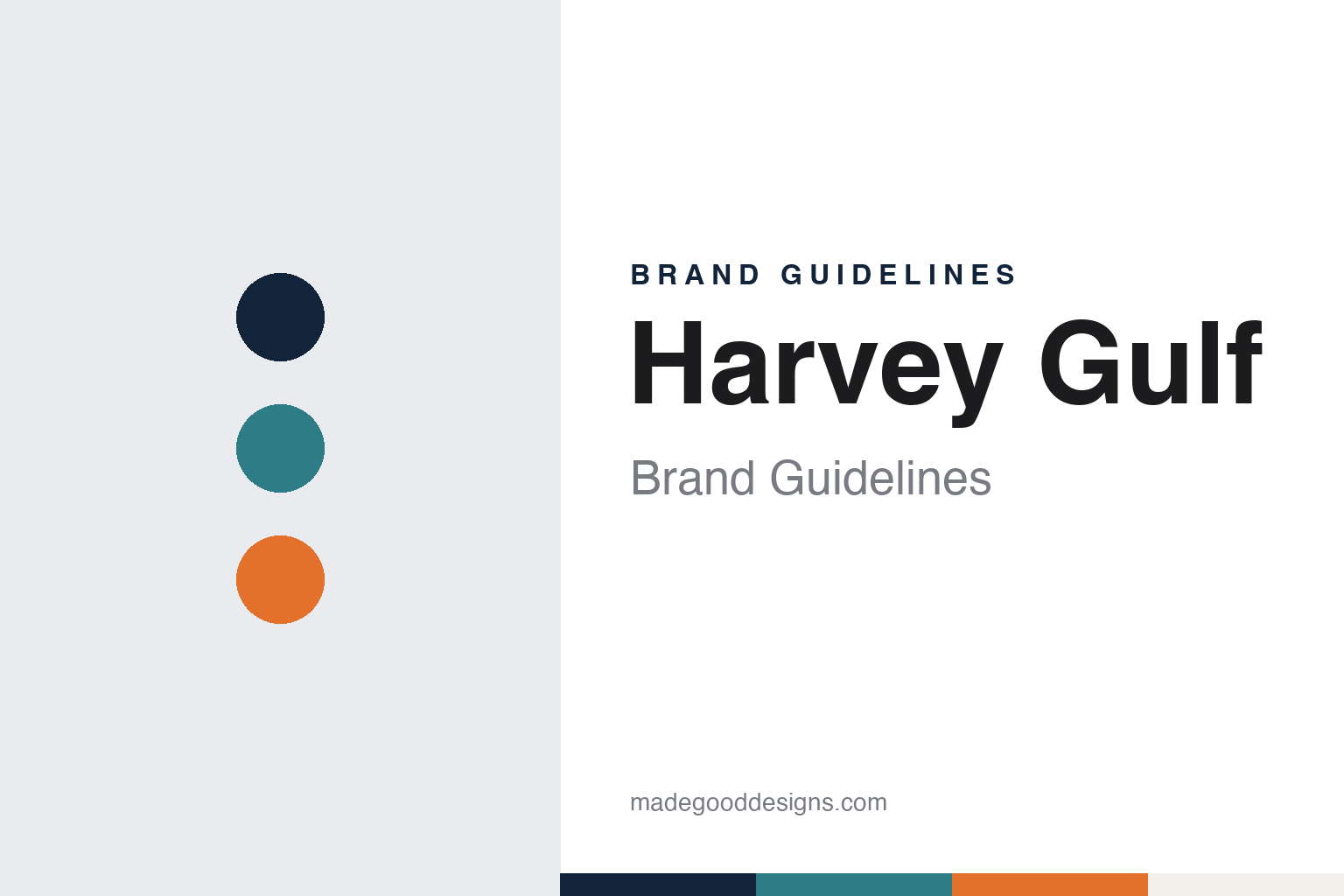
Harvey Gulf Brand Guidelines
A Gulf of Mexico supply-boat fleet with the company name on every bow.
Aa
Two constants: a navy, teal and orange palette and an industrial sans register. Abstract homage — not a Harvey Gulf vessel, livery or mark; no logo or funnel mark is reproduced.
Harvey Gulf
A family vessel company on the Gulf of Mexico.
Harvey Gulf International Marine is a New Orleans company that runs offshore support vessels in the U.S. Gulf of Mexico. It was founded in 1955 by Captain Numa J. Guidry, according to gCaptain in July 2018, which described it as one of the largest privately owned and operated marine transportation companies in the U.S. Gulf of Mexico. Five years earlier the same publication summed up its work as towing drilling rigs and providing offshore supply and multi-purpose support vessels for deepwater operations.
The business stayed with the founding family for half a century. In 2008 it was bought from the Guidry family by its chief executive, a member of that family, together with the New York private-equity firm The Jordan Company, gCaptain reported in 2018. New Orleans CityBusiness described the company in 2013 and again in 2018 as privately held.
Growth came quickly in the early 2010s. New Orleans CityBusiness reported in September 2013 that Harvey Gulf had bought Bee Mar, a young supply-vessel operator with bases in Broussard, Louisiana, and Sugar Land, Texas, in 2012; that it had bought 11 vessels from Gulf Offshore Logistics of Lafayette in May 2013, in a deal that also covered contracts to build two heavy-lift construction vessels and an LNG-powered supply boat; and that it was buying the fleet of Abdon Callais Offshore, a Golden Meadow company whose family roots went back to 1945. gCaptain put the Callais deal at all 48 of that company’s offshore supply vessels, four of them still under construction, and said it was expected to close in the fourth quarter of 2013. Nearly all of the Callais boats were dynamically positioned, a technology that New Orleans CityBusiness called standard for many oil and gas companies.
Colour
Harvey Energy, Harvey Power, Harvey Liberty.
The fleet is where the Harvey Gulf name is most visible: every vessel named in the trade press carries the company name first. The supply vessels include Harvey Energy, Harvey Power and Harvey Liberty; the large subsea vessels were called Harvey Intervention, Harvey Deep-Sea, Harvey Blue-Sea and Harvey Sub-Sea.
Part of that investment went into vessels that run on liquefied natural gas, New Orleans CityBusiness reported in 2013. In June 2013 MarineLink reported its plan to build and operate an LNG marine fuelling facility at its vessel base in Port Fourchon, Louisiana, on two sites, and the signing of a sixth LNG-powered offshore supply vessel at Gulf Coast Shipyard Group in Gulfport, Mississippi. The company said at the time that the sixth vessel would make it the largest owner and operator of LNG-powered offshore supply vessels anywhere. New Orleans CityBusiness reported in 2018 that Harvey Gulf had completed the Port Fourchon facility in 2015 and described it as the first LNG marine fuelling facility in the United States.
In May 2016 gCaptain reported the delivery at Port Fourchon of Harvey Liberty, the third in a series of six U.S.-flagged supply vessels powered almost entirely by liquefied natural gas. She was chartered to Shell for its deepwater platforms in the Gulf, carrying supplies, equipment and drilling fluids, and joined her sisters Harvey Energy and Harvey Power. The 302-foot vessel runs on three dual-fuel Wärtsilä engines, and all three ships were built by Gulf Coast Shipyard in Mississippi and carry the ABS “ENVIRO+” and “Green Passport” notations, gCaptain said. In 2018 the same publication captioned Harvey Energy as the first LNG-powered offshore supply vessel in the Gulf of Mexico.
Alongside the supply boats, Harvey Gulf built a group of large multi-purpose vessels for subsea construction, repair and maintenance, New Orleans CityBusiness reported in 2018. Four of them were built by Eastern Shipbuilding of Panama City, Florida, between 2012 and 2017, ranging from 300 to 340 feet in length, according to WorkBoat and gCaptain in October 2025; all four are Jones Act compliant and are equipped for inspection, repair and maintenance, survey and light construction work.
Typography
How offshore vessel operators present themselves.
Offshore support vessel operators present themselves first through their ships. A fleet is usually painted in one house scheme, with a strong hull colour such as red, blue or orange, a mark on the funnel and a shared naming prefix, so that a client, a port or another crew can tell whose vessel is working a field. In Norway the prefix habit is easy to see: DOF’s ships sail as Skandi vessels and Solstad’s as Normand vessels.
On the web, the core of most operator sites is the fleet list. Vessels are sorted by type — platform supply vessels that carry cargo, fuel and water out to installations, anchor handling tug supply vessels that tow rigs and set moorings, and construction support vessels with cranes, large decks and remotely operated vehicles — and each ship usually has its own specification sheet listing deck area, crane capacity, berths and equipment, often as a downloadable file.
Beside the fleet sit pages on services. Many operators now describe work for offshore wind as well as for oil and gas, and many offer subsea services such as inspection, repair and maintenance, survey and ROV work, sometimes through a sister company or a subsidiary with its own name. Contract announcements, usually naming the vessel, the client region and the length of the charter, keep those pages moving.
Because many of these companies are listed, the annual report and the quarterly results presentation are part of the identity too, and in a sector shaped by mergers, restructurings and fleet sales, the company story page often carries the history. For a designer, the useful material is consistent: hull colours, funnel marks, vessel names, clear fleet tables and sober corporate typography.
Aa
An industrial sans for a fleet named after its owner. (Specimen set in Archivo, a sans STAND-IN; NOT the Harvey Gulf logo.)
Restructuring and refocus
Chapter 11 in 2018, a fleet sale in 2025.
After the fall in oil prices in 2014 and the long offshore downturn that followed, Harvey Gulf turned to Chapter 11 in 2018. On 9 March 2018 it filed a prepackaged Chapter 11 plan in the Southern District of Texas, under which its secured bank debt would be converted into equity for its lenders while unsecured creditors were to be paid in full, New Orleans CityBusiness reported. Court filings at the time gave the company 580 employees and a 60-vessel fleet, mostly offshore supply vessels. On 2 July 2018 Harvey Gulf announced that it had completed its court-approved reorganisation and left Chapter 11, 77 days after the filing, gCaptain reported, with its lenders taking equity in the company.
In October 2025 the company sold its four multi-purpose support vessels to Otto Candies of Des Allemands, Louisiana; the sale took effect on 23 October, WorkBoat reported. At that point Harvey Sub-Sea was working in offshore wind out of Providence, Rhode Island, while the other three supported oil and gas work from Port Fourchon. WorkBoat added that Harvey Gulf then listed 28 platform supply vessels and three crewboats on its website and said it remained focused on supporting the oil and gas industry.
For a design guide, Harvey Gulf shows a brand carried by vessel names: from Harvey Energy to Harvey Intervention, the company name leads every vessel name. Compare Hornbeck Offshore, the Covington, Louisiana, operator that New Orleans CityBusiness named alongside Harvey Gulf in 2018, and Tidewater, the Houston-based supply-vessel operator. For this guide we use a deep navy, a gulf teal and a signal orange with a sans, an unofficial interpretation; no product or logo is reproduced.
Explore & save
Keep Harvey Gulf’s identity on hand — save it to a board in the Made Good inspiration library.
Harvey Gulf identity set
Pin the Harvey Gulf navy, teal and orange palette and the industrial sans register to your own board.