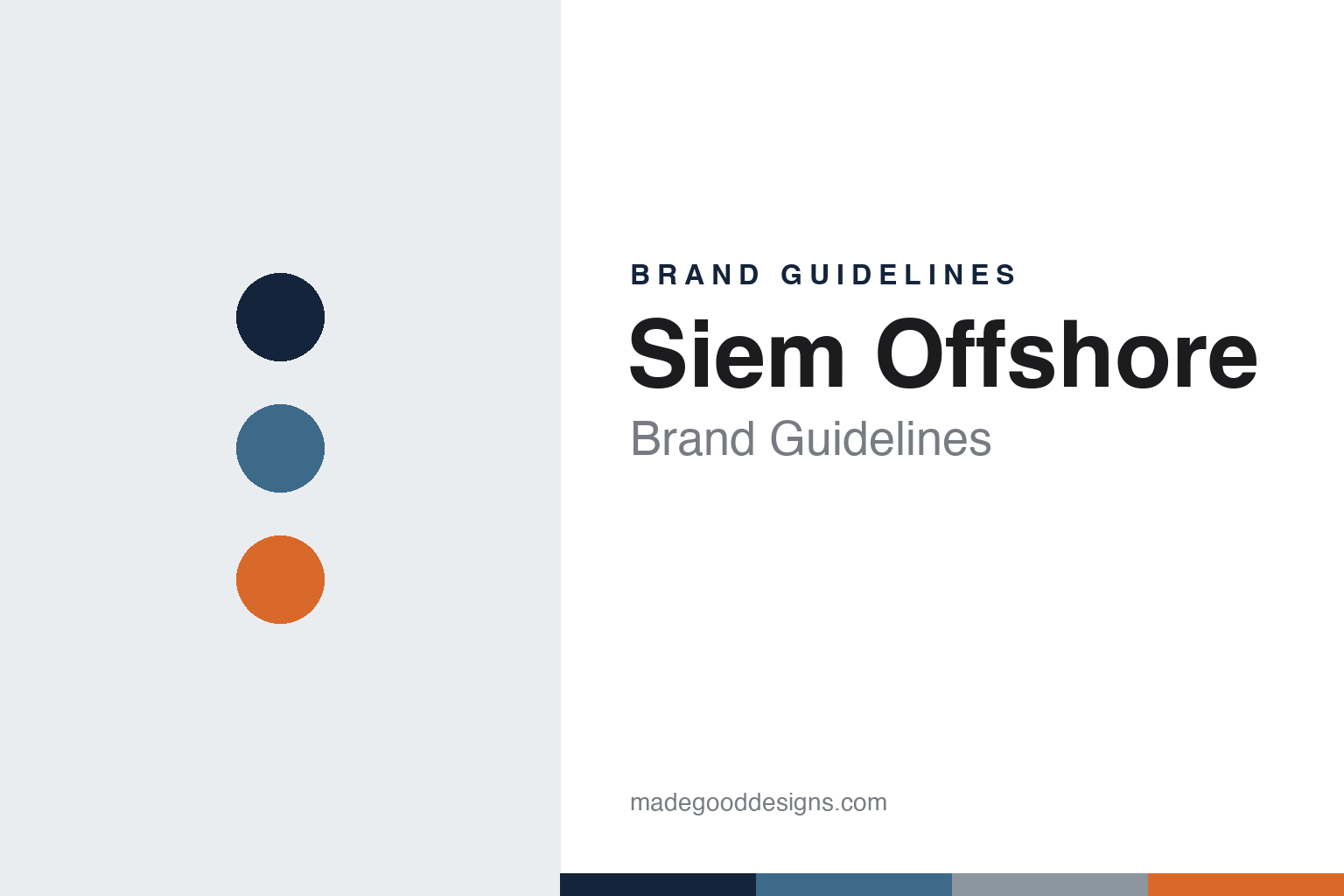
Siem Offshore Brand Guidelines
The Kristiansand vessel owner that dropped its founder’s name in 2024.
Aa
Two constants: a navy, steel blue and orange palette and a technical sans register. Abstract homage — not a Siem Offshore or Sea1 Offshore vessel or mark; no logo, funnel mark or hull livery is reproduced.
A Subsea 7 spin-off
A Kristiansand office and a Cayman registration.
Siem Offshore began on 1 July 2005, when it was set up as a spin-off from Subsea 7, according to English Wikipedia. The company was registered in the Cayman Islands, with its main offices in Kristiansand, on Norway’s southern coast. Its founder and chairman was Kristian Siem, MarineLink reported in 2024, and Wikipedia lists his investment company, Siem Industries, as its largest owner.
Growth came quickly. In September 2005 the new company bought Rovde Shipping, Wikipedia says, and it then ordered a long run of new vessels: platform supply vessels, anchor handling tug and supply vessels, offshore subsea construction vessels and well intervention vessels. A Brazilian subsidiary, Siem Consub, also known as Siem Offshore do Brasil, ran further ships off the Brazilian coast.
In 2011 the company moved into contracting. It bought Five Oceans Services and renamed it Siem Offshore Contractors, a business that installed, repaired and maintained subsea cable systems, with a regional focus on renewable energy in Europe and on oil and gas in the Middle East, according to Wikipedia. The shares traded on the Oslo stock exchange under the ticker SIOFF.
Colour
A fleet that carried the family prefix.
For most of its life the fleet was the brand. Wikipedia’s summary of the company lists platform supply vessels, anchor handling tug and supply vessels, multipurpose field and ROV support vessels, offshore subsea construction vessels, well intervention vessels, scientific core drilling vessels and crew transport vessels. Each ship carried the family prefix: a photograph on the same page shows the platform supply vessel Siem Symphony near Stavanger, and others moored at Risør bear names such as Siem Diamond and Siem Pearl.
Two ships show how long a single charter could run. Siem Helix 1 and Siem Helix 2, well intervention vessels built in 2016, have worked with the Houston contractor Helix Energy Solutions since they were delivered. In February 2024 the two companies signed new six-year contracts, starting on 1 January 2025 and 1 January 2026, with options to extend each by up to five years, MarineLink reported. Siem said the vessels could handle production enhancement, well decommissioning, subsea installation, offshore crane and ROV work.
The late 2010s were difficult for offshore vessel owners, and Siem Offshore sought a restructuring of its debt, citing a prolonged downturn in the offshore market. In January 2021 The Maritime Executive reported that the company had reached terms with its European banks and had called bondholders to a meeting in February to approve a plan under which much of its bond debt would be turned into shares. Existing shareholders, including Kristian Siem, were expected to hold about 4 percent of the company afterwards and Siem Industries about 30 percent, while talks with its Brazilian lenders, BNDES and Banco do Brasil, were still going on. The terms also extended the maturity of secured loans falling due before the end of 2024, the magazine reported, and the company said it was exploring ways to complete the restructuring even without the Brazilian banks’ agreement.
Typography
Design and documentation.
Offshore support vessel operators present themselves first through their ships. A fleet is usually painted in one house scheme, with a strong hull colour such as red, blue or orange, a mark on the funnel and a shared naming prefix, so that a client, a port or another crew can tell whose vessel is working a field. In Norway the prefix habit is easy to see: DOF’s ships sail as Skandi vessels and Solstad’s as Normand vessels.
On the web, the core of most operator sites is the fleet list. Vessels are sorted by type — platform supply vessels that carry cargo, fuel and water out to installations, anchor handling tug supply vessels that tow rigs and set moorings, and construction support vessels with cranes, large decks and remotely operated vehicles — and each ship usually has its own specification sheet listing deck area, crane capacity, berths and equipment, often as a downloadable file.
Beside the fleet sit pages on services. Many operators now describe work for offshore wind as well as for oil and gas, and many offer subsea services such as inspection, repair and maintenance, survey and ROV work, sometimes through a sister company or a subsidiary with its own name. Contract announcements, usually naming the vessel, the client region and the length of the charter, keep those pages moving.
Because many of these companies are listed, the annual report and the quarterly results presentation are part of the identity too, and in a sector shaped by mergers, restructurings and fleet sales, the company story page often carries the history. For a designer, the useful material is consistent: hull colours, funnel marks, vessel names, clear fleet tables and sober corporate typography.
Aa
A technical sans for a fleet company. (Specimen set in IBM Plex Sans, a sans STAND-IN; NOT the Siem Offshore or Sea1 Offshore logo.)
Sea1 Offshore
A new name on the same hulls.
The Siem name left the company in 2024. Kristian Siem stepped away after agreeing to take nine vessels in exchange for his 35 percent stake, and the company changed its name to Sea1 Offshore Inc., with effect from 7 May 2024, MarineLink reported. The company said it would begin removing the Siem prefix from the names of its vessels and subsidiaries, and that its Oslo ticker would change from SIOFF to SEA1.
The renamed company kept ordering ships. In November 2024, The Maritime Executive reported, Sea1 ordered two offshore energy support vessels from COSCO Shipping in China, each about 120 metres long with a 250-tonne deck crane, an ROV hangar and a moonpool, on the ST-245 design by Norway’s Skipsteknisk, for delivery in 2027. Chief executive Bernt Omdal said charter contracts and rates were rising, and the company said the ships were designed for a wide range of work, including offshore wind. Once they arrive, Sea1 said, it will own 19 vessels. It also ended, from April 2025, its management of the nine ships sold to Siem, and signed management agreements for six anchor handlers owned by Viking Supply Ships. Its website, now at sea1offshore.com, gives a fleet of 23 vessels, about 800 employees and offices in Norway, Canada, Australia and Brazil, and its research page names the scientific drilling vessel JOIDES Resolution.
The Siem family name carries on in a separate business. In October 2026 Siem Industries ordered two offshore subsea construction vessels from Fujian Mawei Shipbuilding, for delivery in 2029 and 2030, Inspenet reported. Each is to be about 145 metres long, with a 400-ton subsea crane and a second 50-ton crane, both with active heave compensation, on a design by Sirius Design & Integration.
For a design guide, Siem Offshore shows what happens to a fleet identity built on a founder’s name when the founder leaves: hulls, subsidiaries and a stock ticker all have to be renamed. Compare Subsea7, the contractor it was spun out of, and Helix, the long-term charterer of its Siem Helix pair. For this guide we use a deep navy, a steel blue and a signal orange with a sans, an unofficial interpretation; no product or logo is reproduced.
Explore & save
Keep Siem Offshore’s identity on hand — save it to a board in the Made Good inspiration library.
Siem Offshore identity set
Pin the Siem Offshore navy, steel blue and orange palette and the technical sans register to your own board.