ClassNK Brand Guidelines
The 1899 Tokyo association that became Japan’s class society.
Aa
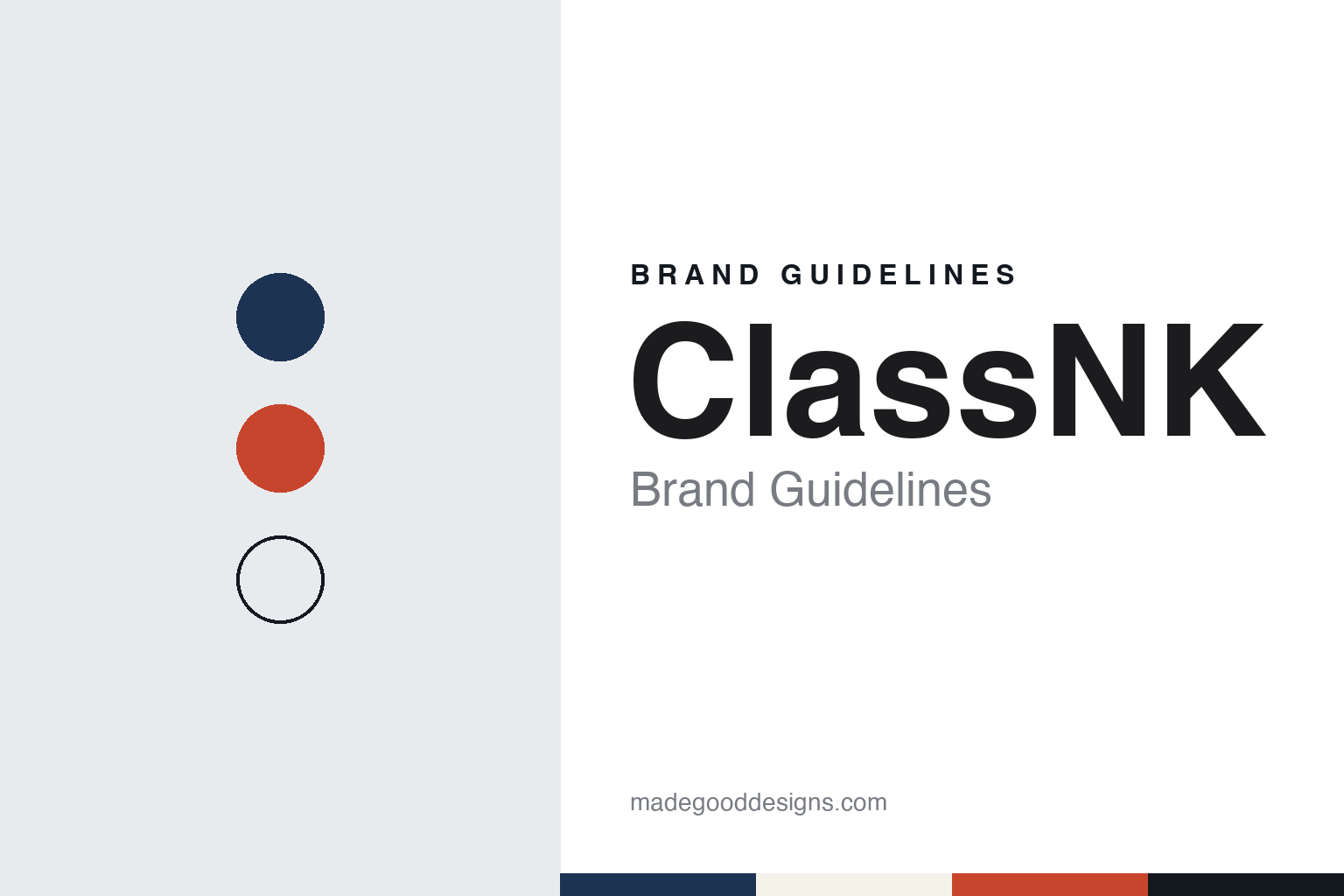
Two constants: a ClassNK navy, vermilion and paper palette and a Technical sans register. Abstract homage — not a ClassNK mark; no logo, notation or certificate is reproduced.
Teikoku Kaiji Kyokai
A Tokyo association of 1899.
ClassNK is the brand name of Nippon Kaiji Kyokai, Japan’s ship classification society. Its origins go back to November 1899, when the Teikoku Kaiji Kyokai, which the society renders in English as the Imperial Marine Association, was founded in Tokyo to promote the regulation and development of Japan’s shipping and shipbuilding industries, according to the society’s history page. A 2019 history written by two ClassNK staff for the Journal of the JIME, the journal of the Japan Institute of Marine Engineering, says 76 promoters backed the founding, among them the industrialist Shibusawa Eiichi and Takahashi Korekiyo; Prince Arisugawa Takehito was its first president and Vice-Admiral Arichi Shinanojō its first chairman.
The early association was much broader than a class society. The JIME article says its work took in insurance, ports, hydrography, maritime education and marine inquiries.
Classification grew step by step. Ship inspection rules were published in 1903, a classification department was set up in 1915, and in 1919 the association joined the American Bureau of Shipping, Italy’s RINA and Britain’s British Corporation, later merged into Lloyd’s Register, in a group of four societies. The first ship it classed, in 1920, was the cargo ship Kwanan Maru, built at the Uraga dock. Steel-ship rules followed in 1921 and the first Register Book in 1924. In 1926 its class notation, NS*, was recognised in the classification clause of the Institute of London Underwriters, and the Ship Safety Law of 1934 made the association Japan’s official classification society. It has been a foundation since 1936, the JIME article says.
The Second World War broke that international standing. During the war, the society’s Japanese history page says, foreign underwriters’ associations withdrew their recognition of its class, a heavy blow. The association was renamed Nippon Kaiji Kyokai, the Japan Marine Association, in 1946, and in 1952, after the San Francisco Peace Treaty took effect, NS* was again recognised by foreign underwriters.
Colour
Rules, surveys and a short name.
A classification society writes technical rules for ships and checks, through plan approval and surveys, that ships are built and kept to them. Nipponica, Shogakukan’s encyclopedia, describes the NK register as a book of ship particulars, and says a ship stays in class through periodic surveys every four years and annual intermediate surveys. English Wikipedia lists ClassNK’s present services as class surveys, statutory surveys and certification on behalf of flag states under international conventions, audits of ship managers under the ISM Code, ISO 9000-series and ISO 14001 management-system certification, and consulting for marine and non-marine projects.
Growth after 1952 followed Japan’s shipbuilding. The society’s history page says its register passed 10 million gross tons by 1966 and 100 million by the end of 1997, and that offices in London and New York, opened in 1962, began a network of exclusive survey offices abroad. The JIME article lists ships it classed along the way, including the Kinkasan Maru, built with a separate engine control room for remote running of the main engine; the Hakone Maru, which the article calls Japan’s first full container ship; and the Sakigake, which it calls Japan’s first LNG-fuelled ship. Nippon Kaiji Kyokai was a founding member of the International Association of Classification Societies when it was set up in 1968, and says it has chaired the association four times.
The name in everyday use changed in 1992. The society had long been called “NK” for short; in 1992, the JIME article says, it adopted the common name ClassNK and its logo mark, both still in use. Its legal form changed on 1 April 2011, when it became a general incorporated foundation under Japanese law, and the society describes itself as an impartial third party and a not-for-profit foundation.
Publications are part of its public face. Japanese Wikipedia lists its annual reports from 1962, ClassNK Magazine from 1994 and the ClassNK Technical Bulletin among open-access holdings in the CiNii research index, and the society’s website now carries a ClassNK Technical Journal alongside its rule books and guidance.
Typography
How classification societies present themselves.
A classification society’s output is mostly rules, surveys and certificates, and its identity tends to draw on marks of approval, dates and documents. Lloyd’s Register says its surveyors have stamped an LR mark into steel since 1884 and that its 2021 logo is a reading of that stamp in a colour it calls marine green; the American Bureau of Shipping’s eagle and anchor still sit on top of 65 Broadway in New York, its headquarters from 1977 to 1986, according to Wikipedia. Founding years — 1760, 1862 — appear prominently on both societies’ websites.
The websites themselves are working tools as much as shop windows. Lloyd’s Register lists its rules and regulations, an “LR Ships in Class” search, an office and port finder and an e-certificate verification portal; ABS offers a Rule Manager, the ABS Record database of classed vessels and certificates, and databases of type-approved products and service suppliers.
Much of the work now reaches beyond ships. Lloyd’s Register says it first inspected refrigerated cold stores in 1911 and later worked in nuclear power, oil and gas; ABS describes independent certification for marine and offshore products, materials, equipment and containers. Both societies have set up or spun off separate businesses for training, software, management systems and consulting.
They also publish heavily. Lloyd’s Register lists research reports, regulatory updates, podcasts and webinars; ABS lists regulatory news, advisories and an annual review. This guide sets out what can be checked about each society — when it was founded, how it is owned and how it presents itself — and marks clearly what rests on the society’s own word.
Aa
A technical sans for a rule-book society. (Specimen set in IBM Plex Sans, a sans STAND-IN; NOT the ClassNK logo.)
ClassNK today
A register past 200 million gross tons.
Today’s register is large. The JIME article gave about 9,000 ships and about 250 million gross tons at the end of September 2018, around a fifth of the tonnage classed by the major societies, with about 130 offices worldwide. ClassNK announced on 28 May 2012 that its register had passed 200 million gross tons, saying no class society had reached that mark before. Japanese Wikipedia says about eight in ten ships on the register fly flags other than Japan’s.
Its work now reaches past ships. The society’s website lists services including ISO management-system certification, cyber-security management-system certification, verification under the EU and UK MRV rules, renewable-energy work and inspections of unmanned aircraft; Japanese Wikipedia notes that it is a designated testing body for drone pilot certification. In October 2026 MarineLink reported that ClassNK had released the second edition of its Guidelines for Cyber Security Management System for Ships, restructured with reference to ISO/IEC 27001 and 27002 and mapped to the cyber requirements of major vetting schemes; the first edition appeared in 2019.
The headquarters are in Chiyoda, Tokyo, Japanese Wikipedia says, with a research and information centre in Chiba. The website runs in Japanese, English and simplified Chinese, and its menus lead to rule books, a Register of Ships search, approval lists and free publications.
For a design guide, ClassNK shows how a technical body can carry an 1899 history under a short modern name: the NS* notation, the 1946 name and the 1992 ClassNK mark sit side by side. Compare Korean Register, the Korean society founded in 1960, and DNV. For this guide we use a deep harbour navy, a vermilion and warm paper with a sans, an unofficial interpretation; no product or logo is reproduced.
Explore & save
Keep ClassNK’s identity on hand — save it to a board in the Made Good inspiration library.
ClassNK identity set
Pin the ClassNK navy, vermilion and paper palette and the Technical sans register to your own board.