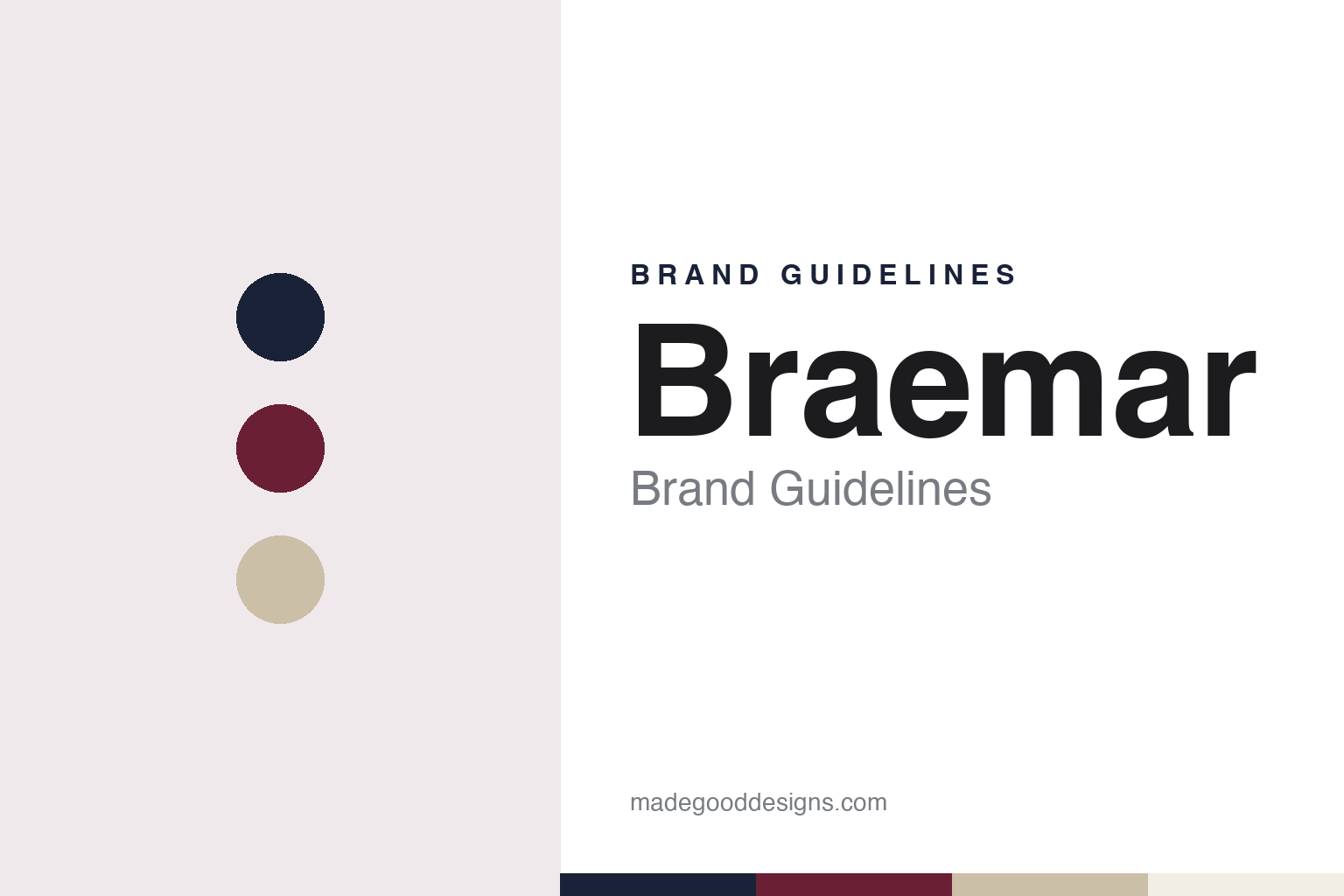
Braemar Brand Guidelines
A 1971 London shipbroker, two mergers and a 2022 name.
Aa
Two constants: a Braemar claret, navy and stone palette and a book serif register. Abstract homage — not a Braemar product or mark; no logo or wordmark is reproduced.
Braemar Shipbrokers
A 1971 London broker and two mergers.
Braemar dates its business to 1971, when Braemar Shipbrokers was founded in London, specialising in the sale and purchase of ships and in tanker chartering, according to the company’s own history. That history describes the founding as the start of what would become a wider maritime services group.
The modern company took shape through a merger. Braemar says that in 2001 Braemar Shipbrokers combined with Seascope Shipping Holdings PLC to create Braemar Seascope Group PLC. The joined name stayed in use for more than a decade: in January 2013 the research director of Braemar Seascope spoke on the newbuilding market at a Marine Money conference, The Maritime Executive reported. Between 2006 and 2011, the company says, acquisitions including DV Howells, Steege Kingston and BMT Marine & Offshore Surveys took it into environmental response, technical consultancy and offshore services.
A second merger followed in 2014, with ACM Shipping Group PLC, which Braemar says formed Braemar ACM Shipbroking. In 2017 it bought NAVES Corporate Finance GmbH, which it says extended its reach into maritime investment banking and advisory work, and in 2018 it acquired Atlantic Brokers Ltd, a commodity derivatives broker. After that, the company says, it realigned the group around its core shipbroking and financial advisory divisions.
Colour
A new name in 2022 and desks from Florida to Singapore.
The listed company changed its name from Braemar Shipping Services Plc to Braemar Plc on 14 September 2022, after shareholders approved the change at the annual general meeting on 19 August 2022, according to the company’s regulatory announcement of that day. The new name took effect on the Main Market of the London Stock Exchange on 15 September 2022, and the ticker, BMS, stayed the same. City AM described Braemar in September 2024 as a London-listed firm and “one of the largest shipbrokers in the UK.”
Recent growth has come in the Americas and southern Europe. In December 2022 Braemar announced the acquisition of Southport Maritime, a US tanker broker, gCaptain reported; its 18-strong team was to work alongside Braemar’s existing tanker desks in London, Singapore, Madrid, Houston and Geneva, from offices in West Palm Beach and Winter Park, Florida, while keeping the Southport Maritime name. Southport’s founders said they had started the firm thirty years earlier to give customers timely market intelligence. In 2023, Braemar says, it brought Madrid Shipping Advisors, a chartering and commercial shipping advisory business, into the group. It also says it has opened its first African office, in Cape Town.
The company describes itself as a shipbroking and securities group serving the shipping and energy markets. Its chartering pages are split by market, among them deep-sea tankers, dry cargo, LNG, and LPG and petrochemicals, with containers, offshore and sale and purchase alongside; a securities arm brokers freight futures for tankers and dry cargo, as well as natural gas and coal. Braemar says it has 20 offices in 14 countries and 388 employees, with its head office in London, and that it works 24 hours a day, seven days a week.
The securities arm and corporate finance team are presented as part of the same offer. Braemar lists desks for tanker and dry freight futures, natural gas, financial and physical coal and cross-commodity options, and a corporate finance service next to its research team. In its strategy update the company says it hired 16 brokers in the year, opened the Cape Town office and centralised tanker claims work into two centres, one in Europe and one in Asia, with round-the-clock coverage.
Typography
How shipbroking houses present themselves.
Shipbrokers arrange charters and ship sales rather than make products, and their websites lean on age, reach and research. Many London houses put a long founding date close to the name: Clarksons traces its business to 1852, and Braemar counts more than fifty years since its 1971 start. This guide reads the category through a sober register of navy, deep red and stone with plain wordmarks, an unofficial interpretation rather than any firm’s own colours.
The websites tend to be organised by market. Clarksons and Braemar both split their chartering pages into desks for tankers, dry cargo, gas and containers, with sale and purchase alongside, and both run derivatives teams that trade freight futures. At Clarksons, offshore and renewables appear as further desks, so a visitor can go straight to the market they trade.
Research is the second pillar. Clarksons runs Clarksons Research as its own business line, with data platforms sold by subscription, while Braemar keeps a research team next to its broking desks and a news and insights section. Market reports, forecasts and conference talks give these firms a public voice between deals, and trade publications such as gCaptain and The Maritime Executive have reported their outlooks and results.
Office maps and careers pages complete the picture. Clarksons says it has more than 70 offices in 26 countries, and Braemar lists tanker desks from London and Madrid to Houston, Geneva and Singapore. Both publish trainee broker programmes for graduates and newcomers, and Clarksons adds summer internships in London and Oslo. The guides that follow look at how each house presents its history, its markets and its people.
Aa
A sober book serif for a London shipbroker. (Specimen set in Source Serif 4, a serif STAND-IN; NOT the Braemar logo.)
Braemar
Experience, insight and one short name.
The company’s own pages stress experience. The about page counts “50+ years of experience,” and the history page closes on the line “Built on experience. Driven by insight.” The strategy section groups the plan under “people, performance and progress” and three pillars it calls operational excellence, diversification and consolidation. A research team, a News & Insights section and an investor centre sit next to the broking desks, and the careers pages carry a Trainee Broker Programme and a page on culture, values and benefits.
Market research has long been part of that offer. At the Marine Money conference in January 2013, The Maritime Executive reported, Braemar Seascope’s research director told delegates that newbuilding prices tended to follow demand, with input costs only setting a floor, called 2012 the peak delivery year for shipyards since the mid-1970s, and argued that the industry had far more shipbuilding capacity than it needed. The history page also shows a house built by joining others: Seascope and ACM each left their name on the group for a time before the single word Braemar became the listed company’s name in 2022.
For a design guide, Braemar shows how a shipbroker formed by mergers can settle on one short name and present every market under it. Compare Clarksons, the London broking group founded in 1852, and Gibson, another London shipbroking house. For this guide we use a deep claret, a dark navy and a warm stone with a serif, an unofficial interpretation; no product or logo is reproduced.
Explore & save
Keep Braemar’s identity on hand — save it to a board in the Made Good inspiration library.
Braemar identity set
Pin the Braemar claret, navy and stone palette and the book serif register to your own board.