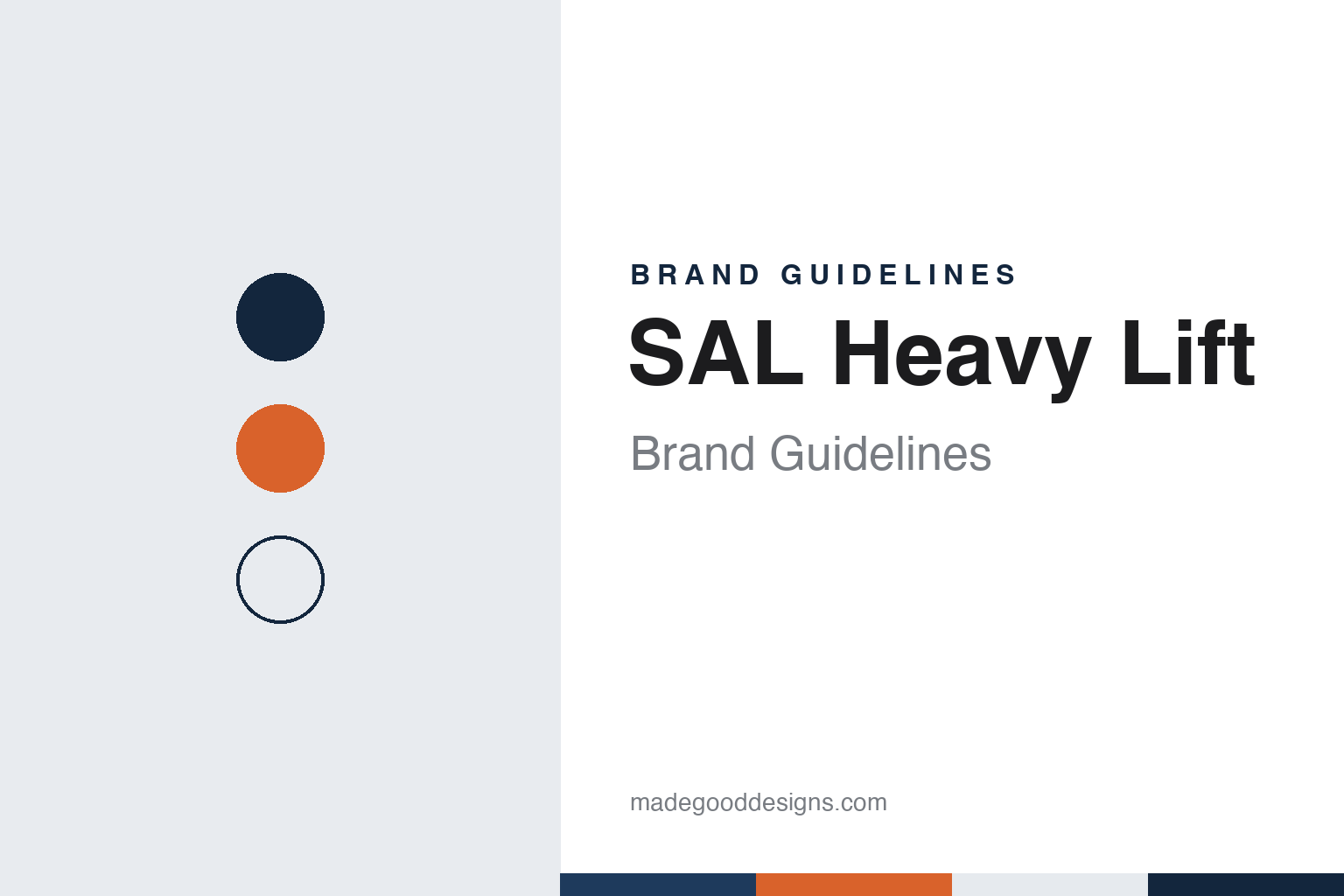
SAL Heavy Lift Brand Guidelines
A family shipping office from the Altes Land that grew into one heavy-lift name.
Aa
Two constants: a navy, orange and steel-grey palette and an industrial sans register. Abstract homage — not a SAL vessel or mark; no ship, logo or livery is reproduced.
Schiffahrtskontor Altes Land
A family shipping office near Hamburg.
SAL began in 1980, when Hans Heinrich founded the shipping company in Steinkirchen, in the Altes Land on the southern bank of the Elbe near Hamburg, German Wikipedia says. The three letters stand for Schiffahrtskontor Altes Land, literally the “Altes Land shipping office,” and Heinrich ran the business with his brother Claus until 2011. The company’s own website describes those beginnings as “a family-run venture in Steinkirchen, just outside Hamburg.”
Its ships were built close to home. German Wikipedia says SAL worked with the J. J. Sietas yard in Hamburg-Neuenfelde on heavy-lift series including Types 132, 161, 176 and 183, most of them planned for heavy cargo and fitted with cranes from Neuenfelder Maschinenfabrik. The two Type 183 ships, Svenja, delivered in December 2010, and Lone, delivered in March 2011, gave the fleet cranes with a lifting capacity of up to 2,000 tonnes, the encyclopaedia says. SAL’s own timeline marks the 1990s as the decade in which it opened new trade lanes and widened its footprint, and 2001 as the year a new generation of heavy-lift vessels arrived. In September 2026 SAL said its office in China, its first outside Germany, was celebrating 25 years.
Ownership changed twice. In 2007 SAL formed a joint venture with the Japanese shipping line “K” Line, which took full control on 30 June 2011. Early in 2012 the company was renamed SAL Heavy Lift GmbH, and in 2013 it moved its head office from Steinkirchen to Hamburg’s HafenCity and began offshore work, according to German Wikipedia. In July 2017 the business was sold to the Bremen shipping group Harren & Partner, which was founded in 1989 and renamed Harren Group in May 2023. SAL then took over the operation of Harren’s CL 900 heavy-lift ships and its Combi-Dock vessels, and an engineering company, SAL Engineering, was set up in Hamburg as a sister firm the same year.
Colour
Five ship groups, two cranes and an alliance.
SAL’s website sorts its fleet into five groups — Heavy Lift, Multipurpose, Offshore, Heavy Transport Vessel and Bulker — with a downloadable fleet list and a separate page for newbuildings. Its services run from heavy lifting and transport to multipurpose and dry-bulk shipping, offshore installation, an Americas liner service and engineering. The homepage line is “Moving what matters,” and it describes the range of cargo it carries as running “from a motorcycle to a refinery.” In May 2026 it added the SAL Atlantic Service, a semi-liner route linking Europe, the Americas and Africa.
The newest ships are the Orca Class. Breakbulk.News reported in September 2026 that SAL first contracted the Wuhu Shipyard in China in 2022 for four firm vessels plus two options, one of which was later taken up, making five. The ships are about 150 metres long with a deadweight of around 14,600 tonnes, and each carries two fully electric Liebherr LS 800 E cranes rated at 800 tonnes, which can work in tandem on loads of up to 1,600 tonnes. The magazine said the class combines hybrid propulsion with a design intended for future methanol use.
The first ship, Elise, was christened in Hamburg on 6 November 2025, SAL says, and the second, Frida, joined the fleet in March 2026 after a christening in Esbjerg. The third, Patricia, was delivered in June 2026; its first voyage carried Vestas wind-energy equipment from Vietnam and China to the Netherlands and Finland, and it was christened on 31 August 2026 at Liebherr’s maritime crane plant in Rostock, Breakbulk.News reported. Two more, Carlotta and Vera, complete the series. On 3 September 2026, at the SMM fair in Hamburg, SAL and Wuhu signed a memorandum of understanding for five further ships of the same size; it was agreed in September 2026 and had not become a firm order at the time of writing.
Partnerships widen the fleet. In 2018, German Wikipedia says, SAL and the Dutch company RollDock agreed to run their dock ships in a shared pool, and in October 2020 SAL took a majority stake in Intermarine, a liner operator serving North and South America. SAL says it formed the Jumbo-SAL-Alliance with the Dutch carrier Jumbo Shipping in 2021, and that the partnership became the JSI Alliance in 2024 when Intermarine joined, bringing together more than 50 vessels.
Typography
How heavy-lift carriers present themselves.
Heavy-lift and project-cargo carriers sell something that is hard to show before it happens: the movement of a single object too large or too heavy for a container. Their websites lean on photographs of their own ships and cargo instead, heavy-lift vessels with paired cranes, decks loaded with modules, port cranes or offshore structures, published by the companies themselves as records of past voyages.
Colour carries much of the identity. Company names are painted large on hulls and crane booms, and across this sector the wordmarks often appear in strong orange, blue or red against white superstructures and dark hulls, so that they read from a quayside or in an aerial photograph. The same few colours then tend to run through the livery, the website and the printed material.
Fleet pages sit at the centre of these sites. Ships are grouped by class and described by crane capacity, deck area and deadweight: Jumbo lists its vessels as K3000, J1800 and H800 classes, and BigLift divides its fleet into heavy-lift types and heavy transport vessels such as the MC-Class. Engineering and transport services, from stowage planning to ship-motion analysis, are presented beside the fleet as a second product.
The rest of a typical site is evidence and reach: project-reference galleries sorted by market, from mining to offshore energy and port development; customer magazines and news of ships on order; and office maps showing sales and agency networks across several continents. This guide sets out what can be checked about each company, its founding, its ownership and its fleet, and marks clearly what rests on the company’s own word.
Aa
An industrial sans for a carrier of cranes and modules. (Specimen set in Archivo, a sans STAND-IN; NOT the SAL logo.)
One name: SAL
Heavy lift, liner and engineering under one brand.
The brand itself was redrawn in 2025. Heavy Lift & Project Forwarding International reported on 4 November 2025 that SAL Heavy Lift and Intermarine, both part of the Harren Group, were bringing their liner, tramp, offshore and engineering services under one name, SAL. SAL Heavy Lift, SAL Engineering, SAL Offshore, Intermarine and Intermarine Bulk Carriers were folded into the new structure. Intermarine became SAL Intermarine, keeping its focus on liner services across the Americas, while SAL Engineering stayed the technical arm for project design, seafastening and on-site supervision. The magazine put the fleet at nearly 80 vessels under operation or commercial management, and around 90 when the JSI Alliance platform is counted.
SAL’s own timeline calls 2025 “a new era,” with a refreshed identity built around the phrase “Limitless Commitment.” Its About page sets out the company’s character under three headings, beginning “We are Skilled” and “We are Adaptive,” and says SAL employs more than 60 engineers and planners. The website carries the legal name SAL Heavy Lift GmbH & Co. KG, Hamburg, and links to sister businesses in the Harren Group, among them Harren Ship Management, Combi Lift and trans-Mar-supply. The older address, sal-heavylift.com, now forwards to sal.global.
For a design guide, SAL shows how a heavy-lift carrier can keep three letters from a village shipping office while turning them into an umbrella for liner, offshore and engineering work. Compare Jumbo, its alliance partner, and Hansa Heavy Lift, another Hamburg heavy-lift name. For this guide we use a harbour navy, a hook orange and steel greys with a sans, an unofficial interpretation; no product or logo is reproduced.
Explore & save
Keep SAL Heavy Lift’s identity on hand — save it to a board in the Made Good inspiration library.
SAL Heavy Lift identity set
Save the SAL navy, orange and steel-grey palette and the industrial sans register to your own board.