Royal IHC Brand Guidelines
A 1943 combination of six Dutch yards that became a builder of dredgers.
Aa
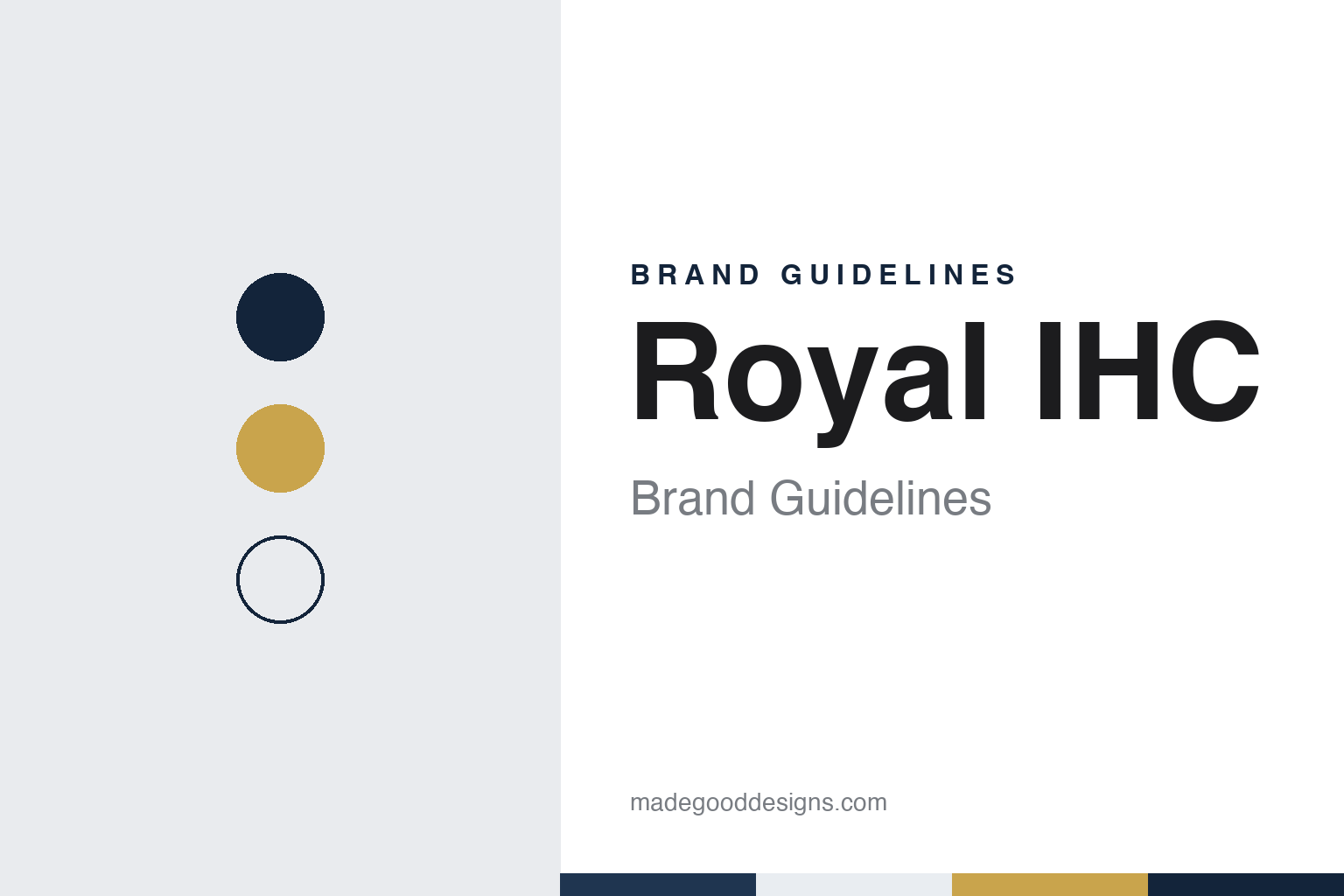
Two constants: a navy, gold and mist palette and an engineering sans register. Abstract homage — not a Royal IHC product or mark; no vessel, logo or crown is reproduced.
Six yards, one combination
A sales partnership of dredging specialists.
Royal IHC traces its company history to 1943, when six Dutch shipyards and engineering works that specialised in dredging equipment began to cooperate, Dutch Wikipedia says. They were Gusto in Schiedam, Conrad (by then called Stork-Hijsch) in Haarlem, J. & K. Smit and L. Smit & Zoon in Kinderdijk, Verschure in Amsterdam and De Klop in Sliedrecht. The partnership took the name Industriële Handels Combinatie, IHC for short, and was based in The Hague. Dutch Wikipedia, citing the National Dredging Museum, says it was not a merger: each firm stayed independent and still competed where no agreement had been made.
English Wikipedia, citing Algemeen Dagblad in 1958, links the idea to plans by the mining company Billiton for tin mining after the war, which no single yard felt able to equip alone, and to the cost of each small firm keeping its own sales agents abroad, as Trouw reported in 1947. The same firms had already set up a joint research cooperative for dredging machinery in January 1942, according to English Wikipedia’s article on J. & K. Smit, which cites a Dutch business paper of that month; the same article records that the Kinderdijk yard converted motor trawlers to steam trawlers during the war. The sources used for this guide do not say how the company’s predecessors operated during the occupation of 1940–1945.
The first large order came in July 1945: six tin bucket dredgers for Billiton, built under J. & K. Smit’s lead. Orders from Turkey and France followed in 1946 and 1947, and in 1960 a rock-breaking spoon dredger was delivered for the Suez Canal. In 1965 five of the members agreed to merge into the listed company IHC Holland, Het Parool reported; Conrad stayed out because it belonged to the Stork group. From 1969 the group’s single buoy mooring business grew into what is now SBM Offshore.
Colour
Standard dredgers, custom dredgers and a crown.
IHC’s name rests on dredging ships. English Wikipedia, citing a company history published for its 70th anniversary in 2013, dates the standard cutter suction dredger series called Beaver to 1963. In May 1983 a new yard opened in Sliedrecht to build such standard dredgers in series, while the Kinderdijk yard was designated for large custom ships, mostly trailing suction hopper dredgers, according to Dutch newspapers of the period cited by Wikipedia. In 1992 the Kinderdijk slipway was widened and lengthened for broader dredgers, Dutch Wikipedia says.
The standard-series idea continues. In October 2025 the Alblasserwaard paper Het Kontakt reported that Royal IHC would build a Beagle 8 trailing suction hopper dredger, with a hopper of 8,000 cubic metres, for India’s Vishwa Samudra Group at its Kinderdijk yard, with delivery expected in summer 2027; the paper describes Beagle as a platform of standardised hopper dredgers ranging from 4,000 to 12,000 cubic metres. In October 2026 DredgingToday reported that Royal IHC and Nauplius Workboats had agreed to develop a new heavy-duty workboat series to support Beaver dredgers on shallow inland waters, quoting a director of the unit it named IHC Dredging.
The company has also built for offshore energy. In 2013 it won an order for six pipe-laying ships for the Brazilian oil industry, described by Dutch Wikipedia as its biggest ever, delivered in 2015 and 2016. Dutch Wikipedia lists its fields today as dredging, offshore energy and mining, among others.
The identity changed with the title. In 2013 the company marked its 325th anniversary, and on 19 June 2014 it received the Dutch predicate Koninklijke, Royal, and changed its name from IHC Merwede to Royal IHC; a crown was added to the logo, according to English and Dutch Wikipedia.
Typography
Design and documentation.
Dredging and marine contracting is a business mostly seen from the shore. A trailing suction hopper dredger working a port channel, or a cutter suction dredger anchored off a reclamation site, is often the only public sign of a contractor, so the hull itself does much of the brand work: a strong field colour such as orange, red or blue, with the company’s wordmark painted large along the side so it reads from a quay or a news photograph.
The companies’ own websites tend to follow a shared pattern. Photographs of dredgers at work, as the firms publish them, sit beside fleet pages that sort the vessels by type, hopper dredgers, cutter suction dredgers, backhoe dredgers and support craft, each with a specification sheet of length, hopper capacity and dredging depth. Ship names are part of the identity too, whether a numbered series or a run of river and place names.
Project-reference pages carry the rest of the story. Rather than advertising, these firms describe what they have built or deepened: land reclamation, port deepening, channel maintenance, beach nourishment and coastal works, usually grouped by region or by type of work and illustrated with aerial views. Larger groups that also build roads, bridges and buildings sort a very mixed portfolio into categories so that a dredging job and a bridge contract sit side by side.
Because many clients are port authorities and governments, the most practical pages are often the plainest: tender notices, archives of completed contracts, investor and stock-exchange filings, and annual reports. For a designer, the useful lesson is how much of a marine contractor’s identity lives in operational material, vessel livery, fleet lists and contract pages, and how a restrained palette and a clear sans can hold that material together.
Aa
An engineering sans for a shipbuilder’s register. (Specimen set in Archivo, a sans STAND-IN; NOT the Royal IHC logo.)
Royal IHC
Splits, sales and a dredging consortium.
IHC’s ownership has changed many times. In the late 1970s Dutch shipbuilding was in crisis; the Gusto yard in Schiedam closed, and in October 1978 the listed company was split, its shipbuilding passing to a new private IHC Holland formed with the dredger builder Van Rees and with state investment, while the listed holding became Caland Holdings, according to English Wikipedia, citing NRC Handelsblad. The Verschure yard in Amsterdam closed in 1979. After a further reorganisation in 1988, IHC Caland became the sole owner in 1992 and bought the De Merwede yard in Hardinxveld in 1993.
On 1 March 2005 IHC Caland sold the shipyards and renamed itself SBM Offshore; the buyers were Rabobank Participaties, management and staff, and Parkland, part of the Indofin group, according to SBM’s 2004 annual report as cited by Wikipedia. The yards traded as IHC Holland Merwede and, from November 2007, as IHC Merwede. After heavy losses in 2018 on large projects, banks and shareholders put in new capital. A consortium then formed of Ackermans & van Haaren, owner of DEME, HAL, owner of Boskalis, the Van Oord family and the family behind Huisman Dredging, and in June 2020 it took over all of the shares, Dutch Wikipedia says, citing De Tijd. Royal IHC announced job cuts in November 2020 and sold non-core units in 2021.
Today Royal IHC is based in Kinderdijk, with further Dutch sites including Krimpen aan den IJssel and Sliedrecht, Dutch Wikipedia says; Het Kontakt named Derk te Bokkel as chief executive in 2025.
For a design guide, Royal IHC shows how a builder’s identity can be carried by named ship series, from Beaver to Beagle, and by a crown earned with the Royal title. Compare Damen, another Dutch shipbuilder from the rivers of South Holland, and Rohde Nielsen, a dredging contractor. For this guide we use a navy, a muted gold and a pale mist with a sans, an unofficial interpretation; no product or logo is reproduced.
Explore & save
Keep Royal IHC’s identity on hand — save it to a board in the Made Good inspiration library.
Royal IHC identity set
Save the Royal IHC navy, gold and mist palette and the engineering sans register to your own board.