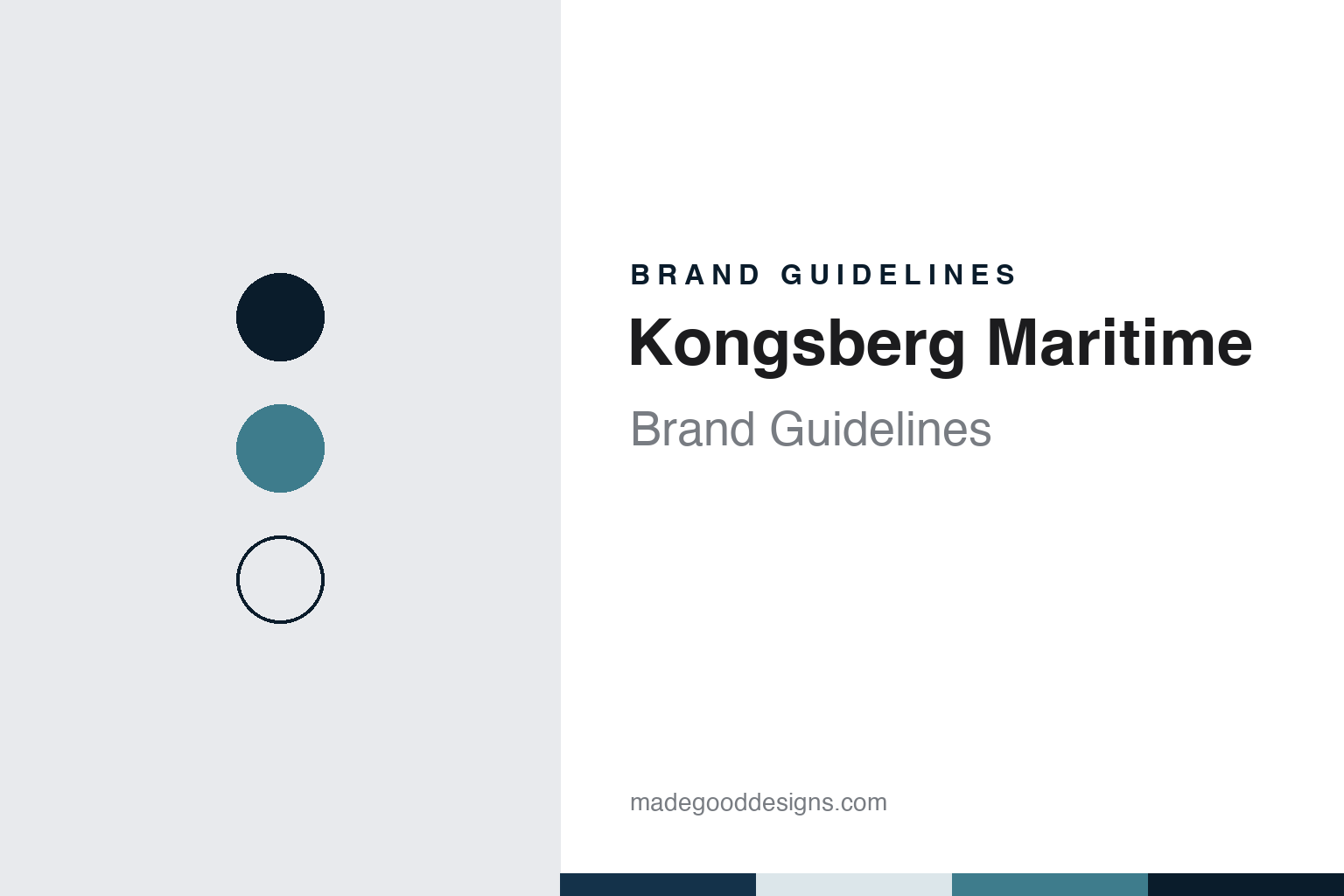
Kongsberg Maritime Brand Guidelines
From Simrad’s fishing-fleet radios to an independent listing in 2026.
Aa
Two constants: a Kongsberg Maritime navy and teal palette and an Engineered sans register. Abstract homage — not a Kongsberg Maritime product or mark; no logo, symbol or vessel is reproduced.
From Simrad to a listing
Several Norwegian firms under one name.
Kongsberg Maritime is a Norwegian maritime-technology company with its headquarters in Kongsberg, the old mining town south-west of Oslo. Since April 2026 it has been a separately listed company on Oslo Børs under the ticker KMAR. DNB Nyheter reported on 22 April 2026 that Kongsberg Gruppen was splitting off its maritime business that week through a demerger, with each shareholder receiving shares in the new company, and that trading in the shares would begin on Thursday 23 April. Until then Kongsberg Maritime had been one of the group’s business areas.
The company grew out of several older firms. Store norske leksikon describes it as a continuation of the Norwegian businesses Norcontrol, Simrad, Kongsberg Albatross, Autronica and Seatex, among others, with dates running from 1992 to 2000. The oldest of these maritime lines is Simrad: Norwegian Wikipedia says Simonsen Radio A/S was set up in Oslo on 31 December 1946 by the engineer Willy Simonsen to make radio telephones for the fishing fleet, took the name Simrad in 1957 when it opened an office in Horten, and has worked on echo sounders and sonars since 1953. Today the Simrad name is used for the company’s fishery and fish-research products.
The Kongsberg name itself is far older. Store norske leksikon says Kongsberg Våpenfabrikk was a state-owned firm founded in 1814 to make hand weapons for the army. During the occupation of 1940–1945, Norwegian Wikipedia’s article on the factory, citing the historian Christine Myrvang at Norgeshistorie.no, says production was restarted under German controllers from June 1940 and that the factory made weapons for the occupying power throughout the war, while output stayed well below what the occupiers demanded. After 1945, Store norske leksikon says, civilian products such as electronic navigation equipment came to outsell military goods. The firm ran into deep financial trouble in the 1980s and was wound up and split in 1987; its defence business went to the new Norsk Forsvarsteknologi, renamed Kongsberg Gruppen in 1995.
The largest step in the maritime business came with Rolls-Royce. Store norske leksikon says Kongsberg Maritime agreed in July 2018 to take over Rolls-Royce Commercial Marine, bringing in a large deck-machinery and propulsion business. Teknisk Ukeblad reported that the takeover was formally completed on Monday 1 April 2019, when 3,600 employees around the world changed employer and offices and workshops, including those in Ålesund, received new Kongsberg signs.
Colour
Positioning, propulsion and the whole vessel.
Store norske leksikon says the company is especially known for its systems for dynamic positioning of offshore vessels and rigs, which hold a vessel in place using its own thrusters, with more than 3,000 installations worldwide, and also names automation and monitoring systems, process automation, satellite navigation and hydroacoustics among its main fields. The encyclopaedia adds that it has offices and production in China with some 500 employees. English Wikipedia lists the HUGIN family of autonomous underwater vehicles among its products.
In its own words, the company now delivers propulsion, navigation, automation, ship design, digital solutions and lifecycle services, for customers in merchant shipping, offshore energy, cruise and ferries, fishing and ocean research. In a release dated 5 November 2026 it gave a workforce of 8,800 employees in 35 countries and said its systems are installed on more than 30,000 vessels, which it describes as “roughly one third of the world fleet.”
Propulsion has been the focus of its first months as an independent company. On 13 July 2026 Kongsberg Maritime announced an agreement to acquire the Swedish company Berg Propulsion, which it described as a designer and maker of integrated propulsion and electrical systems with a strong presence in general cargo ships and product tankers; Store norske leksikon, updated in October 2026, lists Berg Propulsion as bought during 2026. On 7 September 2026 it announced an agreement to acquire Steerprop, a Finnish designer and maker of azimuth propulsion systems for high ice-class and Arctic vessels, with an installed base of more than 400 vessels according to the release. That deal was subject to regulatory approvals: agreed in September 2026 and not completed at the time of writing. Until completion, the release said, both companies would continue to operate independently.
Typography
How marine equipment makers present themselves.
Marine equipment makers sell to shipyards, shipowners and operators rather than to the public, and their identities reflect that. Their marks have long histories of their own: Schottel’s square S has been in use since the 1980s, its centenary history says, and Becker Marine Systems introduced its present logo with its new name in 2001, by the company’s account. The palettes in this guide are our own interpretation, in sea-going blues with warm accents, and none is taken from a company’s files.
The products themselves carry much of the visual weight. Thrusters, rudder propellers, rudders, deck machinery and bridge systems appear in this guide only as the companies publish and describe them, and their scale is part of the story: a regional magazine described one Schottel drive in Wismar in 2021 as twelve metres long once assembled.
Products are presented by vessel type as well as by name. Schottel says its RudderPropeller is used in more than 120 vessel types, from harbour tugs to ferries and offshore ships, and Becker presents rudders, nozzles and steering gear as parts of a single manoeuvring system for a given ship. Service matters as much as sale: both companies describe networks of subsidiaries and offices across Europe, Asia and the Americas, and German Wikipedia lists fourteen Schottel sales and service companies, from Brazil to South Korea.
Newer pages cover data. Schottel lists condition monitoring and data platforms among its products, and Becker sells monitoring systems for steering and rudder bearings. Trade fairs remain a fixed point in the calendar: Becker’s own history records a meeting at Nor-Shipping in Oslo that changed its management in 2001, and in 2022 Schottel’s holding company announced an agreement there, a trade paper reported.
Aa
An engineered sans for a bow-wave mark. (Specimen set in Archivo, a sans STAND-IN; NOT the Kongsberg Maritime logo or typeface.)
Kongsberg Maritime
An abstract K, cutting through water.
On 5 November 2026 Kongsberg Maritime unveiled a new logo and the tagline “Beyond begins here.” The company called it its first independent visual identity since the demerger from Kongsberg Gruppen and the listing on Euronext Oslo Børs in April 2026. The symbol is an abstract K: the company says it draws on the bow of a ship cutting through the water and on several of its own products and technologies, and that the mark is meant to express both precision and motion. The identity was developed with TRY, which the release describes as a Nordic communications and design house. It is to be rolled out gradually across vessels, offices, trade shows and digital channels, with new signage at company locations from the second quarter of 2027.
The company’s communications chief said in the release that the aim was not to reinvent the brand but to bring a broad portfolio together under one clear expression, so that customers see one partner for the whole vessel and its lifecycle, from design and propulsion to automation and service. The release says the brand idea is rooted in more than 200 years of industrial heritage — a reference to the 1814 factory — and in the spirit of explorers of the oceans.
Readers searching the name should keep the Kongsberg companies apart. Kongsberg Gruppen remains a separate listed group after the 2026 demerger, and Store norske leksikon says other parts of the old factory continued in companies such as Kongsberg Automotive, which has no link to the ship business. The company’s own site is kongsbergmaritime.com.
For a design guide, Kongsberg Maritime shows how a company assembled from many older names can use a single new mark to announce its independence. Compare Wärtsilä, another Nordic maker of propulsion and ship systems, and Brunvoll, the thruster maker from Molde. For this guide we use a fjord navy and a sea teal with a sans, an unofficial interpretation; no product or logo is reproduced.
Explore & save
Keep Kongsberg Maritime’s identity on hand — save it to a board in the Made Good inspiration library.
Kongsberg Maritime identity set
Pin the Kongsberg Maritime navy and teal palette and the Engineered sans register to your own board.