Viridien Brand Guidelines
The former CGG, from 1931 Paris to a 2024 rename in Oslo.
Aa
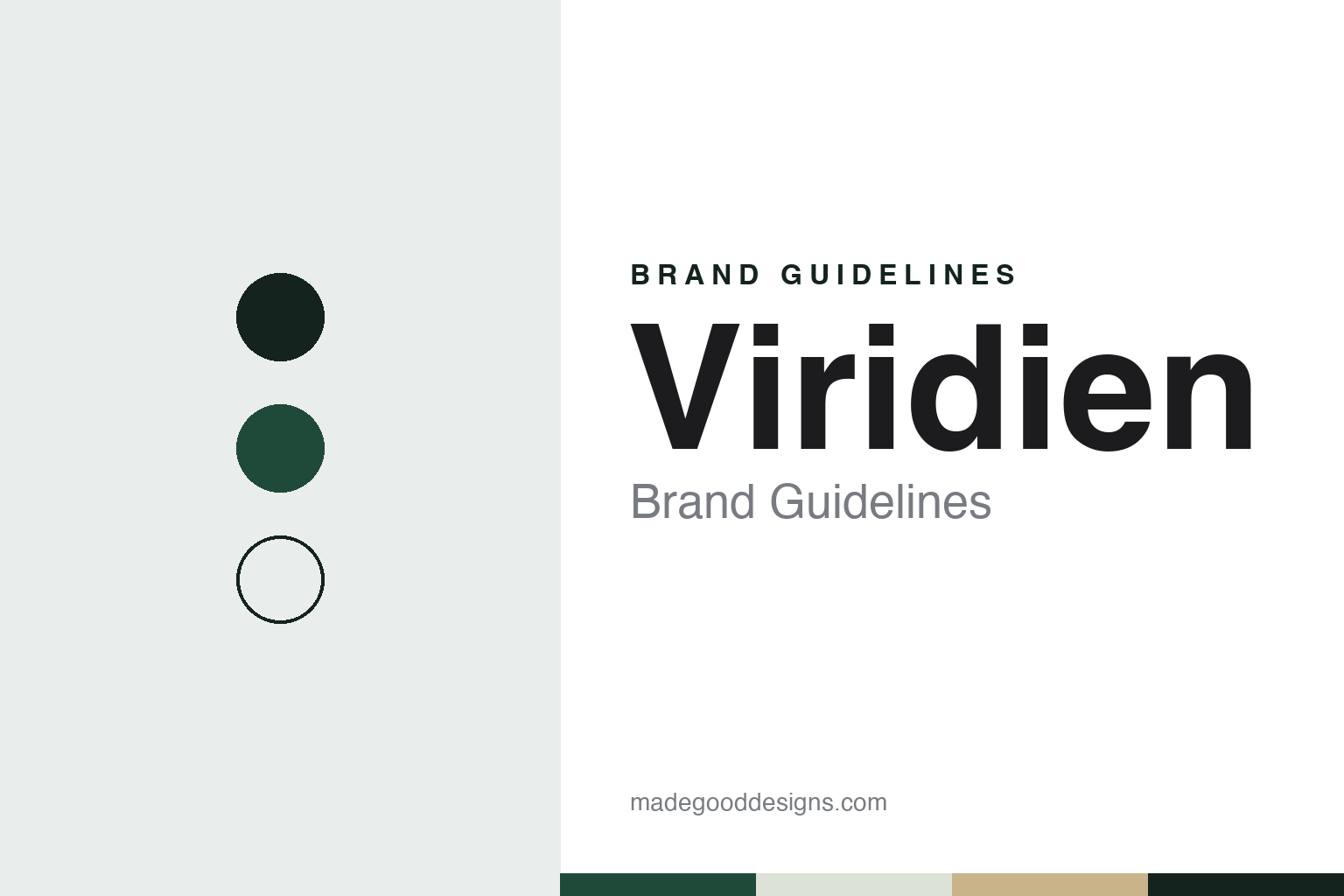
Two constants: a deep green, sage and sand palette and a geometric sans register. Abstract homage — not a Viridien product or mark; no seismic image, logo or nameplate is reproduced.
Compagnie Générale de Géophysique
A Schlumberger venture that took geophysics around the world.
Viridien is the newest name of one of the oldest companies in geophysical surveying. Its roots go back to 1926, when the brothers Conrad and Marcel Schlumberger set up the Société de Prospection Electrique (SPE) in France to look for oil, coal and civil-engineering ground conditions with electrical measurements. In March 1931, English and French Wikipedia say, SPE and the Société Géophysique de Recherches Minières combined their surface-survey work in a new company, Compagnie Générale de Géophysique, or CGG, while SPE kept the measurements made inside boreholes. GEO ExPro, the geoscience magazine, told the same story in 2011 from another angle: SPE had run into difficulty after the 1929 stock market crash, and CGG emerged from it, founded by Conrad Schlumberger in 1931.
The new company travelled far. By 1932 it was using geophysical methods to look for oil in West Africa, and within a decade it had survey teams in India, the Middle East, North America and Venezuela, GEO ExPro reported. The same article describes crews in Morocco and Gabon in the 1930s, where survey lines were cleared by hand through forest and shots were recorded on photographic film.
The Second World War was hard on the company. GEO ExPro wrote that, as with most companies in France, its staff was considerably reduced, but that it managed to carry on surveys until 1944, when the German occupying forces confiscated its equipment. After the Liberation, with encouragement from the new French government, CGG spread back around the world, especially into the Sahara, and its survey work grew quickly through the early 1950s. The Schlumberger family, which still held 47 per cent in 1953, had sold its holdings by 1960, the magazine said.
CGG built its reputation on technique. It bought its first computer, an IBM 604, in 1954; ran its first two-vessel marine survey in 1958; and opened its first seismic data processing centre at Massy, south of Paris, in 1966. In 1971 it experimented with an early form of 3D marine survey, wide-line profiling, by towing three parallel streamers. In 1981 it floated on the Paris Stock Exchange, and in 1994, according to GEO ExPro, it carried out the first 4D seismic surveys, returning to a surveyed area to add the dimension of time.
Colour
Veritas, Fugro and a lighter company.
The company that became Viridien was assembled from several lines. In North America, Digital Consultants was formed in Houston in 1965 by six engineers and geophysicists and became Digicon in 1969; Veritas Energy Services was set up in Calgary in 1974. GEO ExPro credits Digicon with deploying the first digital marine seismic streamer in 1979 and Veritas with processing the first 3D seismic survey in Canada in 1982. The two merged as Veritas DGC in 1996 and added the Hampson-Russell interpretation software group in 2005.
In 2007 CGG and Veritas combined as CGGVeritas. The group bought the Norwegian company Wavefield Inseis in December 2008, and in September 2012 it bought the geoscience division of Fugro and went back to the shorter name CGG, according to English and French Wikipedia.
A hard period followed. In June 2017 CGG opened safeguard proceedings in Paris under French law and chapter 11 proceedings in New York at the same time, the law firm Paul, Weiss, which advised CGG in the United States, said in February 2018. The United States Bankruptcy Court for the Southern District of New York recognised and enforced the French plan on 21 December 2017, and the restructuring was completed in February 2018, turning nearly all of the company’s unsecured debt into equity.
The company then changed shape. French Wikipedia says CGG announced in 2019 the sale of its fleet of five seismic vessels to Shearwater GeoServices, and English Wikipedia says that in 2020 it left seismic acquisition services altogether. From then on the business rested on its multi-client data, its geoscience and imaging services, and the equipment made by its subsidiary Sercel. In March 2022 it completed a sale-and-leaseback of its Galiléo head office building in Massy, French Wikipedia says.
Typography
How survey companies present themselves.
Seismic and geophysical survey companies sell something most people never see: an image of rock layers far below the ground or the seabed. Their websites therefore lean on pictures of the work itself. Survey vessels towing long streamer cables, land crews laying out sensors across desert or farmland, and vibrator trucks lined up on a survey line are the photographs these companies publish again and again, usually next to a coloured cross-section of the subsurface.
Those seismic-image samples do much of the visual work. A processed section, with its bands of colour and folded layers, shows what the company delivers far more quickly than a paragraph of text could. Multi-client data libraries, where a company surveys an area once and licenses the data to several clients, are usually presented through interactive maps and region pages, described in the terms each company chooses for its own library.
Equipment makers and node operators follow a slightly different pattern. Ocean-bottom node pages, land nodal systems and streamer products tend to appear as clean product shots against white or dark backgrounds, with named product lines and launch dates. Land-crew and field-service pages add maps, location lists and training or support offers. Many of these firms also present newer work in mining, geothermal, carbon storage and infrastructure monitoring alongside oil and gas.
Because several of the companies are listed, investor pages are a large part of the picture: results, governance documents and regulated information, laid out in the plain, orderly style that stock exchanges expect. Names change often in this sector, through mergers, renames and asset sales, so a company’s history page and its newsroom are usually the clearest record of who it is today and what it used to be called.
Aa
A clean geometric sans for a data company. (Specimen set in Manrope, a sans STAND-IN; NOT the Viridien logo.)
Viridien
A new name, revealed at EAGE in Oslo.
The name Viridien arrived in 2024. At the annual general meeting on 15 May 2024, shareholders approved changing the corporate name from CGG to Viridien, the company said, and the new brand was launched on 10 June 2024 at the EAGE Annual Conference in Oslo. Energy Connects reported in May 2024 that the logo would be revealed there. The company said the name “connects our company’s history to our future,” and presented itself as an advanced technology, digital and Earth data company.
The rename came with a wider portfolio. Viridien describes three core businesses, geoscience, Earth data, and sensing and monitoring, alongside newer work in minerals and mining and carbon storage, and in markets beyond energy such as high-performance computing and infrastructure monitoring. English Wikipedia groups this into two segments: data, digital and energy transition; and sensing and monitoring, which is Sercel. Its website invites visitors to search its multi-client seismic, geological and gravity and magnetic data on an interactive map. In November 2024 the group announced a restructuring plan at Sercel, French Wikipedia says.
Today Viridien is based in Massy and listed as VIRI on Euronext Paris. It says it employs around 3,500 people worldwide; GEO ExPro put CGGVeritas at more than 7,200 people in 70 countries in 2011, a measure of how far the company has narrowed its focus. Its website now speaks of “nine decades of innovation across five continents.”
For a design guide, Viridien shows how a long-established technical company can carry its history into a completely new name while its products, people and data library stay recognisable. Compare TGS, another company built around a seismic data library, and Sercel, Viridien’s own equipment maker. For this guide we use a deep green, a pale sage, a warm sand and an ink with a sans, an unofficial interpretation; no product or logo is reproduced.
Explore & save
Keep Viridien’s identity on hand — save it to a board in the Made Good inspiration library.
Viridien identity set
Pin the Viridien deep green, sage and sand palette and the geometric sans register to your own board.