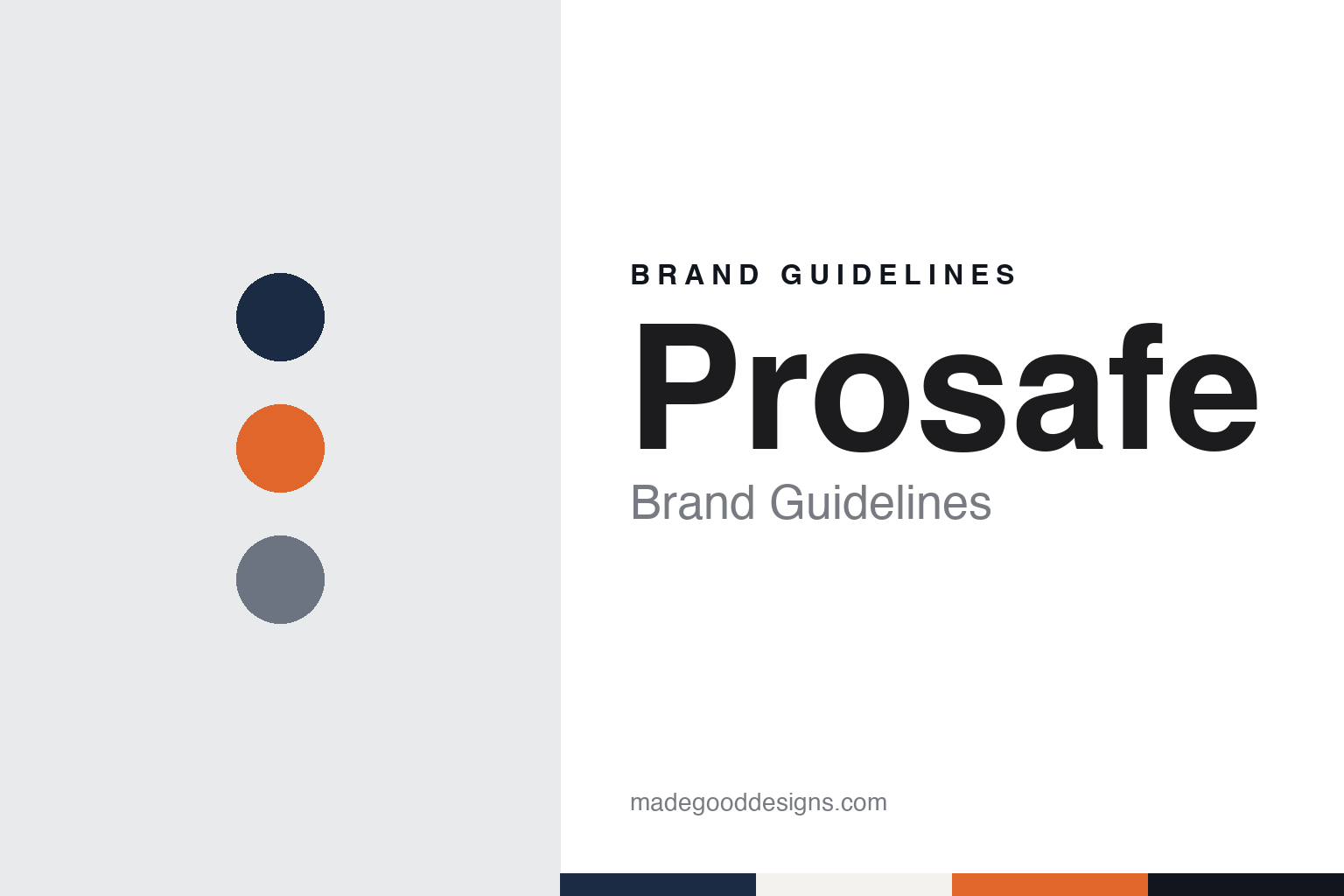
Prosafe Brand Guidelines
Norway’s flotel owner, from Safe Offshore to Safe Eurus.
Aa
Two constants: a North Sea blue, steel grey and signal orange palette and an Industrial sans register. Abstract homage — not a Prosafe vessel or mark; no ship, logo or livery is reproduced.
Safe and Procon
A 1997 merger and a fleet of floating hotels.
Prosafe is a Norwegian company that owns and operates semi-submersible accommodation vessels, the floating hotels, or flotels, that house offshore workers beside oil and gas installations. Its company presentation of January 2026 dates the business to 1997, when Safe Offshore merged with Procon Offshore, a company listed on the Oslo Stock Exchange after a demerger from Transocean. The combined company started, the presentation says, with three accommodation vessels.
The first decade was a period of buying. Between 1997 and 2010, according to the same presentation, Prosafe acquired nine units in several transactions and signed long-term contracts in Mexico for five of them. In 2001 it bought Nontrans Offshore, which added a floating production business; that business was spun off in 2008, leaving Prosafe to concentrate on accommodation. From 2011 it ordered four new vessels with DP3 dynamic positioning, entered Brazil with its first three long-term contracts for Petrobras, and took delivery of Safe Boreas.
The company has used several bases. Its press releases of 2016 were datelined Larnaca, Cyprus, where it then had its headquarters; those of 2020 and 2021 were datelined Stavanger; and its website now names Prosafe SE in Oslo, with offices in Aberdeen, Perth and Rio de Janeiro. The company is listed on the Oslo Stock Exchange under the ticker PRS.
Colour
Five vessels, three regions.
Prosafe’s website lists five vessels in 2026. Four are high-end units with DP3 positioning: Safe Zephyrus (built 2016, 490 beds), Safe Notos (2016, 500 beds) and Safe Eurus (2019, 500 beds), all working for Petrobras off Brazil, and Safe Boreas (2015, 450 beds), which the January 2026 presentation shows on contract with Shell off Australia. The fifth, Safe Caledonia, is a moored unit whose build dates the company gives as 1982, 2004 and 2012; it has worked for Ithaca Energy at the Captain field in the UK North Sea. Two further units, Safe Nova and Safe Vega, built in 2015, appear in the presentation as uncontracted newbuilds still at the yard.
The business is a charter one: oil companies hire a flotel for months or years to house crews during field developments and maintenance campaigns. On 31 August 2026 Safe Notos finished its earlier Petrobras contract and began a new four-year firm period, the company reported in its operational update for that month; Safe Caledonia was then in lay-up at Scapa Flow, in the UK, ahead of a six-month contract with Ithaca Energy.
Older units have gone. In April 2016, Offshore Energy reported, Prosafe decided to scrap three of its oldest flotels, Safe Britannia, Hibernia and Jasminia, built between 1977 and 1982, and to cold-stack others, starting with Safe Astoria. The same report described the conversion of Safe Scandinavia into a tender support vessel at the Westcon yard in Norway for drilling support work for Statoil on the Oseberg Øst installation. In February 2025 the company agreed to sell Safe Concordia, a unit built at Keppel FELS in Singapore in 2005 and upgraded in 2015, Brazil Energy Insight reported; the company presentation lists Safe Concordia as divested in the first quarter of 2025 and Safe Scandinavia, sold for recycling, in the second.
Typography
Design and documentation.
Companies that own and run floating production units rarely sell to the public, so their identities live in a small set of places: the photograph of a unit at sea, the fleet or project page, and the investor section. The unit is usually the hero image. A floating production, storage and offloading vessel, a floating storage unit or a floating LNG design is shown whole, in open water or alongside an integration yard, often as a rendering before the hull exists and as a photograph once it is on station.
Fleet and project pages do much of the identity work. Units are listed by name, field and country, and many names follow a house pattern, so a list of projects reads as a record of where the company has worked. Counts of units in operation, completed projects and years of operating experience are given as dated figures on “at a glance” pages, and they change from year to year as units are sold, redeployed or retired.
Standardised hull programmes have become part of the story. SBM Offshore describes its Fast4Ward programme as a generic new-build hull with a catalogue of topside modules, and its hulls are numbered in sequence, as with the seventh, MPF7, reported by Offshore Energy in 2026. Programmes like this give a company a repeatable product to show, rather than a series of one-off conversions, and the language around them leans on standard designs, modules and delivery schedules as the companies describe them.
The investor pages complete the picture. Annual and integrated reports, results presentations, shareholder lists and financial calendars sit next to newsroom image libraries, and the same unit photographs reappear across them. For a designer, the useful lesson is restraint: a short corporate name, a consistent naming system for assets, and large, plain images of the units themselves carry most of the visual identity.
Aa
An industrial sans for a fleet of named flotels. (Specimen set in Archivo, a sans STAND-IN; NOT the Prosafe logo.)
Prosafe
Three financial rebuilds in a decade.
Prosafe’s recent history is one of repeated financial rebuilding after the offshore downturn that began in 2014. In July 2016 it announced a comprehensive refinancing involving new equity, relief from its banks and the conversion of its unsecured bonds into shares; the company said all steps were completed on 22 September 2016.
In 2019 Prosafe agreed to combine with its rival Floatel International. Norway’s Competition Authority blocked the merger on 28 October 2019, saying it would reduce competition in floating accommodation on the Norwegian shelf, E24 reported in November 2019; Prosafe appealed. On 13 February 2020 Prosafe and Floatel said they had mutually decided to discontinue the merger process.
A full financial restructuring followed. Using schemes in Singapore and a Norwegian restructuring plan, Prosafe converted most of its debt into shares, leaving creditors with about 99 percent of the equity; the company announced on 20 December 2021 that the restructuring was complete. A further recapitalisation was agreed with lenders in April 2025, under which lenders took 90 percent of the shares and a new Norwegian holding company was placed between Prosafe and some of its subsidiaries; the company reported it completed on 21 July 2025. In the fourth quarter of 2025 all five of its vessels earned revenue, the company said, and Safe Boreas had arrived in Australia ahead of its contract there.
Prosafe describes itself as a leading owner and operator of semi-submersible accommodation and construction support vessels. Its public face is mostly its fleet: vessel pages with bed counts, build years and contract status, virtual tours of the vessels, monthly operational updates by unit, and a map showing where each flotel is working.
For a design guide, Prosafe shows how a company that rents out floating hotels presents itself through named vessels and a steady stream of utilisation updates. Compare Petrobras, which charters three of its flotels off Brazil, and Equinor, the former Statoil, for which Safe Scandinavia worked in Norway. For this guide we use a North Sea blue, steel grey and a signal orange with a sans, an unofficial interpretation; no product or logo is reproduced.
Explore & save
Keep Prosafe’s identity on hand — save it to a board in the Made Good inspiration library.
Prosafe identity set
Pin the Prosafe blue, grey and orange palette and the Industrial sans register to your own board.