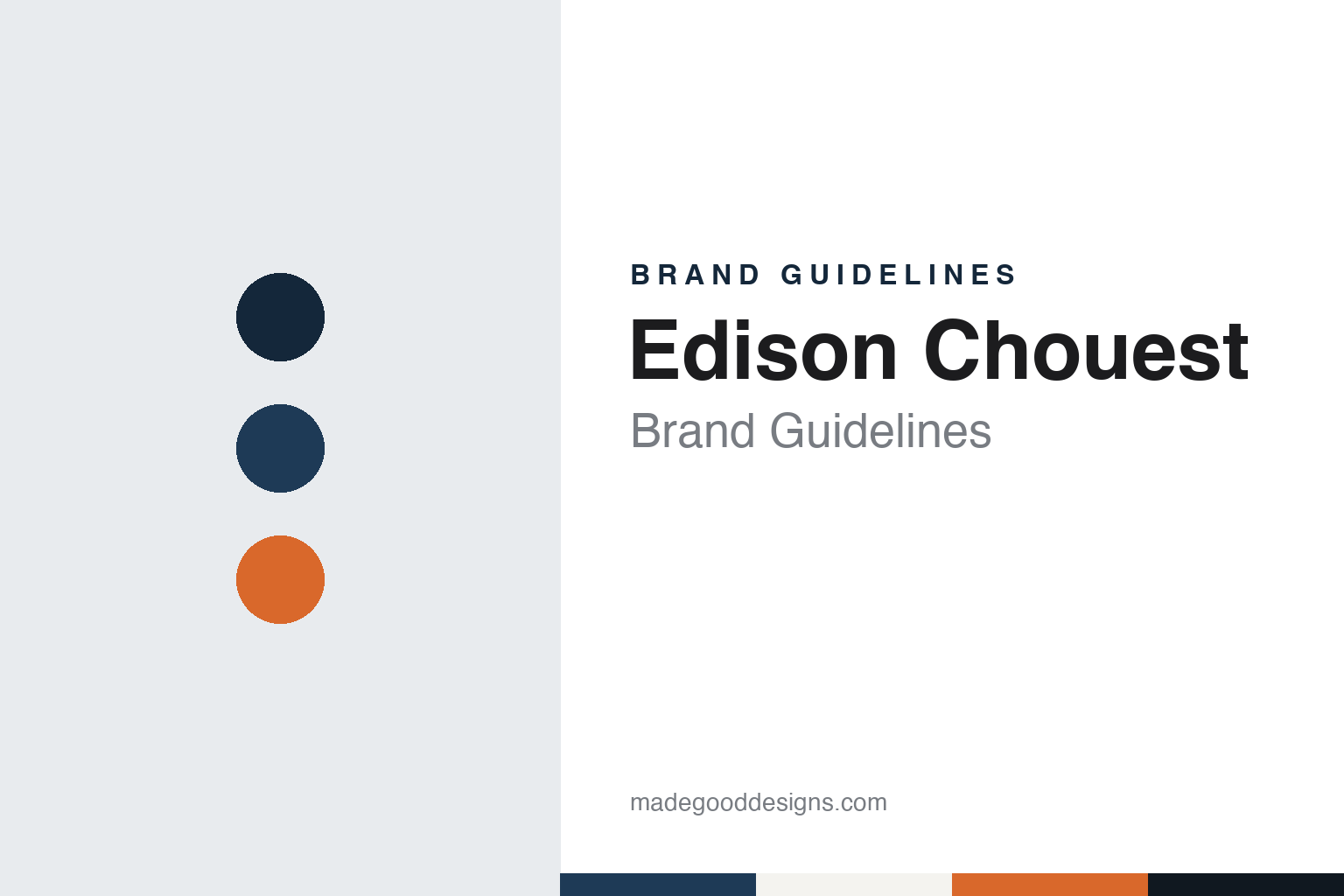
Edison Chouest Brand Guidelines
A Louisiana boat rental that grew into a fleet, its yards and its ports.
Aa
Two constants: a blue, white and orange palette and a workboat sans register. Abstract homage — not an Edison Chouest vessel, livery or mark; no logo or nameplate is reproduced.
Galliano, 1960
A boat rental business on the Louisiana coast.
Edison Chouest Offshore began in 1960 as Edison Chouest Boat Rental in Galliano, Louisiana, the company says on its own history page. English Wikipedia gives the starting name in the plural, Edison Chouest Boat Rentals, and describes ECO as “a family of companies in the marine transportation business” based in Cut Off, Louisiana, where the company’s website also lists its main address. An Associated Press report carried by New Orleans CityBusiness in February 2014 still called the business “Galliano-based.” The group calls itself a family of companies, and its press releases from 2024 to 2026 quote Dino Chouest, named in May 2026 as Executive Vice President of the Chouest Group.
Over the following decades the company moved from renting boats to designing, building and owning them. Its website says the majority of ECO vessels are “designed, engineered and built at Chouest-affiliated shipyards.” The oldest of those yards is North American Shipbuilding in Larose, founded in 1974, according to both the company and English Wikipedia. Later yards include LaShip in Houma, which the company now calls the largest shipyard in the group; Gulf Ship in Gulfport, Mississippi, which the company says opened in 2006 and English Wikipedia dates to 2007; Tampa Ship, a conversion and repair yard in Florida; and Estaleiro Navship in Navegantes, Brazil, which the company says launched its first vessel in 2006. gCaptain reported in June 2025 that ECO operates five commercial shipyards in the United States.
Ports are the third leg. The company says it conceived C-Port at Port Fourchon, Louisiana, in 1996 as a multi-service terminal, and that the three C-Port facilities now hold 24 specialised slips for cargo transfer and vessel support. Nearby it runs Martin Terminal, which it describes as covering more than 75 acres, and C-Terminal, a dock and warehouse site. In Brazil it has opened B-Port, a logistics base and repair yard at the Port of Açu in São João da Barra, in the north of Rio de Janeiro state.
Colour
Supply boats, anchor handlers and subsea work.
The fleet is large, and the company gives more than one figure for it. Its About page describes “well over 200 vessels,” from 87 to more than 525 feet long, while its press releases of May 2024 and March 2025 speak of “nearly 300” and “almost 300” vessels. gCaptain put the figure at 300 offshore support vessels in June 2025.
The company’s own vessel pages sort that fleet by job. Platform supply vessels, which it calls the workhorses of the fleet, carry cargo above and below deck; a 312-foot diesel-electric PSV series is the newest class it shows. Anchor handling towing supply vessels such as the 288-foot Max Chouest tow, moor and supply deepwater rigs. Multi-purpose supply vessels, among them the Holiday and the C-Installer, handle subsea construction, pipe laying and decommissioning support. The list continues with light construction vessels, oil spill response vessels, fast supply boats that the company says reach speeds near 30 knots, specialty vessels and tractor tugs. Vessel names on those pages mix the family name, as in Max Chouest and Carolyn Chouest, with a C- prefix, as in C-Installer and C-Admiral, alongside place names such as Copacabana and Santos Supplier.
Subsea work is handled by C-Innovation, which the company says it created in 2007 to provide remotely operated vehicle services, from inspection and repair to field development. In May 2024 the group announced the purchase of ROVOP, an ROV service company, saying the two businesses together would control more than 100 ROVs and six autonomous underwater vehicles. In March 2025 it added Kystdesign, a Norwegian maker of ROV systems in the Haugaland region, and said its workforce was approaching 20,000 people. Other affiliates listed on its website include Marine Technologies, set up in 2002 for dynamic positioning and integrated bridge systems, and BRAM Offshore, which runs the group’s Brazilian fleet.
Offshore wind is a newer line. In August 2023 the French maritime site Mer et Marine reported that construction of a 12-metre crew transfer vessel to a Chartwell Marine design had begun at ECO’s Louisiana yards, for charter to Ørsted. The same report described the ECO Edison, a 79-metre service operation vessel for the Revolution Wind, South Fork and Sunrise Wind projects of Ørsted and Eversource, as the first such vessel to fly the US flag under the Jones Act, with room for 60 people.
Typography
How offshore support vessel operators present themselves.
Offshore support vessel operators sell a service rather than a product, so their public face is the fleet itself. Their websites lead with photographs of platform supply vessels, anchor-handling tugs, fast crew boats and liftboats as the companies publish them, usually at sea or alongside a quay, with the working deck and the bridge in view.
Behind those photographs sits the fleet list. Operators sort their vessels by type, from supply vessels and anchor handlers to crew boats, liftboats and specialist ships, and give each class a short description, a named example and a length or deck size. Vessel names often run in families, such as a shared prefix, a family surname or a set of animal or place names, and those naming habits become part of how an operator is recognised in port and on charter lists.
Colour plays a similar role. Hull paint, superstructure colour and the mark on the funnel or the side of the bridge are what people see first from a distance, and many operators repeat the same few colours across a whole fleet. In this guide those colours are described in plain words rather than copied, and the palettes shown are our own interpretation.
The rest of an operator’s identity lives in plainer pages: contract and charter news, regional contact lists, sustainability reports and, for listed companies, investor pages with results and presentations. Ownership in the sector has changed often through mergers, restructurings and sales, so each guide sets out who owns the company today, what it says about its fleet, and which facts come from the company and which from independent reports.
Aa
A sturdy workboat sans for a Louisiana fleet. (Specimen set in Archivo, a sans STAND-IN; NOT the Edison Chouest logo.)
Edison Chouest
Buying fleets, yards and services.
Growth has often come through purchases. In February 2014 the Associated Press reported that Edison Chouest had acquired the remaining fleet assets of Bee Mar, a marine transport company based in Broussard, Louisiana: three 270 Class and four 300 Class platform supply vessels then on order at a Bollinger yard in Amelia. In June 2025 gCaptain reported a strategic partnership with the South Korean shipbuilder HD Hyundai, formalised at an ECO office in New Orleans, to build LNG dual-fuel container ships in the United States, a new segment for ECO, with the first medium-sized ship aimed for completion by 2028.
Late-life oilfield work followed. On 1 May 2026 the Chouest Group said it had completed the acquisition of the Alliance business from Helix Energy Solutions Group, folding it into Champagne Energy Solutions, a recently formed group company for offshore decommissioning and plug-and-abandonment work. On 26 October 2026 the group announced a partnership with the founders of Horizon Maritime Services, a harsh-environment marine services company based in St. John’s, Newfoundland, including the acquisition of the business; that deal was announced in October 2026 and not completed at the time of writing. The group says Horizon Maritime will keep its existing management team.
For a design guide, Edison Chouest shows how a family-held workboat company presents a fleet, its shipyards and its ports as one system: each vessel class on its website carries a named example and a length in feet, and the yards that built the boats appear beside them. Compare Tidewater, another offshore vessel operator with Louisiana roots, and SEACOR Marine, an offshore support vessel operator based in Houston. For this guide we use a harbour blue, workboat white and a signal orange with a sans, an unofficial interpretation; no product or logo is reproduced.
Explore & save
Keep Edison Chouest’s identity on hand — save it to a board in the Made Good inspiration library.
Edison Chouest identity set
Pin the Edison Chouest blue, white and orange palette and the workboat sans register to your own board.